The New Patriotic Party (NPP) flagbearer, Dr. Mahamudu Bawumia, has moved decisively to unify the party ahead of the 2028 general elections by appointing all four of his former rivals in the party’s January 2026 presidential primary as co-chairmen of newly established policy committees designed to reposition the NPP as a credible government-in-waiting.
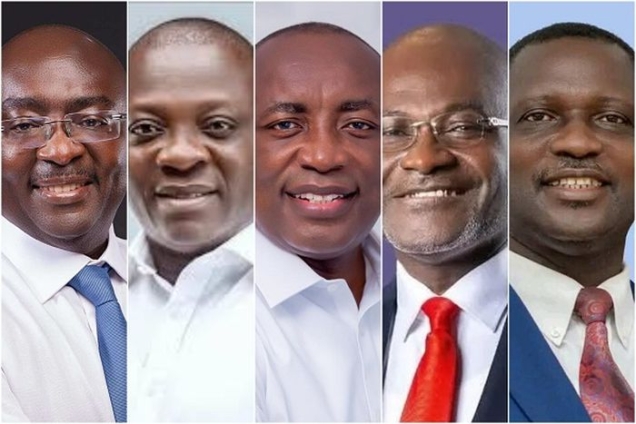
In what political observers describe as a calculated show of unity and strategic inclusion, Dr. Bawumia and the party leadership assigned key policy responsibilities to Kennedy Ohene Agyapong, Bryan Acheampong, Dr. Yaw Osei Adutwum and Kwabena Agyapong, effectively bringing the major blocs within the party under one coordinated policy framework.
The move forms part of a broader restructuring exercise intended to deepen policy development within the opposition party and shift the NPP from what insiders describe as “reactive opposition politics” to a more structured, solution-oriented approach to governance preparation.
At the centre of the new arrangement is the establishment of an extensive policy architecture comprising 30 Standing and Sector Committees tasked with producing evidence-based policy alternatives across critical sectors of Ghana’s economy and governance system.
The initiative, according to the office of the flagbearer, is intended to create a structured, data-driven framework capable of generating credible and costed policy proposals that can be presented to Ghanaians as practical alternatives to the current government.
Party sources said Dr. Bawumia believes the NPP must now move beyond mere criticism of government policies and instead demonstrate preparedness for governance through rigorous policy work backed by research, stakeholder engagement and measurable outcomes.
“Dr. Bawumia wants a party that doesn’t just criticise. He wants a party that can present Ghanaians with a clear, costed and credible alternative at any point in time,” a source close to the flagbearer explained.
The appointments are also widely being interpreted as a deliberate effort to heal post-primary divisions and consolidate party unity after what many described as a fiercely contested internal election.
Ken Agyapong, the outspoken businessman and former Assin Central Member of Parliament who emerged as one of Dr. Bawumia’s strongest challengers during the presidential primary, has been appointed Co-Chairman of the Employment and Jobs Policy Committee.
The assignment aligns closely with Mr. Agyapong’s long-standing advocacy for entrepreneurship, industrialisation and private sector-led job creation.
Over the years, he has consistently argued that Ghana’s unemployment crisis can only be resolved through aggressive support for local enterprise development and expansion of opportunities for young entrepreneurs.
Kwabena Agyapong, former General Secretary of the NPP and another presidential aspirant, has been named Co-Chairman of the Housing and Urban Development Policy Committee.
The portfolio is expected to focus on addressing Ghana’s growing housing deficit, urban planning challenges and infrastructure development concerns affecting both urban and rural communities.
Bryan Acheampong, former Minister for Food and Agriculture and former Minister for the Interior, will co-chair the Defence and Interior Policy Committee, a role many believe fits naturally with his extensive experience in security and governance.
His background in national security and public administration is expected to strengthen the committee’s work on issues relating to internal security, intelligence, policing and national resilience.
Dr. Yaw Osei Adutwum, former Minister for Education and internationally recognised education reform advocate, has been appointed Co-Chairman of the Education Policy Committee.
His appointment is expected to reinforce the NPP’s policy direction on education reform, skills development, science and technology education, and human capital development.
Observers say the inclusion of all four former rivals sends a strong signal that Dr. Bawumia is seeking to build a broad-based coalition within the party rather than operate through factional dominance.
According to analysts, each of the appointed co-chairmen commands considerable political influence and grassroots support within the NPP.
By integrating them into a shared policy platform, Dr. Bawumia is effectively consolidating various internal constituencies into a united organisational structure ahead of the next national election cycle.
At the apex of the new structure is the NPP Policy Committee, chaired by former Information Minister and Member of Parliament for Ofoase-Ayirebi, Kojo Oppong Nkrumah.
Widely regarded as one of the party’s leading policy communicators and strategists, Mr. Oppong Nkrumah is expected to provide intellectual leadership and policy coordination across the various committees.
Serving as Secretary to the Committee is Dr. Kwasi Nyame Baafi, whose technocratic background is expected to bring administrative discipline and research depth to the operations of the policy structure.
The overarching committee will supervise a broad range of subcommittees covering sectors such as employment, energy, roads and transport, decentralisation and local governance, education, health, land and natural resources, economy and finance, communications, constitutional and legal affairs, research and several other thematic areas.
Each committee is expected to conduct independent research, engage industry experts and stakeholders, and develop evidence-based policy proposals for consideration by the party leadership and eventual approval by the flagbearer.
The NPP said the establishment of the committees follows decisions taken by the party’s National Executive Committee and National Council in accordance with Articles 10(2)(6), 10(3)(8) and 14(5) of the party’s constitution.
In a statement signed by the General Secretary of the party, Justin Kodua Frimpong, the NPP explained that the committees form part of ongoing efforts to strengthen internal structures, deepen stakeholder engagement and reposition the party for effective political organisation and future governance.
The party also expressed confidence in the ability of the appointed members to discharge their responsibilities diligently and in the broader national interest.
Political observers say the establishment of the committees marks a major transition in the NPP’s opposition strategy.
Rather than relying solely on political rhetoric and criticism of government policies, the party appears to be positioning itself as a policy-driven alternative government capable of presenting detailed and technically grounded solutions to Ghana’s economic and governance challenges.
Analysts also believe the initiative could help the NPP reconnect with middle-class voters, professionals and policy-oriented constituencies who increasingly demand substance and clarity from political parties.