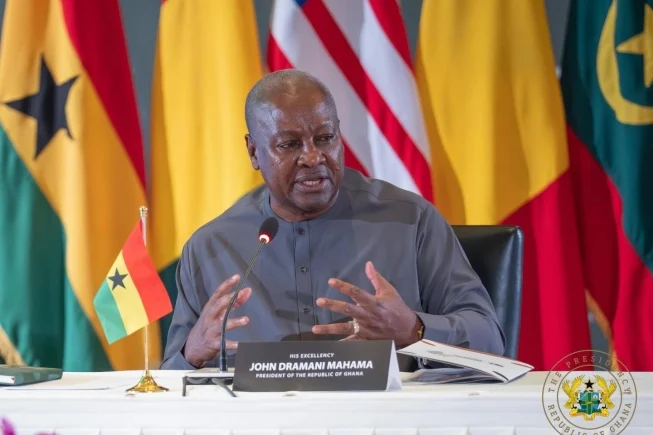
President John Dramani Mahama has called for collective regional action to address the security, economic and social challenges that have made West Africa vulnerable to terrorism and violent extremism.
He stressed that no single country could achieve peace and prosperity on its own, underscoring the need for cooperation among West African states to ensure regional stability and shared growth.
Speaking at a high-level Consultative Conference on Regional Cooperation and Security in Accra last Friday (January 30, 2025), President Mahama urged regional leaders to confront prevailing realities honestly, rebuild trust in public institutions and work towards inclusive, resilient and forward-looking societies.
He referenced the recent terrorist attack at the Niamey airport in Niger on Wednesday (January 28, 2026) as a stark reminder of the existential threat posed by terrorism and violent extremism across the sub-region.
President Mahama advocated the establishment of a new framework for regional cooperation that would address shared security threats while respecting the sovereignty and political choices of all West African nations.
The conference, which began with meetings of senior officials and ministers, culminated in a summit attended by the Presidents of Liberia, Joseph Nyuma Boakai, and Sierra Leone, Julius Maada Bio.
Interconnected threats
President Mahama highlighted the deep interconnectedness of West African countries through shared history, culture and economic ties, noting that threats such as terrorism, violent extremism and climate change required a unified response.
He explained that progress in one country strengthened the entire region, while instability in any state had ripple effects across borders, making isolated approaches to peace and security unrealistic and unsustainable.
According to him, West Africa was more than a collection of neighbouring states, describing it as a closely linked community shaped by centuries of trade, migration and cultural exchange.
Rebuilding trust
President Mahama observed that weakened trust, which had contributed to the withdrawal of some countries from ECOWAS, had undermined effective regional responses to shared challenges.
He noted that terrorism, transnational organised crime, unconstitutional changes of government, youth unemployment and climate-induced vulnerabilities interacted in ways that strained national institutions and tested regional solidarity.
These complex challenges, he said, required a shift from traditional state-centric responses towards a broader human security approach, preventive diplomacy and collective resilience—principles already embedded in the ECOWAS security framework.
Call for unity
In his address, the President of Sierra Leone and Chairman of ECOWAS, Julius Maada Bio, reaffirmed the need for a unified regional response to terrorism, noting that more than half of global terrorism-related deaths occurred in West Africa.
President Bio stressed that fragmentation was no longer acceptable and called for stronger intelligence sharing, logistics and surveillance, while emphasising that military action alone was insufficient.
He advocated governance reforms, inclusive development and expanded economic opportunities to address the root causes of terrorism, including poverty, hunger and weak social systems.
Commitment to cooperation
Liberian President Joseph Boakai reaffirmed his country’s commitment to regional cooperation, citing Liberia’s own experience with the devastating effects of violent conflict.
He urged West African leaders to strengthen regional mechanisms, mobilise resources and tackle socio-economic challenges such as youth unemployment and drug abuse.
As a non-permanent member of the UN Security Council, President Boakai said Liberia would continue to advocate a regional approach to peace-building and security, with a focus on dismantling terrorist networks and their support systems.