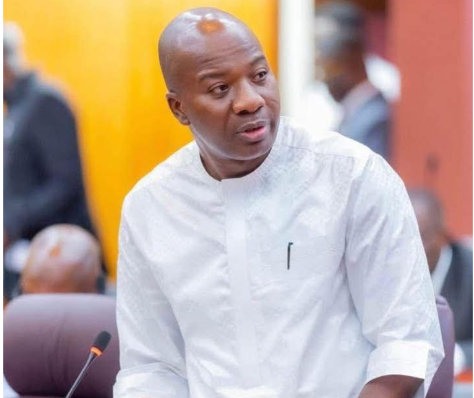
The Majority Leader in Parliament, Mahama Ayariga, has accused cocoa farmers demonstrating across parts of the country of being politically engineered rather than representing a genuine expression of grassroots frustration.
Speaking during a charged sitting of Parliament on Friday, February 20, 2026, Mr Ayariga dismissed the protests that have swept through key cocoa-growing areas as calculated “political theatre” designed to discredit the government.
According to him, the unrest in Sefwi Wiawso, Juaboso, Bia West and other communities should not be mistaken for widespread dissatisfaction among genuine cocoa farmers.
His comments come amid mounting anger over the government’s decision to reduce the cocoa producer price from GH¢3,625 to GH¢2,587 per 64kg bag for the remainder of the 2025/2026 crop season — a 28% cut that many farmers have described as devastating.
The reduction contrasts sharply with campaign promises by the governing National Democratic Congress (NDC), which had pledged to improve cocoa prices, with some expectations among farmers of figures between GH¢6,000 and GH¢7,000 per bag.
Protests spread across cocoa belts
Hundreds of cocoa farmers in the Western North Region picketed at the offices of the Ghana Cocoa Board (COCOBOD) on Friday, demanding a reversal of the price cut.
Similar demonstrations were recorded in parts of the Central and Ashanti Regions, underscoring the depth of frustration within cocoa-growing communities.
In Sefwi-Wiawso and surrounding districts, including Bekwai, Asunafo and Amenfi, demonstrators marched through principal streets carrying placards bearing messages such as “Save the Cocoa Farmer” and “Our Labour Deserves Better Pay.”
The protests, largely peaceful, drew elderly farmers, women actively engaged in cocoa cultivation and young growers who expressed disappointment over what they described as broken promises.
In the Assin North District of the Central Region, farmers from Assin Dansame, Asempanaye, Praso, Bereku and Assin Nuaso also staged a peaceful protest.
In Adomfe, in the Asante Akyem area, a demonstration caused temporary traffic disruptions, prompting security personnel to be deployed to maintain order.
Across these communities, farmers cited rising production costs as a major source of concern.
They pointed to high prices of fertilisers, agrochemicals, hired labour and transportation, arguing that the reduced farmgate price makes it increasingly difficult to sustain cocoa farming as a viable livelihood.
Some warned that if the situation is not urgently reviewed, many smallholder farmers may abandon their farms, potentially reducing national output and affecting Ghana’s status as one of the world’s leading cocoa producers.
Others expressed fears that the lower price could encourage smuggling of cocoa beans to neighbouring Côte d’Ivoire, where farmgate prices are perceived to be more stable.
“Not the real cocoa farmers”
Despite the visible demonstrations, Mr Ayariga insisted in Parliament that the protests do not reflect the views of the core cocoa-growing community.
“Just because you think that cocoa politics is what can help your party, I can assure you that the demonstrators… we know their real motivation,” he told the Minority caucus.
Placards displayed during some of the protests sharply criticised President John Dramani Mahama, accusing the administration of betraying cocoa farmers.
However, the Majority Leader argued that the optics of the marches should not be interpreted as broad-based rural anger.
According to him, genuine farmers understand the economic constraints confronting the country and appreciate what he described as the difficult but necessary decisions being taken by the government.
Govt cites financial realities
The government maintains that the downward adjustment in producer prices is an economic necessity aimed at safeguarding the long-term sustainability of COCOBOD.
Mr Ayariga told the House that COCOBOD is burdened with significant liabilities inherited from the previous New Patriotic Party (NPP) administration.
He described the situation as a “financial wreckage” compounded by falling global cocoa prices and operational challenges, including a reported 50,000-tonne backlog at the ports.
“You cannot give what you don’t have, even if you promised it. The practical problem is there. The farmer appreciates it, and I can assure you that the farmer appreciates the solution proposed by government,” he stated.
Government officials argue that maintaining the previous price level in the face of declining international prices would have further strained COCOBOD’s finances and potentially pushed the institution toward collapse.
They insist that the revision is intended to stabilise the sector and prevent deeper structural problems.
Farmers reject govt position
On the ground, however, many farmers dispute the assertion that they understand or accept the government’s explanation.
Demonstrators in Bia West and Juaboso warned that the price cut, combined with inflation and rising input costs, threatens their survival.
Some described the reduction as a “death sentence” for smallholder farmers who operate on narrow margins and depend heavily on cocoa proceeds to support their families.
They argue that while global market conditions may be challenging, the burden of adjustment appears to be falling disproportionately on farmers, who are already grappling with climate-related risks and fluctuating yields.
The protests underscore the central role cocoa plays in rural livelihoods and the sensitivity surrounding producer pricing decisions.
Thousands of families depend on cocoa farming for their survival, making any adjustment to producer prices politically and economically significant.
Political undercurrents
The cocoa price controversy is increasingly taking on a political dimension.
By characterising the protests as partisan manoeuvring, Mr Ayariga has framed the issue as a contest over political influence rather than solely an economic dispute.
His remarks suggest that the government believes opposition elements are exploiting the situation to gain political mileage in cocoa-growing regions that are often electorally strategic.
The Minority, however, has accused the government of insensitivity and of failing to protect farmers from the full impact of economic adjustment measures.
They argue that cocoa farmers, as key contributors to national revenue, deserve better protection and more transparent engagement.
A growing trust gap
As Parliament continues to debate the issue, tensions remain high in cocoa-producing areas, particularly in the Western North Region.
While the government insists that the price cut is a necessary step to stabilise COCOBOD and preserve the sector’s long-term viability, visible anger among segments of the farming community points to a widening trust gap.
The unfolding situation highlights the delicate balancing act facing policymakers — managing fiscal constraints and global market realities while maintaining social cohesion in rural communities heavily dependent on cocoa farming.
For now, the Majority Leader remains confident that what he calls the “real farmers” will ultimately understand and accept the government’s position.
Yet the scenes in Sefwi Wiawso, Juaboso and other cocoa belts suggest that the debate over cocoa pricing — and the politics surrounding it — is far from settled