
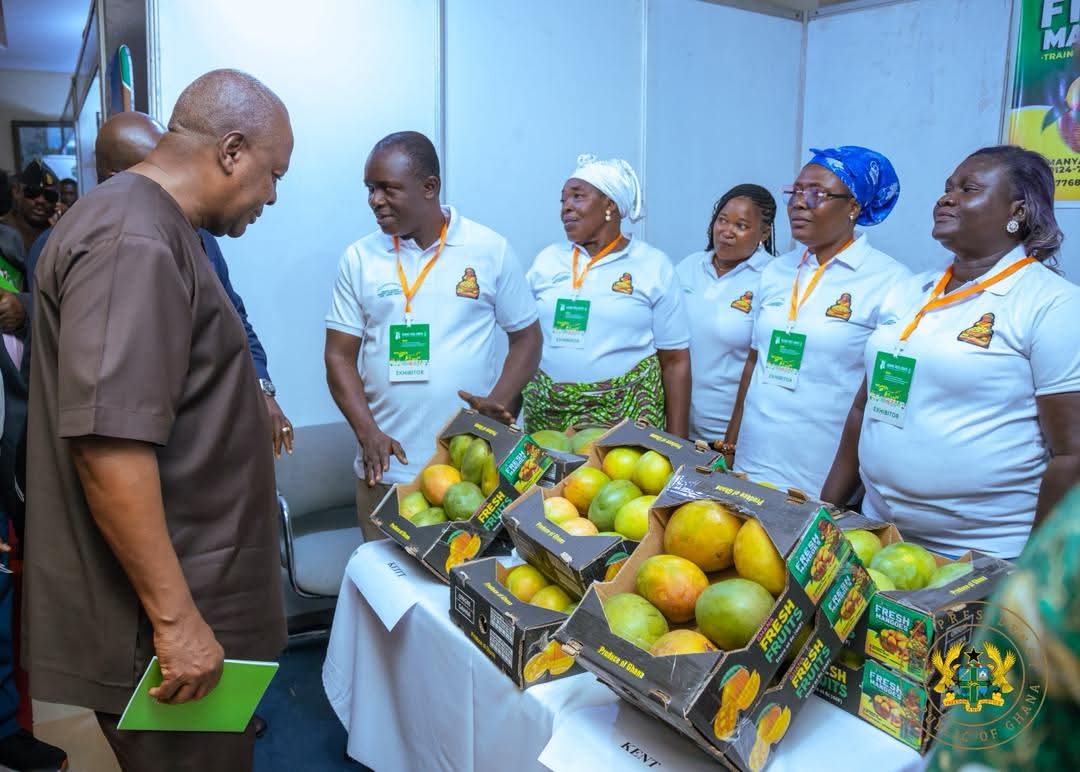
President John Dramani Mahama has declared that Ghana will no longer export raw cashew nuts, signalling a major policy shift aimed at deepening value addition, boosting industrialisation and retaining more wealth within the country.
Speaking at the official opening of the Ghana Tree Crops Investment Summit 2026 in Accra, the President made it clear that the era of exporting raw agricultural commodities while importing finished products at higher prices must come to an end.
“I want to travel and be able to buy cashew and see produce of Ghana, not produce of India or produce of some third-party country,” President Mahama stated.
“We will no longer export raw cashew, raw shea nuts or unprocessed rubber; while we import the same finished products at higher prices.”
His pronouncement was met with applause from stakeholders in the tree crops sector, who see the directive as a bold move to reposition Ghana within the global agricultural value chain.
Value addition at the centre of policy shift
President Mahama appealed to investors and players in the cashew industry to take advantage of the new policy direction by investing in processing factories to add value before export.
The Tree Crops sector, which encompasses coconut, oil palm, cashew, shea, mango and rubber, has long been identified as a high-potential area for economic diversification and job creation.
However, the bulk of exports have traditionally been in raw form, limiting earnings and industrial growth.
Under the new strategy, government is targeting 50–60 per cent local processing annually.
The policy also includes the expansion of agro-industrial parks, incentives for private sector processors, and stronger regulatory oversight through the Tree Crops Development Authority.
The President emphasised that agriculture must be modern, profitable and attractive to young people.
He stressed that Ghana cannot continue to export jobs and industrial opportunities to other countries.
Red gold policy and oil palm ambitions
President Mahama reiterated government’s commitment under the National Policy on Integrated Oil-Palm Development, popularly known as the Red Gold policy.
He announced plans to invest $500 million to develop 100,000 hectares of oil palm and create 250,000 direct jobs.
“If we achieve this target, it will eliminate the 40 per cent oil palm imports from other areas and make Ghana a net exporter of oil palm,” he said.
The President noted that this initiative is consistent with government’s pledge to scale up high-impact agricultural value chains with strong private sector participation.
Empowering women and youth through tree crops
A key pillar of the strategy is inclusive growth. President Mahama underscored the importance of empowering women and young people through agricultural value chains.
He observed that women processors already dominate the shea industry, while cashew and mango offer strong opportunities for youth engagement in agribusiness.
Coconut and oil palm, he added, create substantial processing and logistical employment.
Through improved seedlings, farmers’ hubs, access to finance and matching grants for small and medium enterprises, government intends to build inclusive and resilient value chains.
“Agriculture must be modern, it must be profitable, and it must be attractive to young people,” the President stressed.
Tree crops and Ghana’s green economy
The summit, held under the theme “Sustainable Growth Through Tree Crop Investments: Resetting and Building Ghana’s Green Economy,” placed sustainability at the forefront of Ghana’s development agenda.
President Mahama described tree crops as climate-positive assets, explaining that they enhance carbon sequestration, reduce soil degradation, promote biodiversity and strengthen climate resilience.
He noted that the tree crops strategy is designed to support both economic and ecological transformation, positioning Ghana as a leader in green growth on the continent.
ACP targets 85,000 metric tons processing
In a related development, the Association of Cashew Processors, Ghana (ACPG) has unveiled plans to process 85,000 metric tons of cashew annually by 2026.
The ambitious target follows a comprehensive survey of processing facilities in Ghana’s Middle Belt region, including Techiman and Sunyani, where industry leaders assessed operations and identified key growth constraints.
The expansion plan is seen as a significant step toward establishing Ghana as a major player in West Africa’s growing value-added cashew industry.
However, the processing sector faces considerable headwinds. Cashew production dropped by 30% in 2024, while processors continue to grapple with irregular raw material supply, fluctuating prices, high operating costs and limited access to affordable financing.
Competition from raw nut exporters often leaves local processors struggling to secure adequate supplies at competitive prices.
Untapped continental potential
West Africa produces approximately 2.1 million tons of cashew annually, accounting for 57% of global raw cashew production. Yet Africa processes less than 15% of its yield, with the majority exported to Asia for value addition.
Although regional processing capacity has improved from 8 per cent to 25% in recent years, the industry remains in its infancy compared to established Asian processing hubs.
Ghana’s cashew exports were valued at over $300 million in 2022, reflecting strong international demand.
More than 90% of Ghana’s cashews are classified as Grade A quality, giving the country a competitive advantage in premium markets.
Africa’s cashew market, valued at $856 million in 2024, is projected to reach $1.19 billion by 2033, driven by increasing global demand for healthy snack alternatives.
Coordinated effort required
Achieving the 85,000-metric-ton processing target and meeting government’s 50–60 per cent local processing goal will require coordinated action among government agencies, development partners and private sector stakeholders.
Addressing financing gaps, strengthening supply chains, stabilising raw material availability and promoting technological adoption will be critical to unlocking the sector’s full potential.
President Mahama’s policy directive signals a decisive break from Ghana’s long-standing dependence on raw commodity exports.
If successfully implemented, it could transform the tree crops sector into a powerful engine of industrialisation, job creation and green economic growth.

