President John Dramani Mahama has intensified engagement with organised labour over far-reaching reforms in Ghana’s power sector, urging workers to back government’s plan to introduce private sector participation in selected operations of the Electricity Company of Ghana (ECG), while labour unions push back, warning against what they describe as a premature and potentially disruptive shift.
Assurance against privatisation, job losses
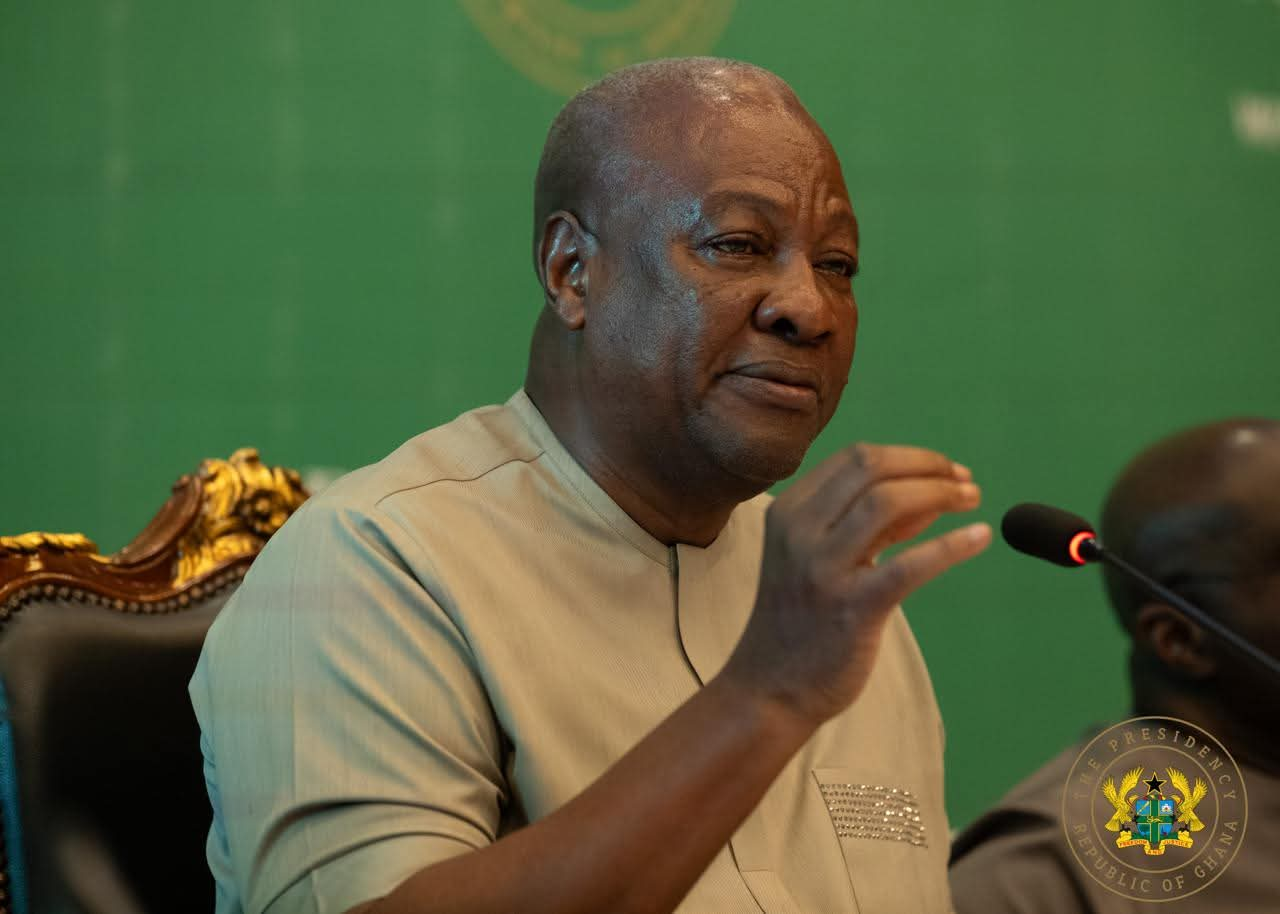
At a high-level meeting with union leaders at Jubilee House in Accra, President Mahama sought to allay fears over the proposed reforms, insisting that the initiative would not amount to privatisation of ECG nor lead to job losses.
Instead, he framed the policy as a targeted intervention aimed at addressing deep-seated inefficiencies in billing and metering systems—areas widely seen as critical leakages undermining the financial health of the power distributor.
“ECG is not going to be privatised, nobody will lose jobs because of private sector participation,” the President emphasised, drawing a clear distinction between outright divestiture and what he described as a limited operational partnership.
He explained that under the proposed model, ECG would remain the owner and supplier of electricity, while private firms would be contracted to handle billing and metering functions under strict accountability arrangements.
“ECG will sell the electricity to the private sector and say we’ve given you this amount of electricity, pay us,” he said. “ECG will get its money, pay its employees, but the private sector would be responsible for billing and metering…for emphasis, it is not privatisation of ECG.”
Billing inefficiencies and financial strain
The President argued that persistent inefficiencies in these operational segments have significantly weakened ECG’s revenue mobilisation capacity, with ripple effects across the entire energy value chain.
According to him, the inability to accurately meter consumption and collect revenue has constrained the company’s capacity to improve wages, enhance working conditions and extend social protection for its workforce.
He placed the proposed reforms within the broader context of Ghana’s long-running energy sector financial crisis, disclosing that government spent US$1.57 billion in 2025 alone to clear legacy debts.
Over a nine-year period, he noted, nearly US$8 billion has been injected into the sector to stabilise operations and address accumulated liabilities.
Call for labour backing on structural reforms
President Mahama stressed that the proposed “new institutional architecture” for ECG is intended not as an anti-labour measure but as a long-term stabilisation strategy.
“This reform is not designed against labour, it is designed with labour and for the long-term stability of Ghana’s public sector compensation system,” he said, calling on unions to support the initiative as a pathway to sustaining jobs rather than threatening them.
Pension system under pressure
Beyond the energy sector, the President broadened the discussion to encompass structural issues in Ghana’s wage and pension systems—areas that have long been at the centre of organised labour’s advocacy.
He acknowledged that pension coverage remains critically low, revealing that pension assets currently stand at about GH¢100 billion, representing just seven per cent of Gross Domestic Product.
“Less than two million workers out of the 10 million are contributing to pensions regularly,” he said, warning that failure to act would deepen the imbalance between contributors and retirees and threaten the sustainability of the system.
To address these concerns, he said the Ministry of Finance had been tasked to review the pension framework, expand coverage within the informal sector, modernise contribution systems and strengthen governance and investment management.
“Our goal is clear—every Ghanaian worker must retire with dignity, security and confidence in the pension system,” he added.
Union resistance to private sector participation
However, even as the President sought to build consensus, resistance from organised labour—particularly within the power sector—has exposed deep-seated mistrust over private sector involvement in state-owned enterprises.
The Public Utility Workers’ Union (PUWU) of the Trades Union Congress (TUC) has mounted strong opposition to reports that government intends to appoint a transaction adviser as a precursor to private sector participation.
The Union described the move as “hasty, premature and potentially disruptive,” especially given an ongoing internal turnaround programme at ECG.
Turnaround delivering results
According to PUWU, the recovery programme was developed through extensive consultations with the Ministry of Energy and Green Transition and designed to restore ECG’s viability through internal reforms, improved operational efficiency and strengthened management systems—without resorting to privatisation.
The Union emphasised that the programme is being jointly implemented by ECG management and staff with clearly defined deliverables and timelines, warning that any external intervention could derail progress.
PUWU disclosed that workers had demonstrated exceptional commitment to the reform agenda, leading to improved revenue collection, reduced system losses and more stable electricity supply across parts of the country.
Recognition from top govt officials
The Union noted that these gains have been acknowledged at the highest levels of government, citing commendations from Finance Minister Cassiel Ato Forson, Majority Leader Mahama Ayariga and Energy Minister John Abdulai Jinapor.
In its view, these improvements demonstrate that ECG can be revived through local expertise and worker commitment without transferring operational control to private entities.
Concerns over external interests and transparency
PUWU also raised concerns about the lack of clarity surrounding the proposed transaction, questioning the rationale for introducing external actors when many operational challenges are already being addressed internally.
The Union warned that the move could open the door to external interests seeking to control a strategic national asset, potentially at the expense of the Ghanaian public.
Labour’s long-standing position
At the heart of organised labour’s resistance is a long-standing position that public sector challenges should be addressed through institutional strengthening, improved governance and accountability rather than private sector control.
Labour unions argue that reforms must prioritise public ownership, protect jobs and ensure that essential services remain accessible and affordable.
Past experiences, they contend, have shown that private sector participation does not always translate into improved outcomes for workers or consumers.
Call for suspension and broader consultation
Reaffirming its stance, PUWU called on government to immediately halt all processes toward private sector participation in ECG, allow the existing turnaround programme to run its full course and conduct an objective evaluation of its outcomes.
The Union stressed that any decision affecting ECG must be guided by transparency, due process and broad stakeholder consultation, including workers and consumers.
A delicate policy balancing act
The unfolding debate highlights a delicate balancing act for government—restoring financial stability in the energy sector while maintaining labour trust and protecting public ownership of critical infrastructure.
With billions already spent on stabilising the sector and fiscal pressures mounting, the outcome of this engagement is expected to shape not only the future of ECG but also the broader direction of public sector reforms in Ghana.