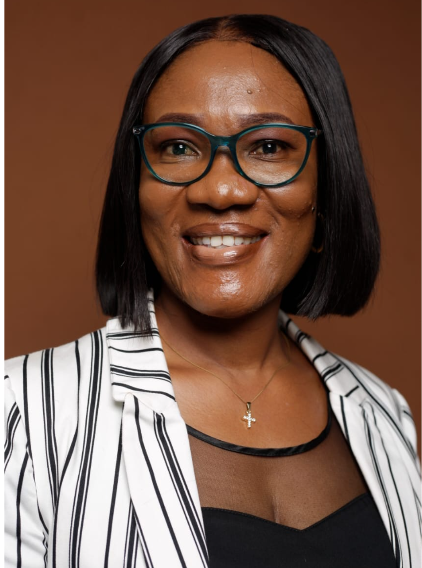
Chief Executive Officer of Serene Insurance and Second Vice-President and Chairman of the Ghana Insurers Association (GIA), Mercy Naa Koshie Boampong, has mounted a strong defence of the capacity of local insurance companies to underwrite marine and aviation cargo risks.
She assured importers and regulators that Ghana’s insurers are well-equipped to safeguard the country’s import trade for the long term.
Her comments come at a critical moment as government intensifies enforcement of compulsory domestic marine cargo insurance for all commercial imports.
The renewed push, which takes effect from February 1, 2026, is expected to redirect millions of dollars in premiums back into the local economy and significantly deepen Ghana’s insurance market.
Speaking in her dual capacity as an industry leader and CEO of Serene Insurance, Mrs. Boampong dismissed suggestions that local insurers lack the technical and financial strength to handle large-scale marine risks.
She described marine cargo insurance as a mature and well-established class of business within Ghana’s insurance industry, not a new product being introduced merely because of enforcement.
“Marine cargo insurance is not a new product being introduced because of enforcement,” she stated. “It is a mature class of business in Ghana. At Serene Insurance, we have the structures, systems and expertise to handle complex and high-value cargo risks, just as the industry has done for decades.”
She explained that Serene Insurance is financially sound and technically prepared to support Ghana’s import trade through comprehensive marine cargo cover.
According to her, the capacity of local insurers is built on strong capital bases, experienced underwriting teams and structured access to international reinsurance markets.
Mrs. Boampong stressed that every risk underwritten locally is backed by reinsurance arrangements that spread exposure across global markets.
Through reinsurance and retrocession mechanisms, Ghanaian insurers are able to share risks with international partners, ensuring that even high-value claims can be settled without difficulty.
“Every risk underwritten locally is supported by reinsurance,” she noted, emphasising that this global risk-sharing framework provides an added layer of security for importers and the broader economy.
She further observed that Ghana’s insurance industry currently has significant unused underwriting capacity.
This underutilisation, she said, is largely the result of importers continuing to insure cargo offshore, despite the existence of a local insurance requirement since 2006.
“With renewed enforcement, that capacity can now be put to use to protect Ghanaian importers, while keeping premium income within the local economy,” she said.
The enforcement directive is being implemented under Section 222 of the Insurance Act, 2021 (Act 1061).
It is being coordinated by the Ministry of Finance in collaboration with the Bank of Ghana, the National Insurance Commission (NIC) and the Ghana Revenue Authority (GRA).
Data from the NIC indicate that only about six percent of Ghana’s imports are currently insured locally, even though the legal requirement has been in place for nearly two decades.
According to the GIA, close to US$100 million in marine insurance premiums is paid annually to foreign insurers.
Industry stakeholders argue that these funds could otherwise be retained within Ghana to strengthen domestic investment, create jobs and deepen financial sector development.
Mrs. Boampong described the renewed enforcement as a significant opportunity to reposition Ghana’s insurance industry. Beyond premium retention, she said the policy would contribute to building stronger domestic institutions capable of supporting national development.
“The Ghanaian Insurance Industry is ready. Serene Insurance is ready,” she declared. “The structures, expertise and financial backing are already in place.”
The scale of the opportunity is underscored by Ghana’s import volumes.
In 2024 alone, the country handled an estimated 13.7 million metric tonnes of cargo through its ports, with merchandise imports valued at approximately US$15.2 billion.
These imports include refined petroleum products, grains, edible oils, frozen foods and heavy machinery — all of which require comprehensive marine cargo cover.
Daniel F. Yeboah, Head of Insurance and Pensions at the Ministry of Finance, recently indicated that full implementation of the policy could generate nearly GH₵300 million annually for the local insurance industry.
Speaking at a stakeholder engagement organised by the Ghana Chamber of Shipping, he acknowledged that implementation has been slow over the years but stressed the need for decisive action.
“Over the years, it has been recognised that this policy must be fully rolled out so that the country can derive its full benefits,” Mr. Yeboah said.