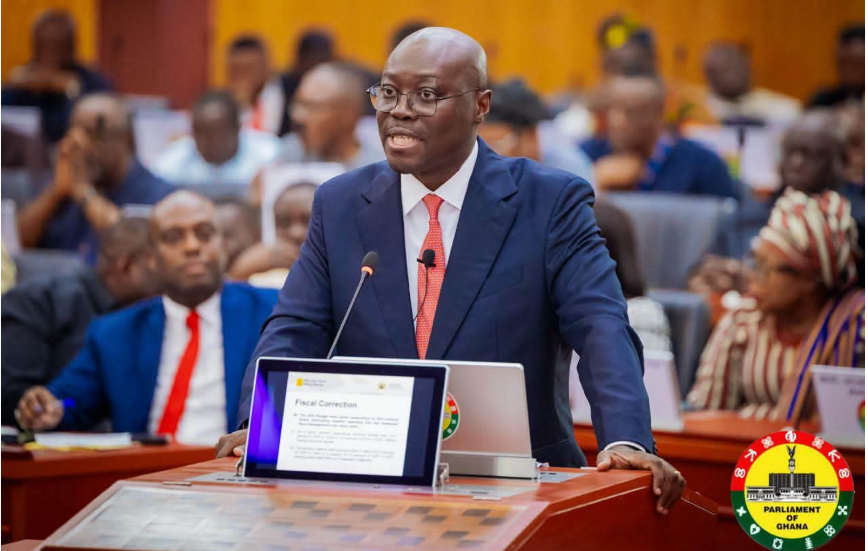
Government cut public spending by GH¢35.6 billion in the first half of 2026, significantly undershooting its expenditure target as it pursued an aggressive fiscal consolidation programme that Finance Minister Dr Cassiel Ato Forson said has delivered Ghana’s strongest fiscal performance in many years.
Presenting the 2026 Mid-Year Fiscal Policy Review in Parliament, he said total expenditure on a cash basis stood at GH¢136.9 billion at the end of June 2026, well below the half-year target of GH¢172.5 billion, reflecting a substantial reduction in government spending.
The sharp expenditure restraint comes alongside a slight revenue shortfall, with total revenue and grants amounting to GH¢124.8 billion, marginally below the target of GH¢126.1 billion.
While the spending cuts have strengthened the government’s fiscal position and reduced borrowing needs, economists say restrained public expenditure—particularly on government consumption and investment—could moderate economic activity in the short term by slowing demand across sectors dependent on public spending.
Dr Forson, however, maintained that the expenditure reductions were the result of deliberate policy choices rather than fiscal distress.
“This performance reflects the resolve of this Administration to make difficult decisions, implement them consistently and maintain unwavering fiscal discipline,” he said.
Expenditure falls sharply
Government’s expenditure on a commitment basis reached 8% of GDP, substantially below the half-year target of 9.9 % of GDP.
Primary expenditure—excluding interest payments—also declined to 6.6 % of GDP, compared with the target of 8.1%, reflecting tighter controls on discretionary spending.
Interest costs equally declined, falling to 1.3 % of GDP against the programmed 1.8 %, largely due to declining interest rates and improved debt management following recent debt restructuring efforts.
The lower interest burden translated into substantial budgetary savings.
Total interest payments amounted to GH¢21.5 billion, against a target of GH¢28.4 billion, generating savings of GH¢6.9 billion.
Domestic interest payments came to GH¢20.4 billion, compared with the projected GH¢24.6 billion, resulting in savings of GH¢4.2 billion.
External interest payments also fell sharply to GH¢1.1 billion, significantly below the target of GH¢3.9 billion, yielding additional savings of GH¢2.8 billion.
Dr Forson attributed the lower debt service costs to improved debt management and favourable financing conditions.
Revenue remains broadly on course
Despite the slight revenue shortfall, government collections remained largely resilient.
Total revenue and grants reached 7.8 % of GDP, just below the programmed 7.9 %, while domestic revenue stood at 7.7 % of GDP, compared to the target of 7.8 %.
Non-oil tax revenue reached 6.4 % of GDP, narrowly missing the target of 6.5 %.
A major bright spot came from taxes on income and property.
Collections reached GH¢57.5 billion, exceeding the target of GH¢53.2 billion by GH¢4.3 billion.
According to Dr Forson, company income taxes improved significantly as businesses benefited from falling interest rates and continued stability of the cedi, boosting corporate profitability.
However, oil revenues disappointed.
Receipts from upstream oil and gas activities amounted to GH¢6.3 billion, far below the half-year target of GH¢9.1 billion, reflecting weaker-than-expected petroleum receipts.
Non-oil non-tax revenue also underperformed slightly, reaching GH¢9.8 billion, compared to the target of GH¢11.0 billion.
Energy levy cushions revenue
One of government’s strongest revenue performers was the Energy Sector Levy.
Collections amounted to GH¢7.7 billion, comfortably surpassing the half-year target of GH¢4.2 billion.
The Finance Minister attributed the over-performance largely to strong collections from the Energy Debt Recovery Levy, which is now generating at least GH¢1 billion every month.
The additional revenues are expected to support ongoing efforts to address legacy debts within the energy sector.
Payroll controls reduce wage bill
Government also recorded savings on employee compensation.
Compensation of employees totalled GH¢42.9 billion, below the target of GH¢45.4 billion.
Within this amount, wages and salaries stood at GH¢38.5 billion, compared to the projected GH¢40.7 billion.
Dr Forson said the reduction reflects tighter payroll management, including the elimination of ghost names and unauthorised allowances that had inflated the public sector wage bill for years.
Goods and services expenditure amounted to GH¢6.3 billion, slightly below the target of GH¢6.6 billion.
Legacy energy sector shortfall payments reached GH¢6.9 billion, compared with a target of GH¢8.2 billion.
Capital spending maintained
Despite the overall expenditure cuts, government maintained relatively strong investment spending.
Capital expenditure totalled GH¢22.2 billion during the first half of the year.
Of this amount, GH¢19.8 billion came from domestic financing while GH¢2.4 billion was financed through external sources.
Maintaining capital investment while restraining recurrent expenditure is viewed as critical to preserving long-term economic growth potential despite ongoing fiscal consolidation.
No new arrears
In what the Finance Minister described as an unprecedented achievement, government accumulated no new arrears during the first six months of the year.
Instead, outstanding payables were reduced by GH¢5.3 billion.
“Government did not incur expenditure it could not pay for. Indeed, commitment authorisation is working. This is unprecedented,” Dr Forson told Parliament.
Fiscal targets comfortably exceeded
The provisional fiscal outturn significantly outperformed the approved 2026 fiscal programme.
The original fiscal targets included, overall deficit on a commitment basis: 2.2% of GDP, primary surplus on a commitment basis: 1.5% of GDP, overall deficit on a cash basis: 4% of GDP and primary surplus on a cash basis: 0.4% of GDP
By the end of June, the primary balance on a commitment basis recorded a 0.9% surplus, placing government on course to meet the full-year target of 1.5 % of GDP.
On a cash basis, the primary balance recorded a 0.6 % surplus, outperforming the targeted 1.1 % deficit.
The overall fiscal deficit on a commitment basis narrowed to just 0.4 % of GDP, significantly better than the targeted 2 % deficit.
Similarly, the cash deficit stood at 0.8 % of GDP, comfortably outperforming the programmed 2.9 % deficit.
Growth trade-off
Although the fiscal results underscore stronger public finances, analysts note that the sizeable GH¢35.6 billion expenditure compression represents a substantial withdrawal of fiscal stimulus from the economy.
Reduced government spending may slow activity in construction, infrastructure, public procurement and related sectors in the short term, even as it strengthens debt sustainability, lowers borrowing requirements and improves investor confidence.
Dr Forson nevertheless argued that the strategy is laying the foundation for durable macroeconomic stability.
He concluded that revenue remained largely on track, expenditure was below target “for the right reasons”, fiscal balances exceeded programme targets across all measures, the primary surplus remained ahead of target, no new arrears had accumulated, and interest costs continued to decline developments he described as evidence that Ghana’s fiscal recovery is firmly taking hold.