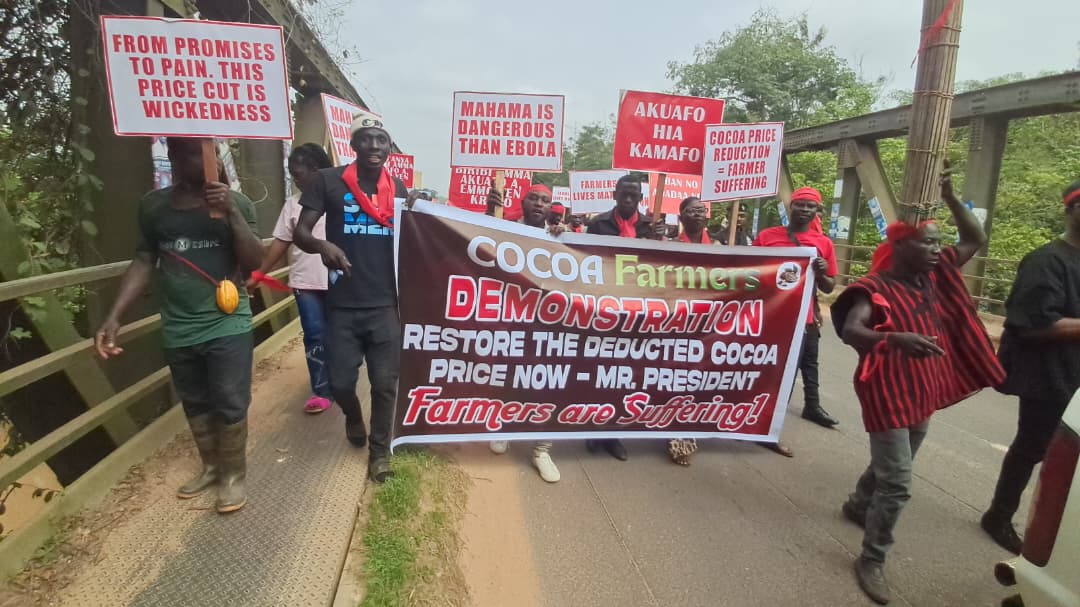
Hundreds of cocoa farmers across key cocoa-growing belts of the country have taken to the streets in protest against the mid-season reduction in cocoa producer prices, describing the decision as a severe blow to their livelihoods and a betrayal of campaign promises.
The protests, which erupted in parts of the Western North, Central and Ashanti Regions, follow the government’s downward adjustment of the cocoa farmgate price from GH¢3,625 to GH¢2,587 per 64kg bag for the remainder of the 2025/2026 crop season.
In Sefwi-Wiawso and surrounding cocoa-producing districts, including Bekwai, Asunafo and Amenfi, demonstrators marched through the principal streets carrying placards with inscriptions such as “Save the Cocoa Farmer” and “Our Labour Deserves Better Pay.”
The largely peaceful protest drew elderly farmers, women actively engaged in cocoa cultivation and young farmers who expressed deep frustration over what they termed a broken promise.
The farmers accused the governing National Democratic Congress (NDC) of reneging on assurances made during the 2024 election campaign to improve cocoa prices and enhance farmer welfare.
Similar scenes were recorded in the Assin North District of the Central Region, where farmers from Assin Dansame, Asempanaye, Praso, Bereku and Assin Nuaso staged a peaceful demonstration to register their displeasure.
Speaking to the media on behalf of some farmers, Mr Ransford Quainoo, Chief Farmer of Assin Brasiako, lamented that the price cut would severely undermine their ability to cater for their families and finance their children’s education.
“For decades we have dedicated our lives to cocoa farming. We were expecting better returns, not a reduction,” he said, appealing to government to either maintain the previous rate or fulfil the GH¢7,000 producer price promise made during the campaign.
According to him, anything below that threshold would impoverish cocoa farmers and weaken morale within the sector.
Nana Ama Dede, Aduana Queenmother of Assin Dansame, also voiced concern about mounting tensions within cocoa-growing communities.
She noted that cocoa purchasing clerks were facing pressure from farmers demanding immediate payment of their proceeds, creating anxiety and uncertainty.
She called on the authorities to urgently engage stakeholders and address the concerns of cocoa farmers to prevent further unrest.
In Adomfe, a community in Asante Akyem, cocoa farmers also staged a protest against the reduction in producer prices. Although largely peaceful, the demonstration caused temporary traffic disruptions, prompting the deployment of security personnel to maintain calm and order.
Across the protesting communities, farmers cited rising production costs as a major concern.
They argued that the prices of fertilizers, agrochemicals, hired labour and transportation have remained high, making it difficult to absorb the impact of the price cut.
Many warned that if the situation is not reviewed, some farmers may be forced to abandon their farms, a development they fear could reduce cocoa output and negatively affect Ghana’s standing as a leading cocoa producer.
Others expressed worry that the reduced farmgate price could encourage smuggling of cocoa beans to neighbouring Côte d’Ivoire, where rates are perceived to be more stable. Such a trend, they cautioned, could undermine national cocoa revenues and further weaken the position of smallholder farmers.
However, not all cocoa farmers share the same view, as some believe the government may have acted in response to global market pressures.
Nonetheless, the dominant sentiment in the protesting communities is one of disappointment and economic anxiety.
The unfolding protests underscore the central role cocoa plays in rural livelihoods and the sensitivity surrounding producer pricing decisions.
With thousands of families dependent on cocoa farming for survival, stakeholders say urgent dialogue and transparent communication will be crucial to restoring confidence and stability within the sector.