The Chief Justice, Justice Paul Baffoe-Bonnie, last Friday publicly endorsed the ongoing efforts by the Director-General of the Ghana Tertiary Education Commission (GTEC), Prof. Ahmed Jinapor Abdulai, to sanitise Ghana’s tertiary education sector.
Describing the exercise as necessary and widely supported, Justice Baffoe-Bonnie encouraged the GTEC leadership to remain steadfast despite public criticism.
“This sanitisation exercise that is going on is good. Even if you do not see public support, you should know that silently there are many people who cannot come out openly, but who fully support you. So continue with it,” he said.
Courtesy call
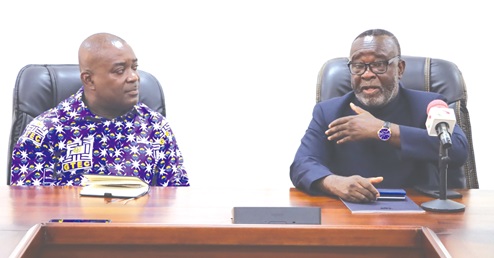
The Chief Justice made the remarks during a courtesy call on Prof. Jinapor and his management team at the GTEC offices in Accra. He said the visit was primarily to congratulate the Commission on what he described as its “good work”, formally introduce himself and his team, and engage GTEC on matters relating to legal education in Ghana.
Justice Baffoe-Bonnie was accompanied by the Judicial Secretary, Musah Ahmed; the Acting Director of the Ghana Law School, Prof. Raymond A. Atuguba; and other officials from the Chief Justice’s Secretariat.
Unearned titles
Reflecting on his upbringing in Goaso, the Chief Justice recalled that academic titles such as “Professor” were once rare and highly respected.
“But now everybody is a professor, everybody is a doctor,” he observed, urging GTEC to remain committed to its clean-up exercise.
He drew parallels with his time in Nigeria, where he said titles such as “Chief” and “Doctor” were widely used, adding that developments in Ghana had now surpassed what he had witnessed there.
“What we are seeing in the public space today has gone beyond even what we saw in Nigeria. Everybody is a doctor, everybody is a professor,” he said.
Response
In response, Prof. Jinapor expressed appreciation for the visit, describing it as historic.
“Since the days of our predecessor institutions — the National Accreditation Board (NAB) and the National Council for Tertiary Education (NCTE) — we have never received a Chief Justice here. This is the first time,” he said.
He thanked Justice Baffoe-Bonnie and his delegation for the engagement and pledged GTEC’s readiness to collaborate with the judiciary to ensure that reforms in legal education were “done properly and done right”.
Fake qualifications
Touching on the issue of fraudulent academic credentials, Prof. Jinapor warned that the problem extended beyond fake doctoral degrees to include fake professors, and cautioned against complacency.
“If we are not careful, we could even have a fake Chief Justice,” he remarked.
He said GTEC’s investigations had revealed troubling indications within the legal profession, including cases where individuals allegedly lacked the basic qualifications required to sit for law examinations but were nonetheless called to the Bar.
“We are conducting our investigations, and once we are certain of our findings, we will submit them to the General Legal Council for further action,” he said.
Prof. Jinapor stressed that the Commission’s objective was to safeguard the integrity of the tertiary education system and, by extension, the legal profession.
“At the end of the day, we want a clean environment. We cannot operate with a corrupted legal system,” he said, adding that the fundamental purpose of legal education was to confront wrongdoing in society.
He assured the Chief Justice that GTEC would continue to act in the best interest of Ghana’s tertiary education sector.