
Transparency and accountability issues have been raised in the operations of the Minerals Income Investment Fund (MIIF) with a warning that key governance requirements expected of the sovereign investment vehicle have not been fully met.
The Executive Director of the Centre for Extractives and Development Africa (CEDA), Samuel Bekoe, said assessments conducted by the organisation revealed lapses in the Fund’s disclosure practices, including delays in the publication of important statutory documents.
“From the assessments we have conducted, we have noticed that some governance, transparency and accountability requirements have not been fully met,” he said.
Mr Bekoe cited the delayed publication of some statutory disclosures.
“For instance, annual reports and audited financial statements have not consistently been published. Even the investment guidelines, which were supposed to be released within the first or second year of the fund’s operations, were only published in 2024.”
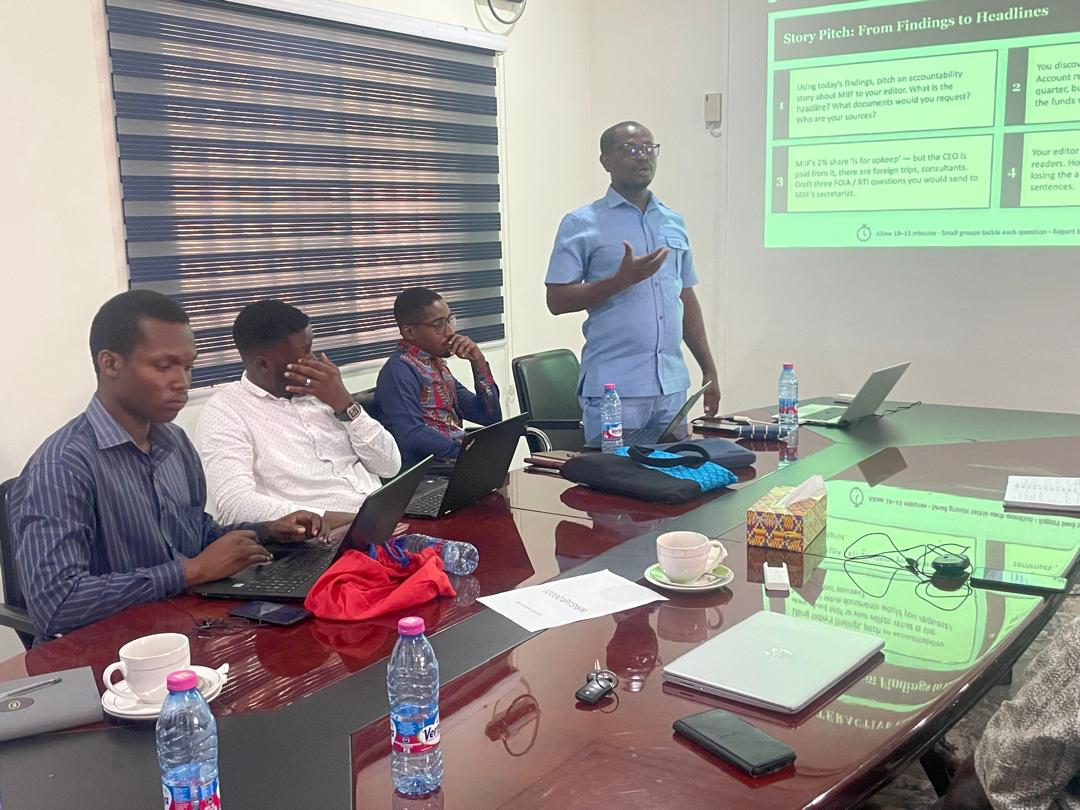
Speaking in an interview at a media training workshop on understanding MIIF organized under the auspices of the Natural Resources and Governance Institute , Mr Bekoe noted further that , although the fund had reported assets under management from several investments, there was still limited public information about the actual returns being generated from those investments.
“Although the fund lists several assets under management, which represent the value of investments it has made, we are yet to see the actual returns from those investments. They are classified as current assets, but the public needs to know the level of returns that are being generated.”, he stressed.
He noted further that recent changes introduced under the Minerals Income Investment Fund Amendment Act which reduced the portion of mineral royalties that previously went to the fund from 80 per cent to just two per cent has fundamentally altered the structure and operational capacity of the fund.
According to him, the two per cent allocation was now meant largely for the operational upkeep of the fund.
“The key question is what this means for the fund going forward. We do not believe the fund, in its current form, will be able to achieve its original mandate,” he stated.
Royalties account
He also questioned the accountability mechanisms surrounding a new arrangement introduced under the amendment, which channels the bulk of mineral royalties into a special holding account.
“Previously, the fund received about 80 per cent of mineral royalties. Now it receives only two per cent, while the remaining 78 per cent goes into what government calls a Mineral Royalties Holding Account,” he explained.
According to him, while the government intends to use the funds for major infrastructure projects under its “Big Push” initiative, clear governance rules must be established.
“The concern is about transparency and accountability. What are the reporting requirements for that account? What are the governance rules and are there quarterly reports showing how the money is being used?” he asked.
Mr Bekoe said although the government’s intention to channel mineral revenues into infrastructure development was commendable, strict oversight was necessary.
“For years, stakeholders have advocated investing mineral revenues in infrastructure that benefits both current and future generations. But there must be clear governance rules, including withdrawal guidelines, investment rules and regular publication of reports so the public can verify that the funds are being used for their intended purposes,” he said.
Transparency gap
The CEDA Executive Director further observed that despite the significant revenues generated from Ghana’s mineral sector, transparency in the management of those revenues remained limited compared to the oil sector.
He pointed out that oversight structures similar to those used in the petroleum industry could help strengthen accountability.
“Mineral revenues over the years have generated significant money compared even to oil. Yet the level of transparency and accountability around mineral revenue management is far lower than what we see in the oil sector,” he said.
Mr Bekoe suggested that the oversight role of the Public Interested and Accountability Community (PIAC) in the petroleum sector could provide a useful model.
“Many citizens know about PIAC and its work in tracking petroleum revenues. But awareness and oversight of mineral revenues are far weaker,” he said.
He proposed that the mandate of PIAC could be expanded or that other mechanisms be created to improve transparency in the extractive sector.
“Even if government decides not to create a new oversight body or expand PIAC’s mandate, it should at least publish more detailed information about how mineral revenues are being used,” he said.
Governance review
Mr Bekoe also called for a review of the governance structure of MIIF, particularly provisions that grant extensive decision-making authority to the Minister of Finance.
“There is a strong case for reviewing the governance structure of the fund, especially the provisions that give significant decision-making power to the Minister of Finance,” he said.
He stressed that strengthening governance arrangements could improve public trust and enhance the effectiveness of the fund.
“Governance could be strengthened by requiring the fund to publish regular reports on investment performance and returns,” he added.
Proactive disclosure
Mr Bekoe further urged the fund to adopt a proactive approach to transparency by regularly publishing information about its investments and programmes.
He cited several projects and investments undertaken by the fund that required greater public disclosure.
“For example, what has happened to the ASM Incubation Programme? Which companies benefited from it and how are they performing now?”
He added that such disclosures would help citizens better understand how mineral revenues were being managed.
“Mineral resources are non-renewable and exhaustible. Future generations may not have the same opportunity to benefit from them, so it is important that we manage them with clear governance rules and strong transparency and accountability,” he said.
He thus called for proactive disclosure practices that would help strengthen public confidence in the management of Ghana’s mineral wealth.

