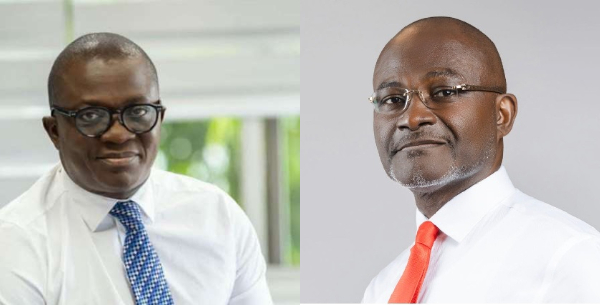
The outcome of the New Patriotic Party’s (NPP) January 31, 2026 presidential primary has triggered a sharp re-examination of internal party dynamics and leadership trajectories.
For years, former Assin Central Member of Parliament (MP) Kennedy Ohene Agyapong was widely seen as the principal alternative force within the NPP — a populist firebrand with a large grassroots following and significant name recognition.
However, the 2026 primary results have unsettled that narrative, particularly in the context of a strong showing by Dr Bryan Acheampong, a first-time presidential aspirant whose performance has reconfigured internal perceptions of leadership potential.
In the January 31, 2026 contest, Mr Agyapong placed second with 46,554 votes, representing 23.76% of valid votes cast. Former Minister for Food and Agriculture, Dr Bryan Acheampong, running for president for the first time, placed third with 36,303 votes, equivalent to 18.53%.
Although Mr Agyapong finished 10,251 votes ahead, the raw margin masks a more unsettling reality for his long-term ambitions.
This was not merely a contest of placement; it was a contest of momentum—and the momentum shifted.
Ken’s sharp decline
The most damaging statistic for Mr Agyapong is the scale of his vote decline. Between the 2023 and 2026 primaries, his vote count fell by 25,442, dropping from 71,996 to 46,554.
This decline is particularly striking because it occurred in a context that should have favoured an established, high-profile contender.
Ahead of the 2026 election, the NPP expanded its delegate base from 204,144 to 211,849, adding 8,243 new delegates as part of reforms intended to deepen participation and strengthen internal democracy.
Yet Mr Agyapong failed not only to grow his support within this expanded pool, but also to retain a significant portion of his previous base.
Delegate expansion without electoral reward
Turnout figures reinforce the significance of this decline.
In 2023, 192,446 valid votes were cast out of 204,144 eligible delegates.
In 2026, valid votes increased modestly to 195,901 out of 211,849 delegates—an increase of 3,455 votes.
Participation therefore grew at a measured pace rather than dramatically.
Against this backdrop, the loss of over 25,000 votes by Mr Agyapong cannot be dismissed as a technical anomaly.
It suggests that while his message resonated strongly with sections of the grassroots in 2023, it failed to sustain that appeal across a slightly larger, more diverse delegate structure three years later.
Dr Acheampong’s first-time surge
While Mr Agyapong grappled with decline, Dr Bryan Acheampong experienced the opposite trajectory.
Entering the race as a first-time presidential contender, he secured 36,303 votes, equivalent to 18.53%, immediately establishing himself as a national force within the party.
His performance was not symbolic; it was numerically and geographically substantial.
In comparative terms, Dr Acheampong’s showing is remarkable precisely because he lacked prior presidential exposure.
Yet he finished close enough to Mr Agyapong to fundamentally weaken claims of the latter’s uncontested dominance among post-Bawumia contenders.
Similar backgrounds, diverging fortunes
The contrast between the two men is made sharper by their similarities.
Both are former Members of Parliament—Dr Acheampong for Abetifi in the Eastern Region and Mr Agyapong for Assin Central in the Central Region.
Both are wealthy businessmen who openly highlighted their financial capacity and investments in the NPP during the campaign.
Each projected business success as proof of competence and promised to leverage private-sector experience to create jobs for party members and the wider Ghanaian population.
Party insiders also indicate that both candidates invested heavily in their campaigns, including logistical and welfare support for delegates during nationwide tours.
In essence, Dr Acheampong competed on largely the same material and organisational terrain as Mr Agyapong—yet achieved a near-breakthrough result on his first attempt.
A country split in two
Regionally, the contest produced a near-even split. Each candidate led in eight regions, underscoring the competitive balance between them.
Mr Agyapong won his home Central Region and outperformed Dr Acheampong in Western, Greater Accra, Ashanti, Western North, Ahafo, Bono and North East regions.
These results affirm his continued strength in several southern and traditional party strongholds.
Dr Acheampong, however, carved out a strategically significant footprint elsewhere.
Northern inroads and cross-regional appeal
Despite failing to win his home Eastern Region outright, Dr Acheampong still polled more votes than Mr Agyapong there. More critically, he won Volta Region and outperformed Mr Agyapong in Bono East, Oti, Northern, Savannah, Upper East and Upper West regions.
Of the five northern regions, Dr Acheampong led in four, with Mr Agyapong managing to outpoll him in only one.
This northern dominance carries weight beyond raw numbers. The northern regions have increasingly become decisive swing zones within the NPP’s internal elections.
A first-time contender establishing such depth of support there signals expansion potential rather than saturation.
The strategic threat to Agyapong’s ambition
The real challenge posed by Dr Acheampong’s performance is not immediate defeat but gradual displacement.
Mr Agyapong’s political brand was built on momentum—on the sense that he was steadily rising.
The 2026 results suggest that momentum has stalled, if not reversed.
Dr Acheampong, by contrast, emerges as a rising force with room to grow.
With campaign networks now established, name recognition secured, and lessons learned from his first attempt, Dr Acheampong enters future contests as a tested contender.
Mr Agyapong, meanwhile, faces the harder task of reversing decline and re-energising a base that has demonstrably thinned.
A turning point, not an endpoint
The 2026 primaries therefore represent a critical inflection point. Mr Agyapong remains influential, but no longer unchallenged.
Dr Bryan Acheampong’s surprise performance has recalibrated the NPP’s internal succession equation and introduced a credible alternative centre of gravity.
For Mr Agyapong, the danger is not irrelevance, but erosion—slow, measurable, and politically consequential.
Whether he can arrest that trend will determine whether his presidential ambition survives as a serious project or becomes a story of missed timing in the party’s evolving power dynamics.
By ELVIS DARKO, Accra