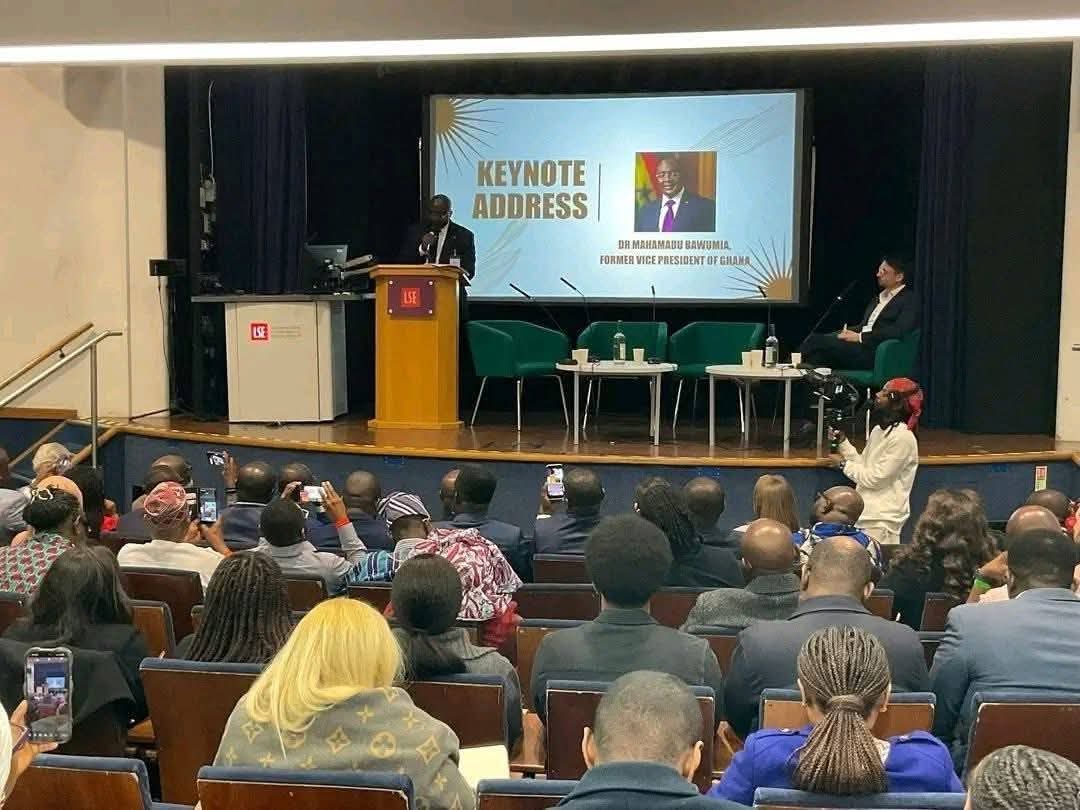
Artificial intelligence is fast emerging as the defining force of the digital age, reshaping economies, governance systems and everyday life, with Africa now standing at a critical crossroads: embrace the transformation decisively or risk being left behind once again.
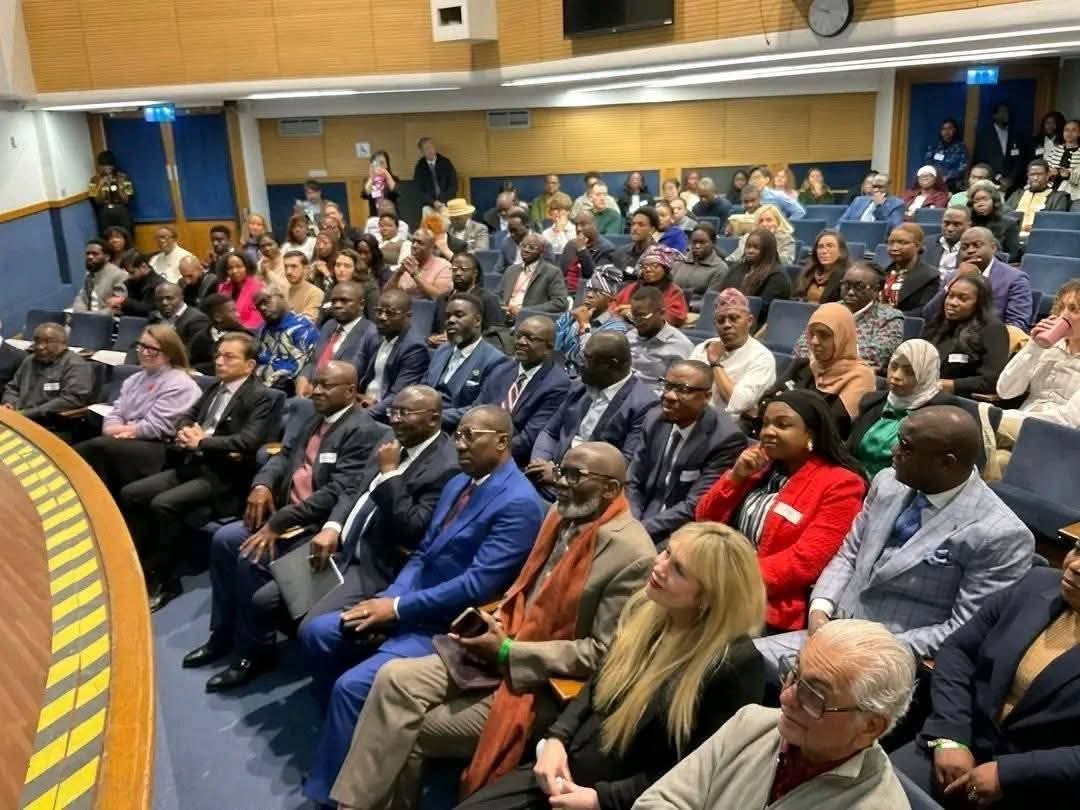
This was the central message delivered by former Vice President of Ghana, Mahamudu Bawumia, during his keynote address at the LSE Africa Summit 2026 held at the London School of Economics and Political Science in London.
He described artificial intelligence (AI) not as a distant technological concept, but as the new face of digitalisation—one that will determine global competitiveness, economic inclusion and national sovereignty in the Fourth Industrial Revolution.
AI as the new phase of digitalisation
Dr Bawumia argued that the world has entered a new phase of the digital revolution, where artificial intelligence, big data, cloud computing and the Internet of Things are no longer optional tools but central drivers of productivity and growth.
According to him, digitalisation has evolved beyond basic connectivity into intelligent systems that shape decision-making, automate processes and unlock new economic opportunities across sectors.
“We are in the midst of a global digital revolution,” he said, stressing that digitalisation is now “front and centre” and a necessity for survival and prosperity in the 21st century.
He cautioned that Africa’s historical failure to fully participate in previous industrial revolutions—largely due to limited investment in technology and weak innovation ecosystems—should not be repeated in this era.
Africa risks being left behind again
Dr Bawumia warned that without deliberate policy action, Africa could once again find itself on the margins of global transformation.
He noted that the continent’s greatest constraint is not a lack of talent, but a deficit in leadership, investment and strategic direction.
“Africa does not lack talent,” he emphasised. “What we lack is deliberateness, leadership and investment to create the ecosystems where innovations and innovators thrive.”
He stressed that the stakes are significantly higher this time, as AI is not just about technology but about control over data, markets and the rules governing the global knowledge economy.
Digital foundations key to AI success
A central pillar of his argument was that artificial intelligence cannot thrive without strong digital foundations.
He outlined three critical enablers: reliable electricity, robust broadband connectivity and trustworthy data systems.
“AI thrives on connectivity, electricity, and reliable digital infrastructure,” he said.
“No electricity, no compute. No broadband, no scaling. No trusted data systems, no safe deployment.”
Citing data on Africa’s digital readiness, he noted that internet penetration across the continent stands at about 43%, with wide disparities between countries.
Ghana, for instance, records about 70% internet usage, compared to 34% in Rwanda and 76% in South Africa.
Electricity access across Africa averages around 60%, with Ghana performing relatively better at about 89.5%.
However, he stressed that access alone is insufficient without reliability and stability, which are essential for AI systems.
Data affordability a major barrier
Beyond infrastructure, Dr Bawumia identified the high cost of mobile data as a critical obstacle to inclusive digital participation.
He noted that while Ghana’s data prices range between approximately $0.05 and $1.50 per gigabyte, affordability remains uneven, particularly for low-income households.
He warned that without addressing such disparities, AI adoption could deepen inequality rather than bridge it.
“The key question is not just who is online, but who is online meaningfully,” he said, highlighting the need for affordable, reliable and high-speed internet access.
AI will reshape jobs, not eliminate them
On the labour front, Dr Bawumia addressed growing concerns about job losses due to automation, clarifying that artificial intelligence is more likely to transform work rather than eliminate it entirely.
He cited global estimates suggesting that about 40 per cent of jobs are exposed to AI-driven changes, but emphasised that this reflects task transformation and productivity enhancement rather than outright job destruction.
“The point is not that 40 per cent of jobs will vanish,” he explained, “but that AI will reshape tasks and productivity across a large share of work.”
He added that the policy challenge for African governments is to ensure workers are equipped with the skills needed to transition into new roles where AI complements human productivity.
Cross-border cooperation critical
Dr Bawumia further underscored the importance of regional collaboration in unlocking Africa’s AI potential.
He argued that no single African country can build a competitive AI ecosystem in isolation, calling for shared infrastructure, harmonised regulations and integrated digital markets.
According to him, frameworks such as the African Continental Free Trade Area provide a strong foundation for cross-border digital cooperation.
“Artificial intelligence can unite borders if Africa builds capability and then connects that capability across borders,” he stated.
He stressed that Africa must position itself not as a passive consumer of AI technologies, but as a co-creator in the global digital economy.
Six policy priorities for AI leadership
To guide Africa’s transition, Dr Bawumia outlined key policy priorities, including investment in digital infrastructure, development of data ecosystems, large-scale talent training, and strengthening institutional capacity.
He also emphasised the need for ethical frameworks to govern AI deployment and ensure trust in digital systems.
“Technological revolutions reward those who build foundations before they chase applications,” he noted, urging policymakers to act “boldly, but methodically.”
A moment of opportunity for Africa
Despite the challenges, Dr Bawumia expressed optimism about Africa’s prospects, pointing to emerging innovations such as “small AI” applications that can run on mobile devices and support sectors like agriculture, healthcare and education.
He also referenced the International Monetary Fund’s AI Preparedness Index, which identifies countries such as Ghana, Kenya, Rwanda and South Africa as relatively well-positioned for AI adoption due to their progress in digitalisation.
He stressed that this momentum must be scaled from pilot projects to national systems to deliver meaningful impact.
Seizing the Fourth Industrial Revolution
Dr Bawumia concluded with a strong call to action, urging African leaders to recognise the urgency of the moment and take decisive steps to secure the continent’s place in the global digital order.
He warned that failure to act would not only limit economic growth but also compromise Africa’s sovereignty in an increasingly data-driven world.
“Africa should not be a passive consumer,” he said. “We must become builders of responsible systems and co-authors of the rules, markets and benefits of artificial intelligence.”
As the Fourth Industrial Revolution accelerates, the message is clear: artificial intelligence is not just the future of digitalisation—it is its present reality. And for Africa, the choices made today will determine whether the continent leads, participates, or is left behind once again.