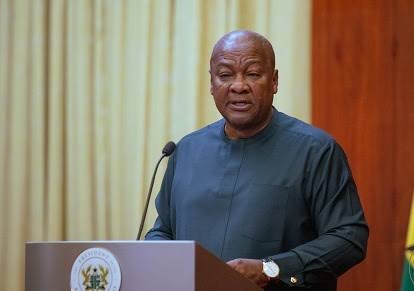
President John Dramani Mahama has urged German companies to increase investments in Ghana’s agriculture, manufacturing, energy and technology sectors, highlighting the government’s US$10 billion New Economy Programme as a major opportunity for private-sector partnerships.
The programme, which will run from 2027 to 2030, is intended to accelerate industrialisation, expand local production and create jobs, with German businesses among the investors government hopes to attract.
Addressing the 6th German-African Business Summit in Accra, President Mahama said Ghana was seeking to leverage German technology, expertise and investment to strengthen its productive capacity and establish itself as a competitive manufacturing destination.
“We believe in this programme and we are putting our own money into it. In the next four years, Ghana intends to spend $10 billion over the next four years, from 2027 to 2030, in implementing the New Economy Programme,” he said.
He identified agriculture, agro-processing, manufacturing, energy, infrastructure, pharmaceuticals, tourism, creative industries, digital innovation and mineral beneficiation as priority areas offering investment opportunities for German companies.
The President also called for a shift in Ghana’s trade relationship with Germany, urging the country to move beyond exporting raw materials and agricultural products towards processing and exporting higher-value goods.
He said Ghana’s exports to the European Union increased by 23.2 per cent in 2025, resulting in a trade surplus of €418 million in the country’s favour.
However, he noted that the existing trade structure, characterised by Ghana’s exports of raw materials and agricultural products and imports of German machinery, chemicals and manufactured goods, offered scope for deeper industrial cooperation.
“We seek to shift our exports from raw materials to value-added processed goods with significantly added value,” he stated.
President Mahama further urged German businesses to consider Ghana as a strategic entry point into the African Continental Free Trade Area (AfCFTA), which provides access to a continental market of approximately 1.4 billion people and a combined GDP estimated at more than US$3.5 trillion.
He said the agreement presented opportunities for German companies to establish production facilities in Ghana and develop supply chains serving markets across the continent.
“I therefore wish to invite German companies to consider Africa not as a collection of isolated markets but as a crystallizing network of interconnected investment and production opportunities and to consider Ghana as one of your strategic entry points into that market,” he added.
The President also highlighted improvements in Ghana’s economic indicators, citing growth of 6 per cent in 2025, a decline in inflation from 23.8 per cent in December 2024 to 5.2 per cent in September 2026, and international reserves of approximately US$12.94 billion as of June 2026.
He said the developments reflected government’s efforts to restore macroeconomic stability and strengthen investor confidence.
“Ghana is stable, Ghana is growing, and Ghana is open for business,” he said.
Acknowledging concerns among investors over infrastructure, financing costs, regulatory processes and energy reliability, President Mahama pledged further reforms to improve the business environment.
He said government would strengthen public institutions, improve administrative efficiency and ensure greater transparency and predictability for businesses.
He also called for stronger partnerships with German financial institutions, development finance organisations and commercial banks to establish financing arrangements for commercially viable projects.
Citing the North Shore Apparel Factory in Savelugu in the Northern Region as an example of successful cooperation, he said financing support from Germany’s KfW, alongside assistance from Ghana Exim Bank, had helped establish a factory employing more than 2,000 people, 80 per cent of whom are women.
President Mahama urged participants to move beyond discussions and translate the summit’s engagements into concrete investment commitments.
“Let the success of this gathering be measured not only by the quality of our discussions or the length of our speeches, but by the partnerships concluded, investments that are mobilized and enterprises that are established in the months and years ahead,” he said.