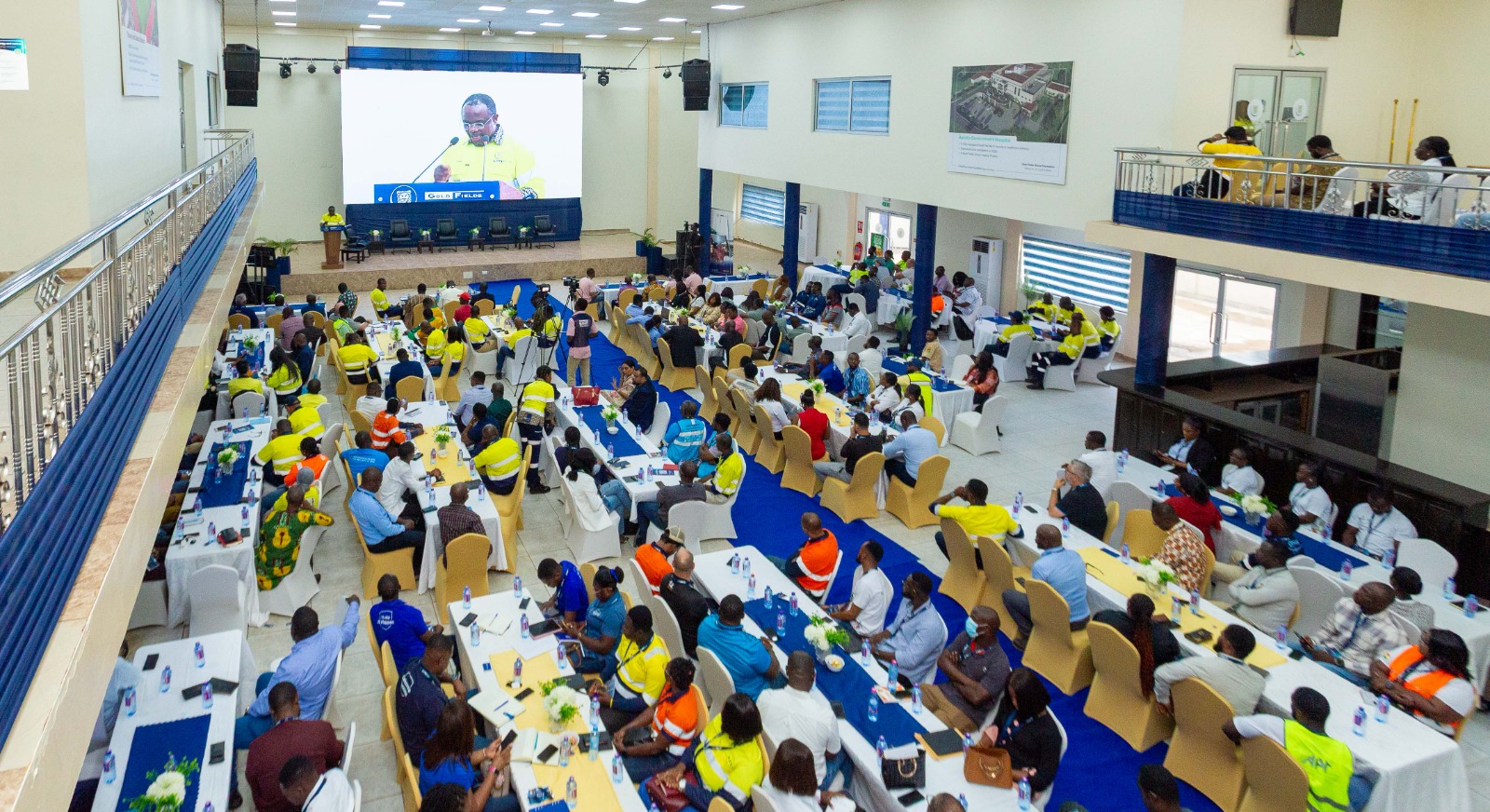
Gold Fields Ghana Limited has spent US$4.26 billion on local procurement over the past five years, including US$2.59 billion with businesses in its host communities, representing 93 per cent of its total procurement expenditure and a major boost to Ghanaian enterprise development.
The expenditure represents approximately 93 per cent of the company’s total procurement spending, reflecting its sustained efforts to retain a greater share of the economic value generated by its mining operations within Ghana.
The company has also engaged and supported nearly 100 suppliers in its host communities, helping strengthen local businesses, expand their capacity and create opportunities for sustainable economic activity beyond mining.
Speaking at the third Gold Fields Suppliers Conference at the Akoon Clubhouse at its Tarkwa Mine, the company’s Senior Vice-President and Managing Director, Mr Elliot Twum, disclosed that local procurement expenditure reached GH¢4.7 billion between January and June 2026.
Of this amount, GH¢4.2 billion went to 124 suppliers in its host communities, underscoring the scale of economic opportunities created for businesses operating around the company’s mines.
The conference, held under the theme, “Partnership for Enduring Value: Building Resilient Supply Chain Beyond Mining,” brought together more than 300 local and international suppliers to explore business partnerships, strengthen supply-chain relationships and identify opportunities for sustainable growth.
Mr Twum, whose speech was read on his behalf, said Gold Fields’ commitment to local content extended beyond regulatory compliance, emphasising the need to develop strong Ghanaian enterprises capable of contributing to the wider economy.
He said the company’s engagement with Ghanaian-owned businesses predated the Minerals and Mining (Local Content and Local Participation) Regulations, 2020, also known as L.I. 2431.
He cited Zen Petroleum, GASO, Genser and Western Transport Services as examples of local businesses that had contributed to the company’s operations and grown through sustained partnerships.
The partnerships, he said, demonstrated how mining procurement could serve as a catalyst for developing domestic enterprises, strengthening industrial capacity and supporting economic activity across sectors.
However, he cautioned suppliers to maintain high standards of quality, safety, environmental responsibility and corporate governance to meet the operational and sustainability requirements of the mining industry.
Beyond procurement and supplier development, Gold Fields is supporting social infrastructure and community development through the Gold Fields Ghana Foundation.
Mr Twum disclosed that more than GH¢53 million had been channelled into socioeconomic development through the Foundation so far in 2026.
Among the projects is an alternative road linking New Atuabo to the Bogoso Junction Highway, constructed by Woodbine Limited, a local contractor from New Atuabo.
The road has reduced travel time between the communities and the highway from 30 minutes to 10 minutes, improving mobility and access for residents.
The Foundation has also supported education, with 150 young people from the company’s host communities receiving scholarships this year.
Since its establishment 20 years ago, the Foundation has provided full tertiary education support to more than 3,000 students, helping expand access to higher education and develop human capital in mining communities.
The company’s contribution to employment and public revenue has also been substantial.
Mr Twum said employment from host communities had reached 70 per cent, reflecting the company’s role in creating jobs and providing livelihoods for people living around its operations.
As of October 2026, Gold Fields had contributed more than GH¢3.5 billion to the Government of Ghana, through its economic activities and statutory payments, providing revenue to support public expenditure and national development.
The figures highlight the company’s contribution through multiple channels, including local procurement, employment, supplier development, community infrastructure, education and government revenue.
Building businesses beyond mining
For his part, the Vice-Chancellor of the University of Mines and Technology (UMaT), Professor Bernard Kumi-Boateng, urged suppliers to use their partnerships with mining companies to build resilient businesses capable of surviving beyond individual contracts and expanding into other sectors.
Addressing the conference on the topic, “Partnerships with Lasting Legacies,” he warned that businesses heavily dependent on one mine, customer or contract risked collapse when operations changed or the relationship ended.
“Enduring value is what a partnership leaves behind that can stand on its own. It is not the cheque,” he said.
He encouraged suppliers to explore opportunities in energy, construction, manufacturing, agriculture and infrastructure, while strengthening their business systems, obtaining professional certifications and training younger workers.
He also urged businesses to diversify their customer base, recommending that no single customer should account for more than half of their revenue.
Professor Kumi-Boateng further advised suppliers to separate personal and business finances, invest in employees, strengthen leadership structures and adopt digital tools to improve their operations.
He called for closer collaboration among mining companies, academic institutions and suppliers to equip local enterprises with the skills, systems and technical capacity required to compete in other industries.
The two-day conference forms part of Gold Fields Ghana’s engagement with its business partners to strengthen supply-chain relationships and promote sustainable economic opportunities beyond individual mining contracts.
The company’s procurement expenditure, community investments, employment contribution and payments to government collectively position its operations as a significant source of economic activity, business development and social investment in Ghana.