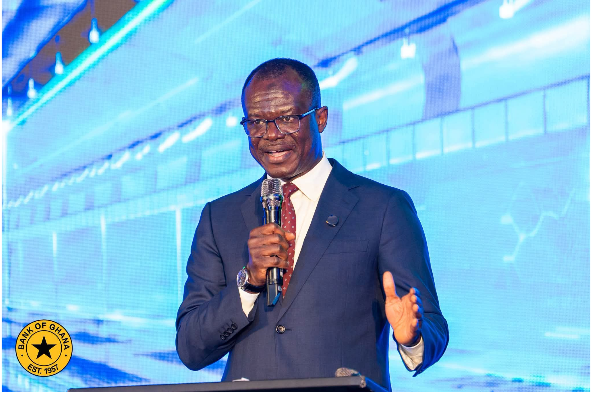
The First Deputy Governor of the Bank of Ghana (BoG), Dr Zakari Mumuni, has called for stronger risk-sharing arrangements, improved project preparation, appropriate financing structures and enduring institutional partnerships to unlock greater Asian investment into West Africa.
He said the challenge confronting the region was not a shortage of capital or investment opportunities, but the difficulty of converting those opportunities into commercially viable projects capable of attracting long-term financing.
Dr Mumuni made the call at the High-Level West Africa–Asia Capital Dialogue, held on the sidelines of the International Monetary Fund (IMF) and World Bank Annual Meetings in Bangkok, Thailand, under the theme, “Two Conversations. One Question. Intervention: Unlocking Greater Asian Investment in West Africa.”
He said investor confidence, risk perception and the availability of effective investment structures were central to determining whether capital flowed into the region, stressing that macroeconomic stability alone was insufficient to secure sustained investment.
Investors, he noted, also required predictable policies, credible institutions, enforceable contracts and well-prepared projects, alongside practical financing and partnership arrangements that could facilitate the execution of investments.
“Development needs do not automatically become investable opportunities,” Dr Mumuni said, emphasising the need for commercially viable projects supported by credible feasibility studies and transparent mechanisms for allocating risks.
Stability provides foundation
Drawing on Ghana’s recent economic experience, the First Deputy Governor said sound macroeconomic management was fundamental to creating an environment conducive to investment.
He noted that elevated inflation, exchange-rate pressures, debt challenges and constrained access to international markets had necessitated difficult policy adjustments and significant reforms.
Those efforts, he said, were beginning to yield results, with inflation easing considerably, debt sustainability improving and Ghana’s sovereign credit ratings upgraded.
Ghana’s experience, according to Dr Mumuni, demonstrated that decisive and credible policy action could restore investor confidence and reposition an economy to attract capital.
He said macroeconomic instability increased investment risks and financing costs, discouraging investors from committing funds to long-term projects. Conversely, price stability, sustainable public finances and credible institutions provided the foundation for private-sector expansion.
He said BoG remained committed to maintaining monetary and financial stability and supporting confidence in the economy.
However, he stressed that stability was only the starting point, as sustainable investment ultimately depended on a strong pipeline of productive opportunities and competitive businesses.
Barriers to Asian investment
Dr Mumuni identified exchange-rate and financing risks, regulatory and policy uncertainty, contract enforcement challenges, infrastructure constraints, and difficulties associated with project exits and risk management as some of the concerns limiting investment flows into West Africa.
He urged governments and institutions in the region to improve project preparation, strengthen transparency and enhance regulatory predictability to address those concerns.
At the same time, he called on investors to assess opportunities in individual countries on their merits rather than relying on broad perceptions of West Africa as a single investment destination.
He noted that investment conditions varied considerably across countries, making it important for investors to recognise the distinct opportunities and risks within the region.
Ghana’s investment opportunities
Dr Mumuni identified agro-processing, manufacturing, energy, transport and logistics, digital services, and financial technology as sectors offering significant investment opportunities in Ghana.
Investment in these areas, he said, could expand productive capacity, create employment and support economic transformation.
He also highlighted the African Continental Free Trade Area (AfCFTA) as an opportunity for investors to access a substantially larger regional market beyond individual national economies.
Realising the benefits of the continental market, however, would require improvements in trade facilitation, logistics, payment systems and dispute resolution mechanisms.
He said the opportunity extended beyond financing individual projects to building productive capacity, developing regional value chains and establishing sustainable commercial partnerships between Asian investors and African businesses.
Four priorities to unlock capital
To accelerate investment flows, Dr Mumuni outlined four priorities for governments, development finance institutions and private investors.
First, he called for stronger risk-sharing arrangements involving development finance institutions, export credit agencies, governments and private investors, with risks allocated to the parties best equipped to manage them.
Second, he stressed the need for better project preparation and a robust pipeline of investment-ready projects capable of meeting investors’ commercial and financing requirements.
Third, he advocated appropriate financing structures, noting that long-term investments required long-term financing.
He also encouraged greater use of local-currency financing, where feasible, to reduce currency mismatches and improve project viability.
Fourth, he called for stronger institutional partnerships that combined Asian capital and expertise with African market knowledge and investment opportunities.
He said such arrangements could help bridge the gap between available capital and viable projects, while ensuring that investments were structured to deliver sustainable commercial returns.
Role of central banks
The First Deputy Governor said central banks had an important but defined role in creating the conditions necessary for investment, although they could not determine the commercial success of individual projects.
Their responsibility, he explained, was to provide a stable and credible monetary and financial environment through price stability, financial-sector safeguards, efficient payment systems and transparent foreign-exchange arrangements.
He also expressed interest in innovations that improved cross-border payments and facilitated trade and investment, provided they were supported by appropriate safeguards for resilience, integrity and regulatory compliance.
Efficient payment systems, he said, could strengthen commercial relationships between West African economies and Asian markets by improving the movement and settlement of funds associated with trade and investment.
Practical steps for implementation
Dr Mumuni proposed four practical measures to translate the dialogue into tangible investment outcomes.
These include identifying priority sectors and projects in West Africa that have genuine commercial appeal for Asian investors; establishing structured engagement channels between African project sponsors and Asian investors; expanding cooperation in trade finance, payment connectivity and local-currency financing; and creating a mechanism to track progress against clear deliverables and timelines.
He identified the ECOWAS Bank for Investment and Development (EBID), alongside other regional development finance institutions, as potential coordinators of efforts to advance the agenda.
He said the success of the dialogue should ultimately be measured by the investments secured, businesses expanded and partnerships sustained, rather than the number of discussions held.
Dr Mumuni urged African countries to make investment opportunities more attractive through credible policies, strong institutions, well-prepared projects and effective risk-management frameworks, while calling on Asian partners to assess those opportunities objectively and collaborate with African institutions to develop commercially viable solutions.
He said successful implementation of the proposed measures would help turn discussions into actual investments, support sustainable business growth and establish partnerships that create value for both regions.