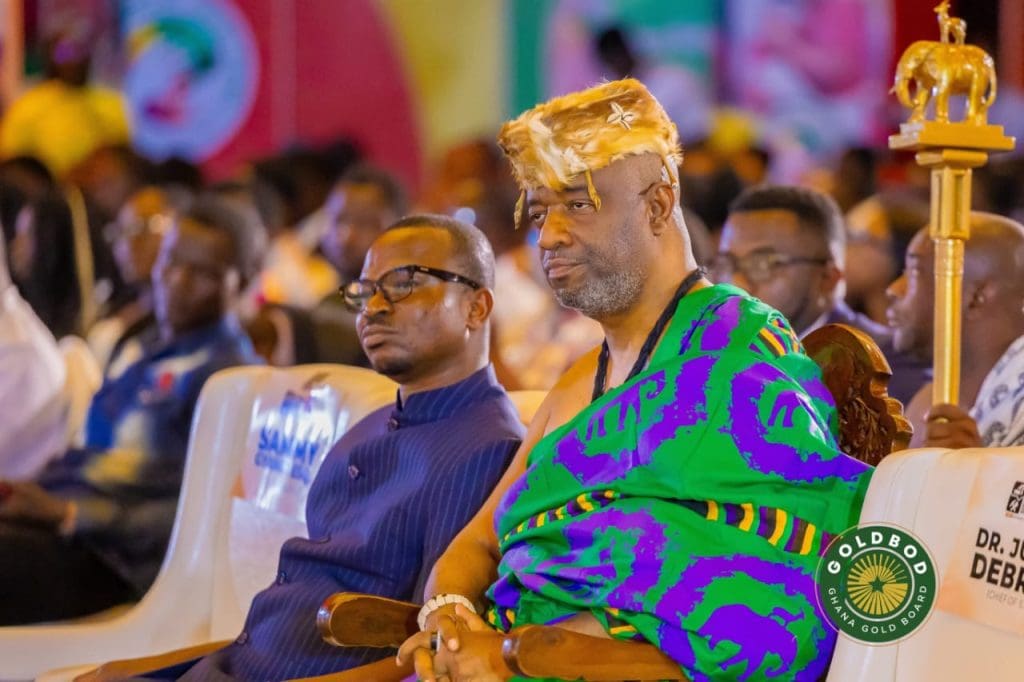
Ga Mantse, King Tackie Teiko Tsuru II, has called on mining companies, government and other stakeholders to ensure that communities hosting mining operations are left with sustainable economic and social benefits long after mineral extraction ends.
He said mining remained an important contributor to Ghana’s economic growth and national development, but stressed that the exploitation of mineral resources must not leave behind degraded land, weakened communities and economies that collapse once mining operations cease.
The Ga Mantse made the call at the National Mining Dialogue 2026 in Accra, where he urged stakeholders to rethink the relationship between mining companies and host communities and establish a stronger social compact that protects both present and future generations.
The dialogue was held on the theme, “Mining, Local Content and the Catchment Compact: Rethinking the Social Licence to Operate.”
The event was organised by Asempa 94.7 FM and its flagship programme, Ekosiisen, in partnership with Semmis DS and the Ministry of Lands and Natural Resources.
It brought together government officials, traditional authorities, mining companies, regulators and other stakeholders to deliberate on how Ghana could maximise the economic and social value of its mineral resources without compromising environmental protection, public health and the wellbeing of mining communities.
Land must outlive mining
King Tackie Teiko Tsuru II said land should not be viewed merely as an input into mining operations but as an inheritance handed down through generations, a source of livelihood and the foundation upon which communities are built.
He noted that while mining companies would eventually leave once mineral deposits were exhausted, the communities and the land would remain.
“Long after the mining companies, the machinery and the trucks are gone, the land and its people remain. The land must be reclaimed, and that awareness must guide our deliberations,” he said.
The traditional ruler said the granting of mining concessions effectively placed part of the country’s generational inheritance in the hands of companies and individuals authorised to extract its mineral resources.
Such permission, he said, came with significant responsibilities to protect the land, support affected communities and ensure that mining generated benefits capable of lasting beyond the operational life of a mine.
He therefore urged stakeholders to ensure that mining activities were linked to long-term investments in communities rather than being driven solely by short-term extraction and financial returns.
Mines must leave development behind
According to the Ga Mantse, properly managed mining could become a powerful catalyst for community development.
He identified roads, schools, hospitals, potable water systems, scholarships, vocational training and employment opportunities as some of the benefits that mining communities should be able to derive from the presence of mineral resources in their areas.
He, however, cautioned against approaches that generated wealth in the short term while leaving communities vulnerable once mining operations ended.
“At the end of the day, the mine may close, but the community must not close with it,” he said.
“We cannot dig for today’s wealth in a manner that buries tomorrow’s future.”
He said the test of successful mining should therefore not be limited to production volumes, export earnings or government revenues, but should include the quality of life and economic opportunities available to people living in mining areas.
Protect the social licence
King Tackie Teiko Tsuru II also stressed the importance of the social licence to operate, saying mining companies could not depend solely on legal permits and regulatory approvals to sustain their operations.
He said public trust had to be earned continuously through responsible conduct, respect for communities, transparency and meaningful engagement.
Mining companies, he said, must demonstrate through their actions that they valued the interests of host communities and were prepared to fulfil commitments made to them.
“The social licence to operate” should therefore be viewed as a continuing relationship between mining companies and communities rather than a one-time approval, he said.
He urged mining companies to deepen engagement with traditional authorities, local residents, youth groups and other affected stakeholders and ensure that community concerns were addressed before they escalated into conflict.
Who benefits from Ghana’s minerals?
The Ga Mantse also challenged stakeholders to examine how much of the wealth generated from Ghana’s mineral resources remained within the country.
He called for greater scrutiny of the contribution of mining to national development through taxation, local ownership, wages, procurement, value addition and other economic linkages.
The key question, he said, should be whether the exploitation of Ghana’s minerals was creating sustainable prosperity for Ghanaians or whether too much of the value was leaving the country.
He encouraged participants at the dialogue to examine whether mining communities were receiving a fair share of the economic opportunities created by mining activities.
He also called for stronger local content requirements to ensure that Ghanaian businesses and professionals were integrated into mining supply chains.
CSR must produce measurable results
King Tackie Teiko Tsuru II further called for greater accountability in community development and corporate social responsibility initiatives undertaken by mining companies.
He said CSR programmes should not be based merely on isolated projects or goodwill gestures but should be measurable, transparent and aligned with the actual development priorities of host communities.
Mining companies, he said, should work with local authorities and communities to identify priority needs and establish clear targets for development interventions.
Such an approach, he argued, would enable communities to assess whether commitments were being fulfilled and whether mining was genuinely contributing to their long-term development.
Catchment Compact must be implemented
The Ga Mantse welcomed plans to adopt a Catchment Compact at the end of the National Mining Dialogue, describing it as an opportunity to translate discussions and commitments into practical action.
He urged stakeholders not to allow the compact to become another document containing promises that were never implemented.
Instead, commitments should be clearly defined, monitored and periodically reviewed to ensure that government, mining companies, communities and other stakeholders remained accountable.
He said traditional authorities had an important role to play in monitoring development commitments and ensuring that the interests of host communities remained central to mining decisions.
Protect future generations
The Ga Mantse said the management of Ghana’s mineral resources was ultimately an intergenerational responsibility.
He reminded stakeholders that current leaders were temporary custodians of the country’s natural resources and would eventually be judged by the condition in which they left the land for future generations.
“Our ancestors entrusted this land to us only for a season, and one day we must hand it over,” he said.
“When that day comes, we must be able to say that we used the wealth beneath our feet without destroying the inheritance above it.”
His call places increasing emphasis on a broader measure of mining success—one that combines economic returns with environmental restoration, local employment, community development, local content and opportunities for future generations.
For mining communities, the challenge is no longer simply whether minerals can be extracted from their land, but whether that extraction can leave behind stronger economies, better infrastructure, skilled people and a healthy environment when the mines eventually close.