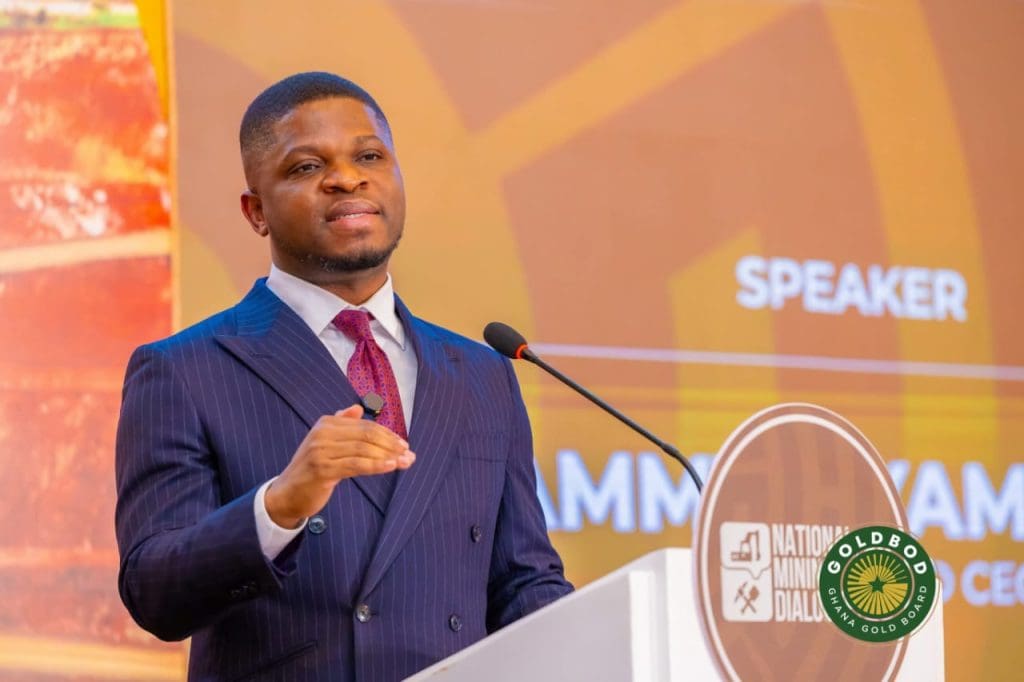
Ghana must move beyond extracting gold to owning more mines, processing more minerals, building local industries and retaining a larger share of the value created along the mining value chain, the Chief Executive Officer of the Ghana Gold Board (GoldBod), Sammy Gyamfi, has said.
He said greater indigenous ownership of mining assets, increased Ghanaian participation in exploration, mine development, mining services and value addition, as well as deliberate investment in host communities, were essential if the country’s mineral wealth was to deliver lasting economic transformation.
Mr Gyamfi said Ghana could no longer be satisfied with increasing gold production while significant portions of the economic benefits continued to accrue to foreign owners, financiers, service providers and downstream industries outside the country.
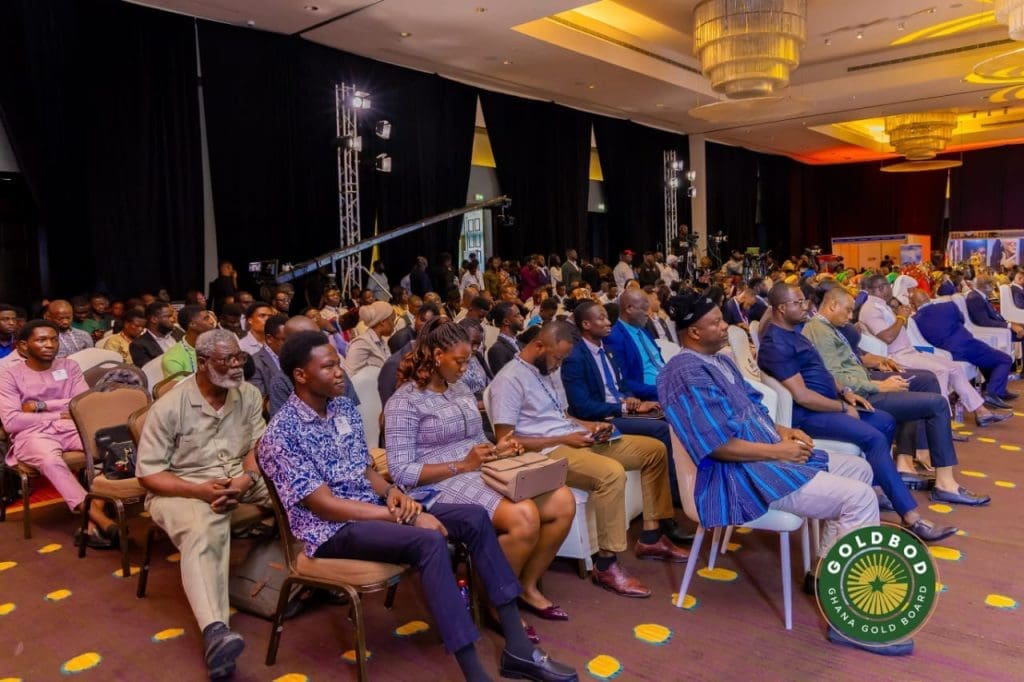
He made the remarks at the National Mining Dialogue held in Accra on the theme, “Rethinking the Social License to Operate.”
According to him, the central question Ghana must confront is why many citizens remain spectators in the ownership and value creation associated with the country’s mineral resources despite mining being one of the most important contributors to the national economy.
“Production without ownership is limited. Production without value addition is leakage. Production without community transformation is a broken social contract,” he said.
Mr Gyamfi argued that Ghana’s mining policy must therefore deliberately connect mineral production with ownership, industrialisation, employment, enterprise development and community transformation.
Own more, refine more, retain more
The GoldBod CEO said the large-scale mining industry had historically been largely foreign-led, resulting in significant portions of the value generated from Ghana’s minerals leaking outside the country through ownership structures, financing arrangements, imported inputs, offshore services, limited beneficiation and weak local industrial linkages.
He stressed that simply extracting more gold would not automatically translate into development unless the country deliberately built the systems required to retain more of the value.
“Extraction without intentional policy does not automatically produce transformation,” he said.
According to him, successful mining economies do not rely solely on production volumes but build value through strategic ownership, partnerships, infrastructure, local linkages, reinvestment and disciplined policy management.
“Own more, refine more, process more, fabricate more and retain more,” he said, outlining what he described as a necessary direction for Ghana’s mining industry.
He called for greater support for Ghanaian capital to participate meaningfully in exploration, mine development, mining services and downstream processing.
He also advocated expanding geological work, responsibly opening new mining fields and ensuring that increases in mineral production were matched by increases in local participation and value retention.
For Mr Gyamfi, the ultimate objective should be to establish local refining, jewellery fabrication and other downstream industries around Ghana’s mineral production rather than continuing to export raw or minimally processed resources.
Gold must transform mining communities
Mr Gyamfi said the debate about the mining sector could not be separated from the conditions in communities where minerals were extracted.
He questioned the justification for continued gold production when many mining communities still struggled with inadequate potable water, poor roads, youth unemployment, weak local economies and limited access to economic opportunities.
“We cannot continue to mine gold from the soil of our communities while poverty, lack of access to potable water, poor roads, youth unemployment and weak local economies remain the daily reality of too many mining communities in our country,” he said.
He described gold as both a strategic national asset and a moral responsibility, arguing that the resource must serve the broader economic interests of Ghana while transforming the communities from which it was extracted.
He said GoldBod’s mandate therefore extended beyond gold trading to helping ensure that every ounce of gold produced in Ghana generated greater value for the country.
Mr Gyamfi said the persistent disconnect between mining wealth and community development was particularly dangerous for the country’s youth.
In many mining communities, he said, young people watched mineral wealth leave their communities without seeing meaningful pathways into decent employment, skills development, business ownership or long-term economic security.
“That contradiction is dangerous. It is not fair. And it is not sustainable,” he said.
Youth must become stakeholders
Mr Gyamfi said Ghana’s social licence to mine could not remain sustainable if young people in mining communities saw themselves only as casual labourers, while mining companies and outsiders controlled most of the opportunities generated by the industry.
He called for a new social compact with the youth that would integrate them into responsible mining through capacity building, sustainable employment, local enterprise development and opportunities to provide services around mining operations.
He said the “Involve, Protect, Expand” approach to mining must ultimately be judged by whether it connected mineral wealth to the future of young people.
Under the proposed approach, mining companies would be expected to create clear pathways for local youth to participate in mining-related services, technical occupations, entrepreneurship and alternative livelihoods.
Mr Gyamfi said communities should also move beyond being consulted by mining companies to becoming genuine development partners and economic participants.
“Mining communities must be treated as development partners and economic shareholders and not mere land donors,” he said.
He called for communities to become active participants across the mining value chain, including exploration services, production support, logistics, fabrication, environmental services, refining, jewellery production and downstream businesses.
When these activities were localised, he said, a mine would become more than an extraction site.
“It becomes a training ground, a market, an industrial anchor and a platform for youth enterprise,” he said.
Local businesses must benefit
The GoldBod CEO said mining companies and policymakers must deliberately create opportunities for businesses in host communities to supply goods and services to mines.
He identified catering, transportation, security, equipment maintenance, reclamation, environmental monitoring, agricultural supplies, housing and local commerce as areas where local enterprises could participate.
He also called for every new mine to have clearly defined commitments on local employment, procurement, enterprise development and infrastructure.
Such commitments, he said, should not be left to goodwill or discretionary corporate social responsibility programmes.
Instead, mining-related community development should be governed by definite contracts that allow communities, district assemblies, traditional authorities and citizens to understand how mineral wealth would translate into tangible development.
He further advocated greater and more decentralised retention of mineral royalties so that development resources could reach communities more directly.
Communities should have greater voice
Mr Gyamfi said mining communities should become “consent providers” rather than simply recipients of information after decisions had already been made.
He called for mining communities to have meaningful voices in licensing processes, clearer access to mining-related opportunities and deliberate pathways for young people to receive training and enter mining services and alternative livelihoods.
This, he argued, would help rebuild trust between communities, mining companies and the state and strengthen the social licence required for responsible mining.
He said communities that hosted Ghana’s mineral wealth should be able to see and feel the benefits of mining in their daily lives.
ASM must be formalised
Turning to artisanal and small-scale mining (ASM), Mr Gyamfi said Ghana must distinguish between responsible miners and operators engaged in destructive practices.
He called for responsible and formalised ASM operators to receive appropriate hard-rock mining equipment, with repayment arrangements that would strengthen GoldBod’s gold aggregation activities while increasing national production and reducing environmental damage.
He said formalisation, traceability and compliance must be strengthened to ensure that responsible miners were supported while illegal and destructive operators faced enforcement.
Water bodies, forests, farmlands and public health, he stressed, must be treated as non-negotiable national assets.
Reclamation and reforestation should be mandatory and effectively enforced, while those responsible for irresponsible mining should be prosecuted and punished in accordance with the law.
GoldBod’s formalisation drive
Mr Gyamfi said GoldBod had, since its establishment, intensified efforts to combat gold smuggling and bring more ASM production into formal channels.
He said about 170 tonnes of ASM gold had been exported through formal channels from 2025 to date, generating more than US$17 billion in foreign exchange.
According to him, the formalisation of gold trading had helped strengthen foreign exchange market stability, national reserves and broader macroeconomic stability.
He said GoldBod had also made local gold trading the preserve of Ghanaians while opening opportunities for Ghanaian jewellers, refiners and young entrepreneurs to become active participants in the value chain.
“This year alone, nearly nine tonnes of gold aggregated by GoldBod has been refined right here in Ghana,” he said.
Ghana Gold Village to deepen value addition
Mr Gyamfi announced plans for the establishment of a Ghana Gold Village in partnership with the private sector to support world-class jewellery manufacturing, gold fabrication and access to international markets for Ghanaian gold products.
The project, he said, would be implemented through GoldBod’s subsidiary, GoldBod Jewellery Limited.
It is expected to serve as a platform for skills development, enterprise creation, employment and industrial growth.
The initiative forms part of the broader effort to shift Ghana’s gold industry from an extraction-oriented model towards a value-creation model in which more processing and manufacturing takes place locally.
He said Ghana had the opportunity to build a globally competitive gold ecosystem in which raw gold was transformed into refined products, jewellery and other high-value goods before being exported.
Citizens to own Ghana’s gold
Mr Gyamfi also disclosed that GoldBod was preparing to introduce a gold tokenisation programme in 2027 aimed at promoting fractional ownership of Ghana’s gold resources by citizens and Africans.
Under the proposed initiative, citizens with relatively modest financial resources would be able to participate in gold-backed investment opportunities.
He said the objective was to broaden ownership of the country’s mineral wealth rather than leaving ordinary Ghanaians on the margins of an industry that contributes significantly to national income.
“We must all own and share in the mineral wealth of our nation,” he said.
Gold’s growing economic importance
Mr Gyamfi cited the increasing contribution of gold to Ghana’s external trade as evidence of the strategic importance of the commodity to the economy.
He said Ghana produced approximately 5.94 million ounces of gold in 2025, with ASM accounting for about 3.11 million ounces, representing roughly 52.4 per cent of national production.
He also cited 2025 merchandise trade data showing total exports of about US$32 billion, with gold accounting for approximately US$20.2 billion, or about 63.1 per cent of export earnings.
Gold, he said, had contributed significantly to Ghana’s record trade surpluses, strengthened international reserves, supported currency appreciation and anchored recent macroeconomic stability.
But he cautioned that the value of the commodity to Ghana should not be measured only by export earnings.
The bigger challenge, he said, was ensuring that the wealth generated by gold was retained within the economy through Ghanaian ownership, local financing, processing, manufacturing, services, employment and community development.
Mr Gyamfi’s central message was that Ghana’s future mining policy must move beyond the question of how much gold the country produces to the more fundamental questions of who owns the assets, who provides the services, who processes the minerals, who manufactures the finished products and who ultimately benefits from the wealth extracted from Ghanaian soil.
For him, a genuinely sustainable social licence to operate will depend on whether mining becomes an engine of broad-based Ghanaian participation rather than an industry in which communities provide the land while others capture most of the economic value.
The proposed shift towards indigenous ownership, local value addition, stronger community participation and greater youth involvement, he said, would ensure that Ghana’s mineral resources become not merely a source of foreign exchange, but a foundation for industrialisation, enterprise development and lasting prosperity.