The Government has accepted far-reaching recommendations to amend Ghana’s 1992 Constitution, endorsing proposals that would extend the presidential and parliamentary terms from four to five years, abolish the death penalty, elect all Metropolitan, Municipal and District Chief Executives (MMDCEs), cap Parliament at 300 members and separate the Office of the Attorney-General from the Ministry of Justice.
The proposals form part of government’s position on the final report of the Constitution Review Committee (CRC), titled “Transforming Ghana from Electoral Democracy to Developmental Democracy.” The report contains 147 proposals for amendments to existing constitutional provisions and 59 entirely new provisions, bringing the total proposed reforms to 206.
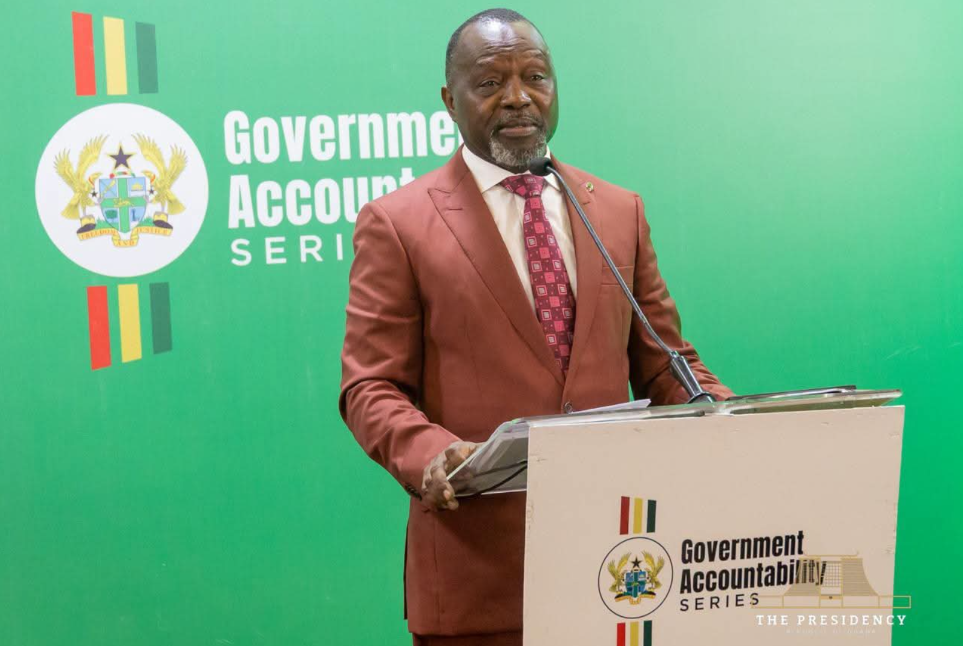
Addressing a press briefing in Accra, the Attorney-General and Minister for Justice, Dr Dominic Akuritinga Ayine, said the government had classified the committee’s recommendations into three categories—accepted, accepted in principle with modifications, and rejected—with reasons provided for every modification or rejection.
5-year presidential term
Among the most significant reforms is government’s acceptance of a proposal to extend the presidential term from four years to five years, with Parliament’s tenure also extended to five years.
Dr Ayine said the current four-year cycle leaves little room for effective governance because the early months of every administration are devoted to transition arrangements while the final year is dominated by electioneering.
“A five-year term provides a more realistic timeframe for the formulation, implementation and assessment of policy,” he said.
He clarified that the proposal, if eventually approved, would apply only to future presidents and not the incumbent.
Government also accepted the recommendation to lower the minimum age for presidential candidates, but with a modification.
While the Committee proposed reducing the age from 40 years to 30 years, government settled on 35 years, arguing that the current threshold unnecessarily excludes qualified citizens while 35 years strikes a balance between inclusiveness and maturity.
Election timetable and disputes
Government further accepted the proposal that presidential elections should be conducted during the first week of November on a date to be determined by the Electoral Commission through a constitutional instrument.
According to Dr Ayine, fixing the election period would provide certainty for political parties, election observers and the Electoral Commission while ensuring sufficient time between elections and the inauguration of a new President on January 7.
On election disputes, government accepted recommendations requiring presidential election petitions to be filed within 14 days after declaration of results and determined by the Supreme Court within 30 days.
The Electoral Commission would also be legally obliged to disclose all relevant election data to both the court and parties involved in the petition.
President to pay taxes
Government also endorsed the principle that the President should no longer enjoy tax exemptions solely because of holding office.
Under the proposal, the President will pay taxes on salary, allowances and all applicable indirect taxes.
However, government rejected suggestions that presidential pensions and retirement gratuities should also be taxed.
Parliament capped at 300
Government accepted the proposal to cap Parliament at 300 members, replacing the current open-ended arrangement.
Under the proposal, 276 MPs will continue to be elected through constituency elections, while the remaining 24 seats will be filled through a proportional representation system reserved for women, persons with disabilities and the youth.
An independent study will be commissioned to determine the design of the proportional representation system.
Government said the reform would both reduce public expenditure and improve representation for historically disadvantaged groups.
Dual citizens cleared
Another major reform accepted by government removes restrictions preventing Ghanaians by birth who possess dual citizenship from contesting parliamentary elections.
Such persons will no longer be required to renounce their foreign citizenship before seeking election to Parliament.
Government said the existing restriction is inconsistent with Ghana’s engagement with its diaspora and modern realities of global citizenship.
Judiciary reforms
Government also endorsed major reforms affecting the Judiciary.
It accepted the recommendation that the Chief Justice should serve a single non-renewable term of 10 years or until reaching the mandatory retirement age, whichever comes first.
The proposal seeks to promote predictable leadership transitions within the Judiciary.
Government also agreed to cap the size of the Supreme Court but increased the Committee’s proposed ceiling.
While the Committee recommended 15 Justices, government proposed 19 Justices, comprising the Chief Justice and 18 other judges.
According to Dr Ayine, this number strikes a balance between efficiency, expenditure control and maintaining sufficient judicial capacity.
Political party reforms
Government accepted recommendations requiring all registered political parties to grant equal voting rights to all members in good standing during the selection of parliamentary and presidential candidates.
Dr Ayine noted that the proposal aligns with a recent Supreme Court decision in Prof. Frimpong Boateng and Others v NPP, NDC and Others, which similarly held that all registered party members should participate in internal elections.
Government also accepted, in principle, the creation of an independent Political Parties Regulatory Commission to assume responsibility for registering and regulating political parties instead of the Electoral Commission.
The commission would be established through legislation and would oversee issues including campaign financing and the proposed Democracy Fund.
All MMDCEs to be elected
Government went beyond the Committee’s recommendation regarding District Chief Executives.
While the Committee proposed a phased election system tied to districts’ fiscal capacity, government insisted that all District Chief Executives should be elected.
Under the proposed arrangement, the President will nominate five persons, including at least two women.
Following vetting by representatives of the Ministry of Local Government, the Public Services Commission and the Local Government Service, three candidates, including at least one woman, will contest the election.
Government argued that allowing only some districts to elect DCEs while others remained appointed would create inequality and political tension.
Independent salaries commission
Government accepted the creation of an Independent Public Emoluments Commission to determine salaries, allowances and benefits for all public office holders, including Article 71 office holders and the President.
Dr Ayine said the current arrangement, where presidential appointees determine the President’s own remuneration, creates an inherent conflict of interest.
Fiscal reforms
Although government agreed with recommendations aimed at strengthening public financial management—including annual reporting of tax expenditures, stronger safeguards for the Contingency Fund, medium-term fiscal frameworks, debt anchors, fiscal sustainability rules and an Independent Fiscal Council—it declined to entrench them in the Constitution.
Instead, government said such reforms would be incorporated into amendments to the Public Financial Management Act, 2016 (Act 921) to ensure flexibility as economic conditions evolve.
Death penalty abolished
Government also accepted the recommendation to abolish the death penalty.
Relevant provisions of Articles 3, 13, 19 and 72 would be amended, with offences previously punishable by death instead attracting life imprisonment.
Government said capital punishment is inconsistent with both the constitutional right to life and Ghana’s international human rights obligations.
Human Rights Act
Rather than amending the entrenched Chapter Five of the Constitution to include numerous new rights, government announced plans to enact a comprehensive Human Rights Act.
The new law will expand protection to economic, social and cultural rights, including rights relating to healthcare, housing, food, a clean environment, women, children, persons with disabilities, older persons and young people.
It will also incorporate Ghana’s obligations under international human rights treaties and provide detailed enforcement mechanisms.
Government also accepted a constitutional right of abode for people of African descent in the diaspora, with Parliament expected to legislate conditions and safeguards, including a heritage-based pathway to citizenship.
Anti-corruption reforms
Government accepted, in principle, proposals for an independent anti-corruption institution but opted for a different model.
Instead of the Committee’s proposed Independent Anti-Corruption and Ethics Commission, government will establish a Public Ethics Commission through the Conduct of Public Officers Bill currently before Parliament.
The Commission will investigate and prosecute corruption and conflict-of-interest offences involving public officials and their private-sector collaborators.
Dr Ayine said the institution would operate independently of executive control.
Attorney-General separated from Cabinet
Government rejected recommendations to remove prosecutorial authority from the Attorney-General but proposed a major institutional reform.
It intends to amend Article 88 so that the Attorney-General ceases to be a Minister of State while remaining the Republic’s principal legal adviser and chief prosecutor.
A separate Minister of Justice will oversee the justice sector.
Government also proposes giving the Attorney-General the same conditions of service as a Supreme Court Justice to strengthen prosecutorial independence.
Citizen-initiated constitutional amendments
Government accepted proposals allowing citizens to initiate constitutional amendments.
However, instead of the Committee’s recommended threshold of five per cent of registered voters, government proposes 10 per cent, together with minimum regional representation and gender-balance requirements.
The initiative will be channelled through the Council of State.
Roadmap
To implement the reforms, President John Dramani Mahama will inaugurate a Constitution Review Implementation Committee (CRIC).
The Committee will prepare two Constitutional Amendment Bills.
One Bill covering non-entrenched provisions will be processed under Article 291, requiring a two-thirds parliamentary majority.
The second Bill, dealing with entrenched provisions, will follow Article 290, requiring publication in the Gazette for six months, parliamentary consideration and a national referendum.
For the referendum to succeed, at least 40 per cent of eligible registered voters must participate, while 75 per cent of valid votes cast must support the amendments.
Government expects both Bills to be ready by October 2026 and intends to hold the referendum alongside the 2027 District Assembly elections to minimise costs.
In addition to the constitutional amendments, government will introduce complementary legislation, including the Human Rights Act and amendments to the Public Financial Management Act, to implement recommendations that do not require constitutional change.