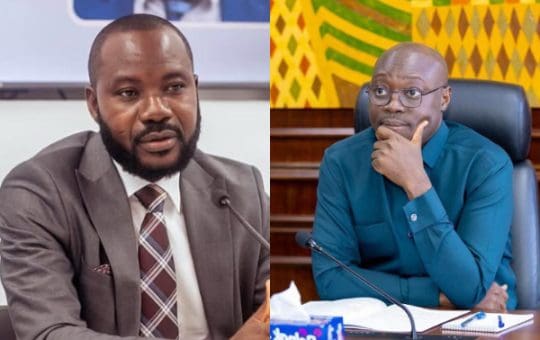
The Centre for Policy Scrutiny (CPS) has raised concerns over what it describes as major inconsistencies in expenditure and capital spending figures contained in the government’s 2026 Mid-Year Budget Review, warning that conflicting data could undermine confidence in Ghana’s fiscal reporting.
The policy think tank said different sections of the budget document presented varying figures for total expenditure and capital expenditure without providing explanations for the differences.
According to the CPS, the discrepancies raise concerns about the credibility of the fiscal data upon which government policies and economic decisions are based.
Dr Adu Owusu Sarkodie, Executive Director of the Centre for Policy Scrutiny, said the inconsistencies must be addressed to improve transparency, accountability and public confidence in Ghana’s budget process.
“The mid-year budget presentation was characterised by data inconsistencies. For instance, the total expenditure as stated on page 25 indicated an amount of GH¢129.2 billion against a target of GH¢158.6 billion. Meanwhile, on page 26, the figure changes to GH¢136.9 billion against a target of GH¢172.5 billion,” he said.
He said similar inconsistencies were identified in capital expenditure figures contained in the document.
“Similarly, the capital expenditure estimates on page 25 stated GH¢21.7 billion actuals against GH¢36.6 billion. But on page 26, the actual H1 2026 CAPEX changes to GH¢22.2 billion,” Dr Sarkodie stated.
“These developments raise serious concerns about the credibility of the data, and to a large extent the entire budget, since the fiscal figures are the foundation upon which government policies are formulated,” he added.
CPS demands stronger fiscal reporting
The CPS review follows the presentation of the 2026 Mid-Year Budget Review by Finance Minister Dr Cassiel Ato Forson in Parliament on Thursday, July 23, 2026.
The Finance Minister highlighted what he described as significant economic gains achieved during the first half of the year, including improvements in economic growth, inflation management, fiscal performance and foreign exchange reserves.
However, in its assessment released on Tuesday, July 28, 2026, the CPS argued that conflicting figures in the government’s own budget document require urgent clarification.
The Centre called on the Ministry of Finance to strengthen fiscal transparency by ensuring consistency across official budget documents and publishing more detailed budget execution reports for ministries, departments and agencies (MDAs).
It also recommended that future budget statements and mid-year reviews provide detailed comparisons between approved budgets and actual expenditure at the programme level to enable independent assessment and improve accountability.
Fiscal gains achieved through spending cuts — CPS
Beyond the data inconsistencies, the CPS said Ghana’s stronger-than-expected fiscal performance came largely through reduced expenditure rather than improved revenue mobilisation.
The Centre said the government’s expenditure-led fiscal consolidation strategy helped improve fiscal balances, reduce borrowing pressures and support debt sustainability.
However, it warned that the approach also resulted in significant under-execution of critical government programmes and capital projects.
According to the CPS, about GH¢30.7 billion in programme-critical expenditure remained unfulfilled over the past 18 months.
Dr Sarkodie said although fiscal consolidation had produced benefits, the reduction in the deficit was partly achieved because actual spending was lower than planned.
“There is no doubting the benefits of the consolidation. The decrease in the deficit means a decrease in borrowing (as a share of GDP), fostering debt sustainability and macroeconomic stability,” he said.
“That said, because the deficit fell by a greater amount than intended, largely as a result of actual expenditure being lower than planned, the consolidation left in its wake unfulfilled budgetary allocations. Hence, many MDAs could not undertake planned capital projects or make expected progress on them,” he added.
Nearly 40% capital expenditure shortfall in 2025
The CPS said government failed to execute almost 40% of the GH¢32.7 billion allocated for capital expenditure in 2025.
For the first half of 2026, the Centre said about GH¢20.5 billion, representing 27% of programme-critical spending on goods and services, capital expenditure, grants and social benefits, was not disbursed.
It said the combined shortfall in programme-critical expenditure for 2025 and the first half of 2026 amounted to approximately GH¢30.7 billion.
Dr Sarkodie said the spending gaps were affecting the delivery of government programmes despite improvements in headline fiscal indicators.
“This is a material difference, whose implication is that many government programmes are being under-delivered, resulting in reduced outputs and outcomes in relation to set targets,” he said.
Call for revenue-led consolidation
The CPS argued that while expenditure restraint had helped improve Ghana’s fiscal position, government must complement the strategy with stronger revenue mobilisation.
“The government has used an expenditure-led fiscal consolidation. There is also the need to embark on revenue-led fiscal consolidation without overburdening the taxpayer,” Dr Sarkodie said.
The Centre urged the Ministry of Finance to improve budget implementation systems to ensure that approved allocations translate into completed projects, improved public services and measurable development outcomes.
It maintained that beyond achieving favourable fiscal indicators, the success of the budget must ultimately be measured by the extent to which government programmes are implemented and deliver benefits to citizens.