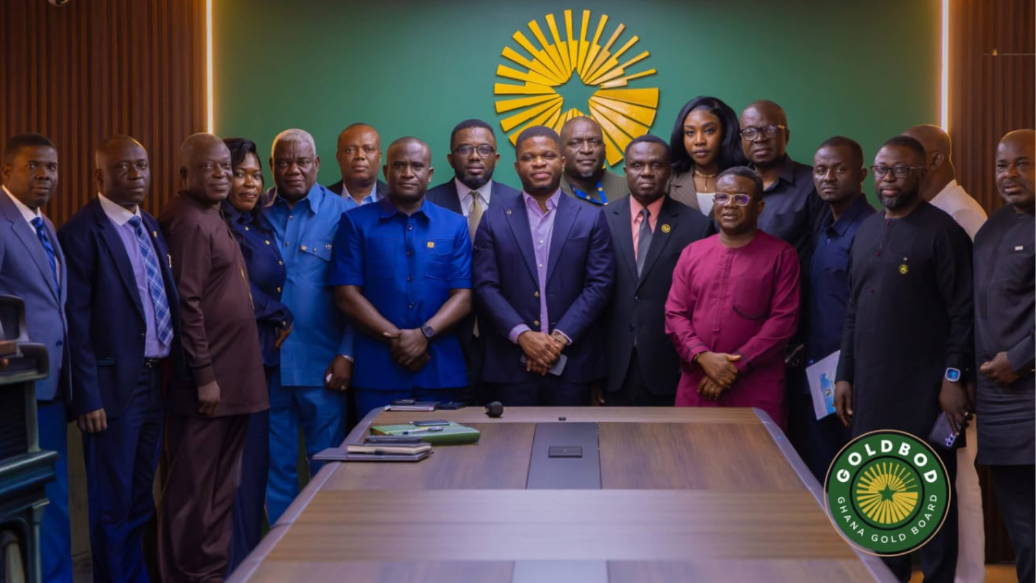
The Parliamentary Select Committee on Economy and Development has paid a working visit to the Ghana Gold Board (GoldBod) to assess the institution’s operations, achievements and strategic direction as the country intensifies efforts to maximise the economic benefits of its gold resources.
The visit formed part of Parliament’s oversight mandate to evaluate GoldBod’s contribution to Ghana’s economy, particularly in the areas of gold trading, foreign exchange mobilisation, reserve accumulation and value addition.
Chairman of the Committee, Eric Afful, said the engagement was aimed at understanding the impact of GoldBod’s operations and how the institution was supporting Ghana’s economic recovery through improved management of the country’s gold resources.
He noted that the Committee was interested in assessing the Board’s role in strengthening the gold value chain, improving foreign exchange inflows and ensuring that Ghana captures greater value from its mineral wealth.
GoldBod outlines reforms
Welcoming the parliamentary delegation, Chief Executive Officer (CEO) of GoldBod, Sammy Gyamfi, Esq., provided a comprehensive overview of the institution’s transformation from the former Precious Minerals Marketing Company (PMMC) into the Ghana Gold Board.
He highlighted GoldBod’s licensing framework, funding model, ongoing review of the Ghana Gold Board Act, 2025 (Act 1140) and initiatives designed to promote responsible mining, gold traceability and value addition.
The CEO also briefed the Committee on GoldBod’s partnerships with large-scale mining companies, the Board’s gold aggregation performance for 2025 and 2026, as well as its new trading model aimed at improving efficiency and transparency in Ghana’s gold export sector.
In a major announcement, Mr Gyamfi disclosed that GoldBod would procure a comprehensive gold traceability system by the end of August 2026 to enable the institution to track all gold purchased from the mine site through to export.
The system is expected to strengthen accountability, improve confidence in Ghana’s gold exports and support efforts to eliminate illegal gold trading and smuggling.
GoldBod purchases 54 tonnes in first half of 2026
GoldBod purchased 54 metric tonnes of gold from the artisanal and small-scale mining (ASM) sector in the first half of 2026, placing Ghana on course to match or surpass the record-breaking performance achieved in the previous year.
The latest figures reinforce the growing dominance of the ASM sector in Ghana’s gold industry and position gold as a critical source of foreign exchange earnings for an economy recovering from one of its worst financial crises in decades.
The strong performance follows an exceptional 2025, when GoldBod purchased and exported 104 metric tonnes of gold from the ASM sector, marking the first time small-scale mining output exceeded production from Ghana’s large-scale mining companies.
The ASM sector generated nearly US$11 billion in foreign exchange earnings for Ghana in 2025, surpassing the approximately US$9 billion contributed by large-scale mining companies.
The development highlights the increasing importance of artisanal and small-scale mining to Ghana’s economy, with the sector now emerging as the country’s largest source of export revenue and foreign exchange inflows.
GoldBod records US$16.11bn gold transactions
Cumulatively, GoldBod purchased and exported gold worth US$16.11 billion between January 2025 and May 2026.
During the period, the Board purchased a total of 135.843 metric tonnes of gold, with 135.221 metric tonnes coming from the artisanal and small-scale mining sector, representing virtually the entire volume purchased.
GoldBod said the performance demonstrates the expansion of licensed small-scale mining operations following reforms introduced to formalise the sector, reduce illegal gold trading and increase official gold purchases.
The Board explained that the reforms have significantly increased the volume of gold entering official marketing channels, enabling the state to capture more export revenue from the country’s growing artisanal mining industry.
The continued growth in official gold purchases has also strengthened Ghana’s external position by increasing dollar inflows at a time government is working to stabilise the economy and consolidate recent macroeconomic gains.
1,184 gold buyers licensed under goldbod regime
GoldBod’s regulatory reforms have expanded oversight within the gold trading sector, with the Board licensing 1,184 gold buyers as of May 31, 2026.
The licensed operators comprise two aggregators, 67 self-financing aggregators, 736 Tier Two buyers and 379 Tier One buyers.
Under the GoldBod framework, all licensed buyers are required to purchase gold exclusively from licensed miners before selling the precious metal to the Board for export.
The licensing system is part of broader measures aimed at reducing gold smuggling, improving traceability and ensuring that export proceeds flow through official channels to strengthen Ghana’s foreign exchange reserves.
Gold sector drives foreign exchange recovery
GoldBod attributed the strong production and export performance to reforms implemented within the gold sector to combat smuggling and improve formal gold purchases.
The Board said the reforms have helped increase the amount of gold captured through official channels, allowing the country to benefit more from its largest export commodity.
GoldBod’s original projections for 2026 were based on an average gold price of about US$5,000 per ounce and average weekly purchases of approximately 2.5 metric tonnes.
Although gold prices have declined from those assumptions, the Board said average bullion prices remain above 2025 levels, meaning Ghana is still expected to record higher gold export earnings in 2026 than in the previous year.
However, revenues could fall below the initial projections due to changes in international gold prices.
With small-scale mining continuing to outperform the large-scale sector, GoldBod expects the gold industry to remain a major pillar of Ghana’s foreign exchange earnings and economic recovery throughout 2026.
Gold purchases linked to reserve accumulation target
GoldBod’s growing role in the gold sector is also expected to support the government’s Ghana Accelerated National Reserve Accumulation Programme (GANRAP), which seeks to build Ghana’s foreign reserves to the equivalent of 15 months of import cover by the end of 2028.
Current estimates place Ghana’s import cover at about 5.7 months, meaning the country must accumulate an additional 9.3 months of import cover to achieve the target.
Government estimates that achieving this objective will require an average annual net reserve build-up of approximately US$9.5 billion after accounting for external debt servicing, foreign exchange market interventions, energy sector obligations and other statutory payments.
As part of GANRAP’s operational framework, government has established a weekly gold purchase target of approximately 3.02 metric tonnes.
Officials estimate that achieving this target could generate annual gross inflows of about US$25.3 billion, providing a significant buffer for reserve accumulation, exchange rate stability and long-term economic resilience.
The engagement between Parliament and GoldBod underscores the growing importance of gold management in Ghana’s economic strategy, as the country seeks to strengthen foreign reserves, improve export earnings and ensure greater value retention from its mineral resources.