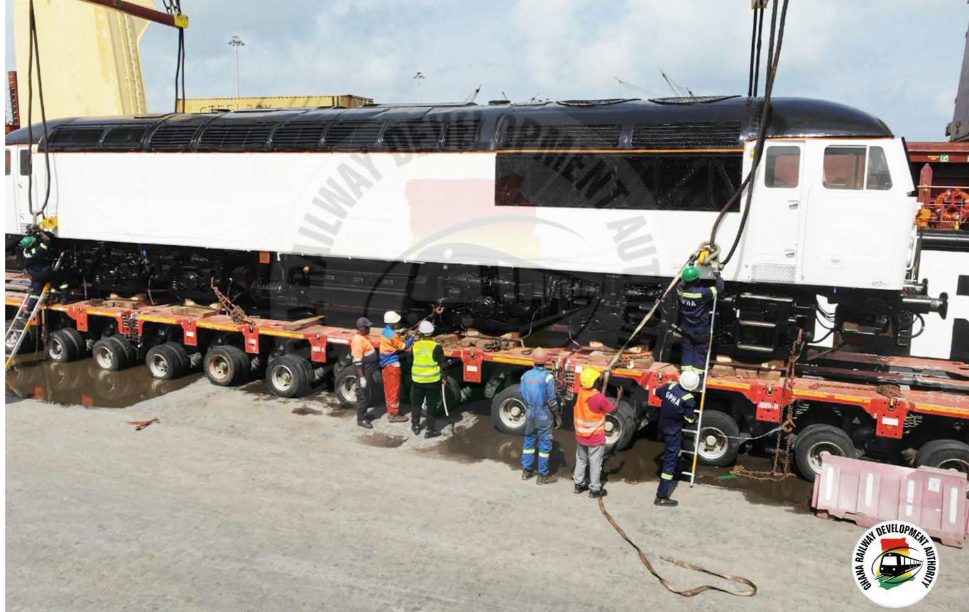
The Ministry of Transport has mounted a vigorous defence of the government’s acquisition of two refurbished Class 56 diesel locomotives and 20 freight wagons, arguing that the entire package cost only $3.18 million (about GH¢37.6 million)—significantly less than the $14.67 million (about GH¢164.7 million) spent by the previous New Patriotic Party (NPP) administration on two passenger Diesel Multiple Unit (DMU) trains.
According to the Ministry, the comparison demonstrates prudent use of public funds, insisting that while the previous administration spent more than GH¢164 million on passenger rolling stock, the current government has acquired heavy freight locomotives and container wagons capable of generating commercial revenue at only a fraction of that cost.
The Ministry’s response follows criticism by the NPP Minority Transport Committee, which questioned the acquisition of the British-built locomotives, describing them as obsolete and likening them to “museum pieces.”
However, the Ministry dismissed the criticisms as technically flawed and politically motivated, insisting that the procurement was carefully designed to establish Ghana’s first structured container rail freight network and transform the country’s logistics system.
Ministry rejects “museum pieces” claims
In a detailed statement, the Ministry said critics had fundamentally misunderstood modern railway engineering by focusing solely on the manufacturing age of the locomotives instead of their engineering condition and commercial value.
It stressed that railway assets are assessed based on structural integrity, remaining fatigue life, refurbishment quality, maintainability, tractive effort, axle load, route compatibility and whole-life operating costs rather than the year they were originally manufactured.
The Ministry therefore rejected suggestions that the locomotives were obsolete.
“The characterisation of the locomotives as museum pieces or mere toys is factually inaccurate and reflects a fundamental misunderstanding of railway engineering and locomotive operations,” it stated.
Extensive refurbishment completed
The Ministry disclosed that before shipment to Ghana, both locomotives underwent comprehensive heavy maintenance and major overhauls in the United Kingdom.
According to the statement, engineers completely rebuilt the diesel engines, overhauled the electrical traction systems, serviced the traction motors and bogies, and replaced worn mechanical components.
The locomotives were also upgraded with modern braking systems, GSM-R digital railway communication equipment and standard railway safety systems required for operation on Britain’s mainline network.
Following independent testing and certification, the supplier provided a five-year warranty against operational defects.
The Ministry said the extensive refurbishment gives the locomotives an expected operational lifespan of at least 15 years under normal maintenance schedules without requiring another major overhaul.
Spare parts readily available
Responding to concerns about maintenance and spare parts, the Ministry maintained that the Class 56 locomotives remain in active commercial freight service across Europe.
It identified operators including Colas Rail, DCRail and GB Railfreight in the United Kingdom, as well as Floyd Zrt in Hungary, as companies that continue to deploy the locomotives for heavy freight operations.
According to the Ministry, Colas Rail currently uses the same locomotive class under a five-year £58 million contract running until 2030 for Network Rail’s infrastructure maintenance programme.
DCRail, it added, also continues to use the locomotives to transport aggregates, construction materials and industrial minerals.
Because the locomotives remain commercially active, the Ministry said spare parts remain readily available internationally.
It disclosed that the Ghana Railway Development Authority (GRDA) has already secured a five-year stock of fast-moving spare parts and technical consumables to support uninterrupted operations.
Engineers training Ghanaians
Beyond spare parts procurement, the Ministry said international railway engineers have already arrived in Ghana to train local technicians.
The training programme, it explained, is intended to transfer specialised engineering knowledge to GRDA engineers and mechanical technicians, enabling them to independently maintain and service the locomotives throughout their operational life.
Freight—not passenger—trains
The Ministry also rejected comparisons between the newly acquired locomotives and the PESA Diesel Multiple Units procured under the previous administration.
It explained that the PESA trains were designed exclusively for passenger transport and do not possess the tractive power required to haul heavy freight.
The newly acquired Class 56 locomotives, by contrast, were specifically selected for heavy cargo operations.
According to the Ministry, comparing passenger trains with freight locomotives demonstrates a misunderstanding of railway engineering and freight economics because the two categories are designed for entirely different operational purposes.
Revenue generation
The Ministry emphasised that the locomotives and wagons are commercial assets intended to generate sustainable revenue rather than simply provide transportation.
Once operational, they will transport shipping containers and heavy industrial cargo between Tema Port and the inland terminal at Mpakadan.
Government expects the freight operations to reduce logistics costs for industry, ease pressure on Ghana’s road network, lower road maintenance costs and provide a reliable revenue stream for the national railway system.
Cargo infrastructure ready
Responding to claims that the Tema-Mpakadan corridor lacks adequate cargo-handling facilities, the Ministry said the GRDA already possesses two operational reach stackers capable of loading containers onto railway wagons.
These are complemented by five heavy-duty forklifts to support terminal operations and bulk cargo handling.
The Ministry further disclosed that procurement is underway for two additional gantry cranes to expand long-term cargo handling capacity.
It therefore described claims that freight operations lack lifting equipment as “factually incorrect, technically uninformed and politically mischievous.”
Commercial demand already confirmed
The Ministry also rejected suggestions that there is insufficient cargo to justify the investment.
It revealed that extensive feasibility studies and traffic demand analyses undertaken before financing was secured from the India EXIM Bank in 2016 confirmed strong commercial demand along the Tema-Mpakadan corridor.
According to the Ministry, the GRDA is currently finalising commercial off-take agreements, with one agreement alone expected to generate approximately US$3.5 million annually.
Government therefore believes the investment could recover its acquisition cost within two years before delivering many more years of profitable operations.
Rail sector inherited in poor condition
The Ministry also criticised the previous administration’s management of Ghana’s railway sector.
It alleged that despite operating a dedicated Ministry of Railway Development between 2017 and 2024, several key rail projects deteriorated or stalled.
Among the examples cited were the Kojokrom-Sekondi railway line, which it said remained dormant for more than two-and-a-half years before being rehabilitated under the current administration, and the Tema-Mpakadan railway, which it claimed was inherited with defective signalling systems and missing track fasteners.
The Ministry further pointed to stalled works on the Western Railway Line, inherited salary arrears for railway workers and the expenditure of $2.5 million on the abandoned Sky Train project, which it said produced no operational infrastructure.
By contrast, it highlighted the recommissioning of damaged DMU trains, restoration of passenger services between Kojokrom and Sekondi, ongoing rehabilitation of the Western Railway Line and corrective works on the Tema-Mpakadan signalling system, supported by a $21 million European Union grant.
The Ministry maintained that the freight locomotive acquisition reflects modern railway economics and prudent investment.
Rather than treating the railway sector as a recurring financial burden, it said government intends to transform it into a productive national asset capable of moving freight efficiently, lowering transport costs, protecting road infrastructure, supporting industrialisation and generating sustainable revenue to underpin Ghana’s 24-hour economy agenda.