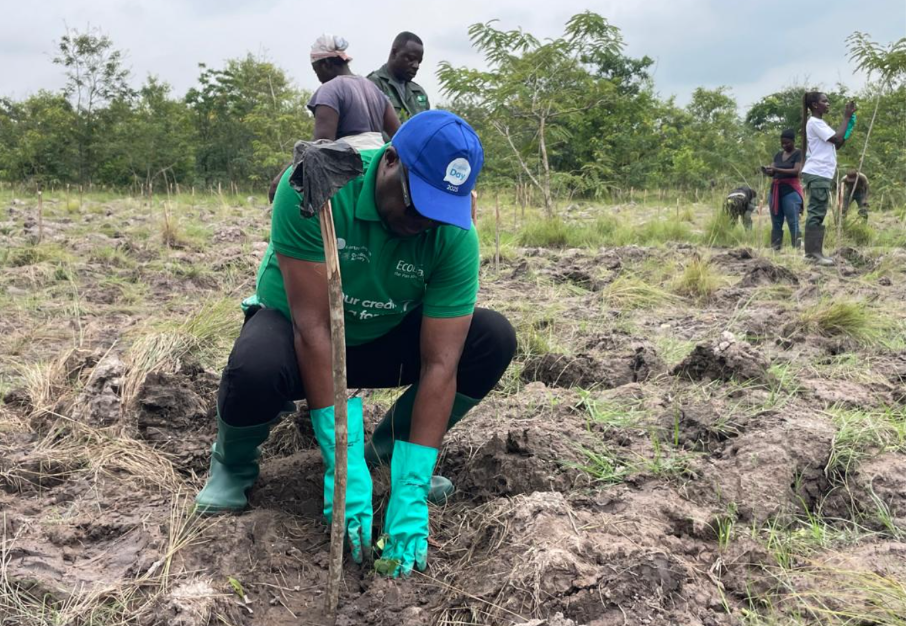
Ecobank Ghana has intensified its commitment to environmental sustainability and climate action with the planting of about 2,000 trees on a two-hectare stretch of the degraded Chipa Forest Reserve in the Greater Accra Region.
The tree-planting exercise, which took place on Thursday in collaboration with the Forestry Commission, forms part of the bank’s month-long environmental sustainability programme and supports the government’s Tree for Life initiative aimed at restoring degraded landscapes and mitigating climate change.
Speaking at the planting site, the Head of Marketing and Corporate Communications at Ecobank Ghana, Dr Daniel Kasser Tee, said the bank’s commitment to environmental conservation was not new, noting that it had been undertaking tree-planting exercises for more than a decade.
“As I indicated earlier, we have been in this business of environmental consciousness and sustainability issues for a long time,” he said.
Dr Kasser Tee recalled that in 2012, the bank planted more than 1,200 trees at Prampram Senior High School and was encouraged by the survival rate of those trees.
“Last week, we were at Prampram Senior High School after 14 years of doing the initial planting, where we went to donate an additional 1,400 trees. We were very excited to see that the initial 1,200 trees were largely doing well,” he stated.
Expanded scope
He explained that following the launch of the Tree for Life initiative by President John Dramani Mahama last year, Ecobank decided to expand its environmental interventions across the country.
According to him, the bank last year extended its tree-planting campaign to five regions and supported 27 institutions, including schools, churches and hospitals.
“We joined in last year and broadened our scope, covering five regions and selecting 27 institutions, including schools, churches and hospitals,” he said.
As part of this year’s programme, Ecobank participated in the national launch of the initiative on June 5 and has since carried out planting exercises in Accra, Takoradi, Sunyani and Tamale, with Kumasi scheduled to undertake its exercise on Friday.
At the Chipa Forest Reserve, the bank is not only planting new seedlings but also monitoring and replacing trees planted last year that may not have survived.
“Last year, we started with a two-hectare piece of land and planted about 1,800 trees. This year, we are going to do about 2,000 and revisit last year’s site to see how those trees are faring and how we can contribute towards replacing all the dead ones,” Dr Kasser Tee explained.
Sustainability and banking
Responding to questions on the relationship between banking and environmental conservation, Dr Kasser Tee said sustainability was embedded in the bank’s operations.
“Tree planting and sustainability cover every sphere of life, including banking,” he said.
He cited Ecobank’s environmentally friendly head office building and its digital transformation agenda as examples of efforts to reduce its ecological footprint.
“We have cut down the use of paper. Our digital transformation agenda is also riding on the back of that. So you will see that there is no more paperwork, as much as possible. Paper comes from trees, and we are discouraging the degradation of the environment,” he stated.
He stressed that the bank remained committed not only to planting trees but also to ensuring their survival.
“That is why we have taken it upon ourselves to keep planting trees and then nurture them and ensure that they survive,” he added.
Restoring a degraded forest
The Tema and Dodowa Forest District Manager of the Forestry Commission, Mrs Linda Ansa, said the Chipa Forest Reserve had suffered degradation mainly due to illegal harvesting of firewood and other human activities.
“We are doing this tree planting at Chipa Forest Reserve because it is a degraded forest reserve. The degradation is caused by the illegal harvesting of firewood,” she explained.
She said the newly planted trees would help restore the forest and contribute to climate change mitigation.
“If you give us some five years, we’ll get what we call canopy closure. They will all grow and we’ll achieve canopy closure. We will also be able to mitigate climate change and restore the degraded Chipa Forest Reserve,” she said.
Mrs Ansa commended Ecobank and other corporate institutions for supporting the restoration effort, stressing that government alone could not shoulder the responsibility.
“We always need corporate organisations like Ecobank to partner with the Forestry Commission to plant trees, restore the degraded Chipa Forest Reserve and also mitigate climate change, which is our ultimate goal,” she said.
She disclosed that about 24 hectares of degraded portions of the reserve had been earmarked for restoration this year, with Ecobank, Telecel Ghana and Stanbic Bank among the organisations supporting the exercise.
Mrs Ansa added that the Forestry Commission had put in place measures such as watering, weeding, replacement planting and the creation of fire belts to ensure the survival of the trees, noting that those planted in the reserve last year were “doing very well.”