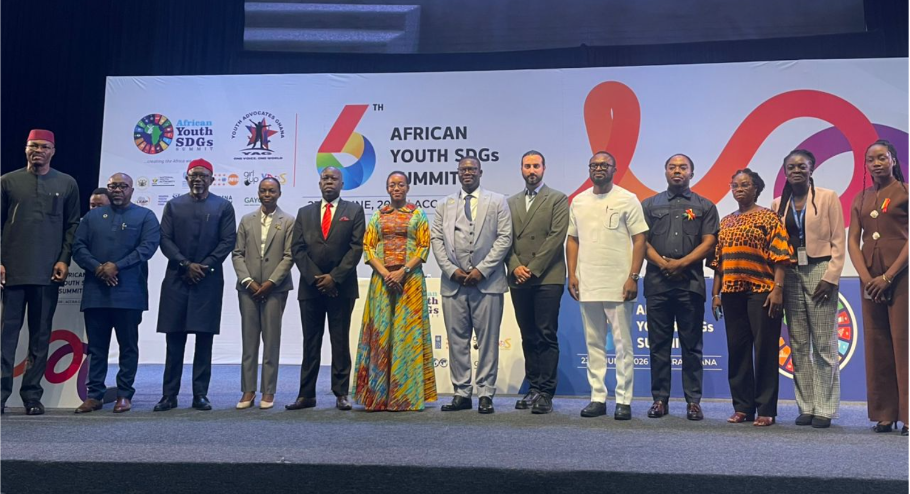
The sixth edition of the African Youth Sustainable Development Goals (SDGs) Summit has opened in Accra, bringing together about 1,000 young leaders, policymakers, development partners, civil society organisations, and United Nations agencies from across Africa and the diaspora to advance youth-driven solutions to the continent’s development challenges.
Held under the theme, “Reimagining Africa through Youth-Driven Solutions,” the three-day summit aims to amplify the voices of young people, showcase innovation, and accelerate action towards achieving the Sustainable Development Goals (SDGs) by 2030.
Participants are deliberating on a wide range of issues, including youth unemployment, economic inclusion, digital transformation, climate action, gender equality, governance, entrepreneurship, and innovation.
Youth must shape Africa’s future
The Member of Parliament for Klottey Korle and Vice-President of the Pan-African Parliament, Dr Zanetor Agyeman-Rawlings, called on young Africans to reject tokenism, challenge outdated systems, and take a leading role in shaping the future of the continent.
She stressed that Africa’s future could not be built using the same approaches that have contributed to many of the challenges confronting the continent today.
Dr Agyeman-Rawlings encouraged young people to pursue leadership opportunities boldly, recalling that her late father, former President Jerry John Rawlings, assumed national leadership in his early thirties.
She challenged narratives that reduce Africa’s youthful population to statistics associated with unemployment and demographic pressures, arguing that young people should instead be recognised as individuals with unique talents, aspirations, and perspectives.
“We must be careful not to reduce youth to an abstract concept that nobody really understands except to see it as a threat,” she said.
The Pan-African Parliament Vice-President further criticised the tendency of governments and institutions to engage young people only after policies have already been formulated.
According to her, meaningful youth participation requires involvement from the earliest stages of policy design, budgeting, and implementation.
Dr Agyeman-Rawlings also underscored the importance of investing in human capital, describing Africa’s people as the continent’s most valuable resource.
She urged governments to increase investment in education, research, innovation, and development programmes that equip young people with the skills and opportunities needed to contribute meaningfully to national development.
She further encouraged participants to build networks and partnerships across the continent, noting that such relationships would be critical in driving future collaboration and leadership.
Touching on emerging technologies, Dr Agyeman-Rawlings expressed concern about the rapid advancement of artificial intelligence and its potential implications for human rights and human autonomy.
She called for robust legal and regulatory frameworks to ensure that human oversight remains central to decision-making processes.
Youth key to achieving SDGs
The Director of the Regional Service Centre for Africa at the United Nations Development Programme (UNDP), Matthias Naab, highlighted the central role of young people in accelerating Africa’s progress towards achieving the Sustainable Development Goals.
He described the summit as taking place at a critical moment, with less than five years remaining to achieve the targets outlined under the 2030 Agenda for Sustainable Development.
Mr Naab noted that Africa remains the youngest continent in the world, with more than 60 per cent of its population under the age of 25.
He explained that between 10 million and 12 million young Africans enter the labour market annually, while only about three million formal jobs are created each year.
Despite these challenges, he urged young people to focus on opportunities rather than obstacles.
According to him, Africa’s vibrant entrepreneurial ecosystem presents significant potential for economic transformation and job creation.
He pointed out that micro, small and medium-sized enterprises account for more than 80 per cent of jobs across the continent, while Africa records the highest rate of early-stage entrepreneurship globally.
UNDP highlights youth empowerment initiatives
Mr Naab outlined a number of flagship UNDP programmes aimed at equipping young Africans with the skills, financing, and opportunities needed to drive innovation and sustainable development.
Among them is the Timbuktoo Initiative, which seeks to establish Africa’s largest innovation ecosystem through the creation of 54 university innovation hubs, known as UniPods, across the continent.
He revealed that 20 of the centres are already operational, including a major facility at the University of Ghana, providing mentorship, technology, and support for young innovators.
The UNDP official also highlighted the success of YouthConnekt Africa, a youth empowerment platform currently operating in 39 countries.
Through the initiative, more than 30,000 jobs have been facilitated, while over 2,000 youth-led enterprises have received support through entrepreneurship programmes, skills development, and access to finance.
On climate action, he said UNDP’s Youth4Climate programme has supported 69 youth-led climate solutions across Africa with nearly US$1.8 million in funding, enabling young people to transform environmental challenges into opportunities for green growth and resilience.
In the area of peace and security, Mr Naab highlighted the Tech for Peace in the Sahel initiative, through which 85 young leaders have received digital and cybersecurity training, while an additional 100 participants are currently undergoing training in Dakar, Senegal.
He said the various initiatives demonstrate that when young people are provided with opportunities, resources, and trust, they become powerful agents of change capable of driving sustainable development across the continent.
Mr Naab emphasised that achieving the SDGs would require more than dialogue and declarations, calling for stronger partnerships, sustained investment, and concrete action to unlock the full potential of Africa’s youth.
“We need to move beyond conversations and commitments to tangible action that empowers young people to lead Africa’s development transformation,” he said.