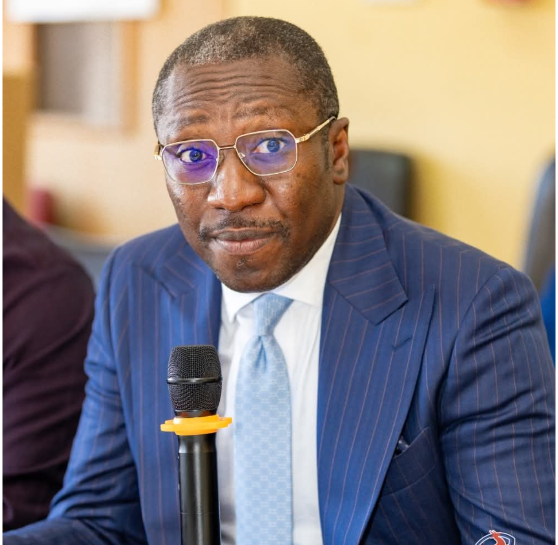
Minority Leader Alexander Afenyo-Markin has mounted a strong defence of the One District One Factory (1D1F) initiative, arguing that the government’s decision to discontinue the programme has significantly worsened Ghana’s unemployment crisis and weakened industrial growth across the country.
According to him, the cancellation of the flagship industrialisation policy has created a major vacuum in Ghana’s private sector development strategy at a time when youth unemployment continues to rise and thousands of young people struggle to secure stable jobs.
Mr. Afenyo-Markin contended that if the programme had been sustained and expanded, many districts would still be attracting investment, supporting local production and creating employment opportunities for the youth.
“The 1D1F was one key policy decision that they should have sustained because in Ghana today, our main problem is unemployment,” he stated.
He made the remarks while criticising what he described as the government’s failure to build on the economic gains inherited from the previous administration led by former President Nana Addo Dankwa Akufo-Addo.
Experts say the 1D1F policy should have formed a major foundation for the government’s proposed 24-hour economy policy, which is largely premised on companies operating multiple shifts around the clock.
Official cancellation raises questions
However, to the surprise of many, the Minister for Trade, Agribusiness and Industry, Mrs. Elizabeth Ofosu-Adjare, officially announced the cancellation of the initiative last year.
The declaration effectively brought to an end one of the previous administration’s flagship economic transformation programmes.
However, industry players say there has been little clarity regarding the fate of incomplete projects, ongoing investor commitments and factories that were still under development.
No official audit has yet been published detailing which projects will continue, which have been abandoned, and whether some initiatives will eventually be absorbed into the government’s proposed 24-hour economy framework.
For many affected districts and investors, the uncertainty carries significant economic implications.
A policy built around jobs and industrialisation
Launched in 2017, the One District One Factory initiative became one of the most ambitious industrialisation programmes in Ghana’s recent history.
The policy sought to establish at least one factory in each of Ghana’s 261 districts with the aim of decentralising industrial growth, stimulating local economies, reducing rural-urban migration and creating sustainable employment opportunities.
Unlike previous state-led industrialisation programmes, the 1D1F initiative relied heavily on partnerships between government and private investors.
Government provided tax incentives, subsidised utilities, policy backing and access to financing support to encourage investors to establish factories in underserved districts.
The factories covered a broad range of sectors including agro-processing, pharmaceuticals, textiles, recycling, aluminium processing, food packaging, ceramics, manufacturing and automobile assembly.
About 300 Factories initiated
By the end of the Akufo-Addo administration, official reports indicated that more than 300 factories were at different stages of implementation, with over 150 already operational across the country.
The programme generated thousands of direct and indirect jobs, particularly in rural communities where formal employment opportunities had historically been limited.
Some of the major factories established under the initiative included the Ekumfi Fruits and Juices factory in the Central Region, which processes mango, pineapple, passion fruit and ginger and reportedly employs about 5,000 people.
Other notable projects included the Twyford Ceramics factory in the Western Region, Keda Ceramics in Shama, the Pwalugu Tomato Factory in the Upper East Region, Birim Oil Mills in the Eastern Region, and Skylines Steel Company in Ejisu.
The initiative also supported agro-processing factories such as EKA Foods in Bono Region, Miros Farms in Ashanti Region, Boris ‘B’ Farms, Anok Jess Farms and Happy Sunshine Company Limited.
Additional projects included fertilizer production by Glofert Ghana Limited, aluminium profile manufacturing by Golden Milan Limited, compost and recycling plants in Accra, bottled water production by Everpure Ghana Limited and tissue production by Brompton Portfolio.
Supporters of the programme argue that these factories collectively created economic ecosystems within districts by supporting farmers, transport operators, traders and suppliers.
Rising unemployment and missing industrial alternative
Mr. Afenyo-Markin argued that the discontinuation of the programme has come at a time when Ghana’s youth unemployment situation remains severe.
According to him, the government has failed to present any comprehensive alternative policy capable of replacing the employment generation potential of the 1D1F initiative.
His comments reflect growing concerns among business groups and industry analysts that Ghana’s industrial momentum may be slowing just as unemployment pressures intensify.
For many economists, industrialisation remains one of the most effective long-term solutions to unemployment because factories create jobs not only within production plants but also across supply chains, transportation, agriculture, logistics and retail.
Under the 1D1F framework, many factories depended heavily on raw materials sourced directly from local farmers and small businesses, creating economic linkages that extended far beyond the factory gates.
In agro-processing districts, for instance, farmers gained ready markets for products such as cassava, tomatoes, mangoes, rice, spices and oil palm, helping to stimulate local production and improve household incomes.
Analysts warn that abandoning such projects risks disrupting these local economic chains and reducing employment opportunities in both agriculture and manufacturing.
AGI raises concerns over stalled projects
Mr. Afenyo-Markin revealed that concerns over the fate of ongoing 1D1F projects emerged during a recent engagement between the Minority Caucus and the Association of Ghana Industries (AGI).
According to him, business leaders expressed frustration over stalled factories and uncertainty surrounding the government’s policy direction for the private sector.
An example is a watermelon processing factory in Walewale which reportedly about 90% complete but has stalled because of lack of government support.
The Minority Leader disclosed that Parliament has since filed a question for the Minister for Trade demanding clarity on what alternative industrial policy has replaced 1D1F and what measures are being implemented to support incomplete projects.
The concerns reflect growing anxiety among investors and communities that ongoing factory projects may eventually be abandoned entirely.
Ghana’s industrial rise to 8th in Africa linked to 1D1F
The defence of the programme also comes against the backdrop of Ghana’s growing recognition as an emerging industrial hub during the implementation years of 1D1F.
Last year, Ghana was ranked the eighth most industrialised manufacturing country in Africa in a report published by The African Exponent, an analytical platform for entrepreneurs and investors across the continent.
The report attributed part of Ghana’s industrial progress to the 1D1F initiative as well as the international success of established Ghanaian manufacturing companies such as Kasapreko and Fan Milk.
Supporters of the programme argue that the ranking demonstrated Ghana’s gradual progress toward building a stronger industrial base capable of improving export competitiveness and reducing dependence on imports.
Factories as engines of rural transformation
One of the strongest arguments in favour of the 1D1F initiative has been its role in shifting industrial activity away from Accra and Kumasi into rural Ghana.
Many districts that previously had little or no industrial presence began experiencing increased economic activity as factories attracted workers, suppliers, transport operators and traders.
The programme also contributed to reducing migration pressures by creating jobs closer to people’s communities.
In many districts, factories established under the initiative became the largest formal employers in the area.
Analysts warn that halting such initiatives without a credible replacement strategy risks reversing gains in rural industrialisation and deepening youth unemployment.
Industrialisation and the future of jobs
While critics of the programme raised concerns over financing sustainability, uneven distribution and operational challenges faced by some factories, many economists maintain that industrialisation remains indispensable to solving Ghana’s unemployment crisis.
The central debate now, analysts say, is not merely whether the 1D1F policy had weaknesses, but whether Ghana can afford to abandon a large-scale industrial job creation strategy without putting a credible alternative in place.
As unemployment pressures continue to mount, the future of stalled factories, unfinished projects and abandoned district enterprises may increasingly shape national debate over economic management, industrialisation and job creation.