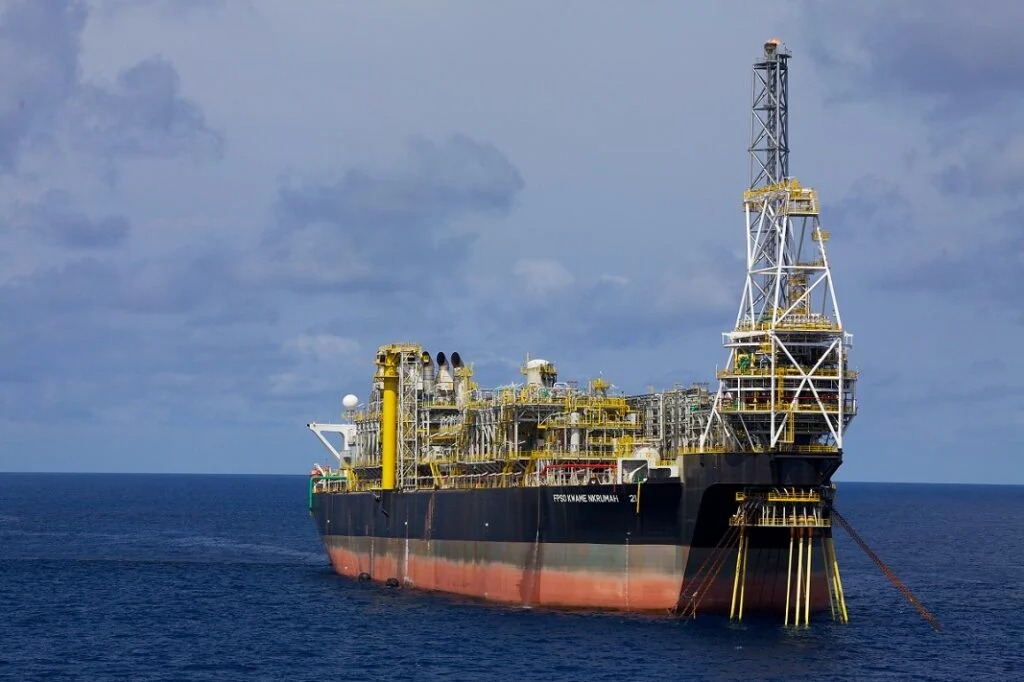
Ghana’s oil production has experienced a dramatic decline over the past six years, falling by nearly half and raising serious concerns about the sustainability of the nation’s petroleum sector.
According to the 2025 Annual Report of the Public Interest Accountability Committee (PIAC), the country lost 34.14 million barrels between 2019 and 2025, as production dropped sharply from 71.44 million barrels in 2019 to 37.3 million barrels in 2025.
Revenue losses top $1.7 billion
At $50 per barrel on average, the 34.14 million barrels lost over six years would have brought in over $1.7 billion ($1.707 billion) in revenue if production had been maintained.
2025 sees sharpest annual decline
The steep reduction underscores a troubling trend for Ghana’s oil-dependent economy, highlighting the need for urgent intervention to safeguard revenue generation, foreign exchange inflows, and energy security.
The report shows that output fell by 22% in 2025 alone, down from 48.2 million barrels in 2024.
Field-by-field analysis reveals uneven declines
Breaking down production by fields, the Jubilee Field produced 22,211,948 barrels, the SGN Field 9,256,418 barrels, and the TEN Field 5,834,432 barrels.
The Jubilee Field experienced the most significant decline, dropping 30.3% from 31,849,046 barrels in 2024 to 22,211,948 barrels in 2025.
TEN Field output fell by 14% from 6,784,440 barrels to 5,834,432 barrels, while SGN Field production declined by 3.6%, from 9,606,544 barrels to 9,256,418 barrels over the same period. Daily average production figures stood at 63,462 barrels for Jubilee, 16,206 barrels for TEN, and 25,360 barrels for SGN.
Causes of the decline
The report attributed the decline to natural field depletion, maintenance work on facilities, and operational disruptions, including activities at the West African Pipeline Company (WAPCo), highlighting the operational and structural challenges facing Ghana’s oil sector.
Gas production also dips
Gas production recorded a reduction, with total output falling to 273,780 million standard cubic feet (MMSCF) in 2025 from 280,511 MMSCF in 2024—a 2.4% decrease—further illustrating the downward pressure on the country’s energy resources.
PIAC warns of peaking oil fields
At the launch of the report in Accra, PIAC Chairperson Richard Ellimah emphasised the severity of the decline, stating: “Production has dropped from a high of 71.44 million barrels in 2019 to 37.3 million barrels in 2025, representing a compounded annual average decline of 9%. This confirms the widely held view that Ghana’s oil fields have peaked and are on a downward spiral.”
Call for investment and regulatory reform
In response to the declining trend, PIAC has urged the Government to develop a comprehensive framework to attract investment into existing oil fields, improve regulatory and fiscal policies, and enhance data acquisition in new basins to stabilise production and reverse the decline.
Urgent action needed to safeguard economy
“Strategic investment, operational efficiency, and regulatory oversight must be prioritised to ensure the sector remains a key driver of Ghana’s economy,” Mr. Ellimah said.
He warned that sustained reductions in crude output could negatively impact government revenue, foreign exchange inflows, and the country’s broader energy security.
Maintaining West Africa’s leading oil position
The report stresses the urgency of boosting production in mature fields while exploring untapped basins, noting that immediate action is essential if Ghana is to maintain its position as a leading oil producer in West Africa.
Critical crossroads for Ghana’s oil sector
With crude output now at 37.3 million barrels—almost half of the 2019 peak—industry experts say Ghana’s oil sector faces a critical crossroads.
Without targeted investment and effective policy intervention, the downward trajectory could threaten both the economic and energy stability of the country.
Wake-up call for stakeholders
PIAC’s findings signal a wake-up call for stakeholders, highlighting that Ghana’s oil industry must prioritise innovation, operational excellence, and strategic partnerships to sustain growth in the coming years.