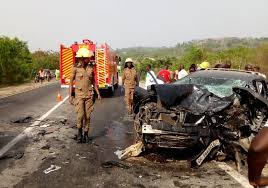
Road fatalities in Ghana continue to rise sharply in 2026 despite intensified nationwide safety education and enforcement efforts, the National Road Safety Authority (NRSA) said on Tuesday.
Mr Joshua Quist, the Greater Accra Regional Director of the Authority, said preliminary data indicated a worrying increase in deaths within the first month of the year, underscoring the urgent need for behavioural change among road users.
“The numbers are increasing, and we need to do something about it,” he said during a sensitisation exercise at the Kasoa Toll Booth to mark the end of a six-day Visibility Programme undertaken by the NRSA, in collaboration with the Motor Traffic and Transport Department (MTTD) of the Ghana Police Service.
The nationwide campaign, which ran from March 30 to April 7, 2026, covered major highways including that of Shai Hills, Aburi-Mampong-Mamfe, and Accra-Suhum-Kumasi, targeting high-risk corridors before, during and after the Easter festivities.
It focused on educating road users such as commercial drivers, private motorists, motorcyclists and pedestrians on compliance with traffic regulations, including speed limits, seatbelt use, helmet use and the dangers of distracted and impaired driving.
Mr Quist said road crash fatalities rose from 261 in January 2025 to 383 in January 2026, representing a significant spike.
In the Greater Accra Region, deaths also more than doubled, increasing from 21 in January 2025 to 50 within the same period this year.
He expressed concern over the persistent challenge of unsafe road user behaviour despite sustained public education across schools, churches, mosques, transport terminals and media platforms.
“We have done a lot of education everywhere – schools, churches, mosques, terminals and on the roads -but the attitude of drivers is not changing,” he said.
Mr Quist attributed the rising fatalities largely to human factors such as speeding, wrongful overtaking, overloading, drunk driving, drug abuse and fatigue driving.
“Speeding is one of the major causes of crashes. Wrongful overtaking and overloading also contribute significantly. When a vehicle is overloaded, it becomes difficult to control, and in the event of a crash, injuries are more severe,” he explained.
Mr Quist expressed concern about the use of alcohol and drugs by some drivers, particularly substances such as tramadol and other locally known drugs, which impaired judgment and reduced concentration.
“When you take alcohol or drugs and drive, it affects your thinking and decision-making, and that can lead to crashes,” he said.
The Director further highlighted fatigue driving as a critical risk, especially among long-distance drivers, who did not comply with rest requirements or operated without relay drivers.
“Some drivers travel for 13 hours without rest. That is dangerous. After about eight hours of driving, you are required to stop and rest or change drivers,” he noted.
As part of the exercise, Mr Quist said officials also undertook enforcement actions, including the removal of unapproved auxiliary lights from vehicles.
He explained that such lights, often installed in excess of standard vehicle specifications, could blind oncoming drivers and increase the likelihood of crashes, particularly at night.
“Some vehicles have six or seven additional lights. When they are switched on, they blind other road users, making it difficult for them to see clearly. This is dangerous, and we are taking them off the vehicles,” he said.
Mr Quist reiterated the shared responsibility towards road safety and called on all road users to respect traffic regulations and one another.
“We are all road users—drivers, pedestrians, motorcyclists. At one point, you may even park your car and become a pedestrian. So, we must respect each other on the road,” he said.
The NRSA continued to intensify education and enforcement measures beyond the Easter period, including in-traffic inspections, community outreach programmes and media engagements, to reduce road crashes and fatalities across the country, Mr Quist added.
He said the Authority would also engage more influential figures as road safety ambassadors to help drive behavioural change.
Meanwhile, Superintendent Stella Ewool of the MTTD, Weija Division, urged drivers to adhere strictly to speed limits and avoid drunk and fatigued driving.
“Don’t speed because speed kills. Avoid using mobile phones while driving, and ensure you are alert at all times.”
She called on passengers to play an active role by ensuring that drivers complied with road safety regulations and reporting recalcitrant ones to the nearest police station.
“Most drivers know what to do, but they choose not to do it. This exercise is to remind them of their responsibilities,” she added.
GNA