President John Dramani Mahama has signalled that government may be forced to review and possibly suspend some fuel-related levies, including the controversial GH¢1 fuel levy, as Ghana grapples with a sharp surge in petroleum prices driven by global market disruptions.
Govt signals possible fuel levy relief
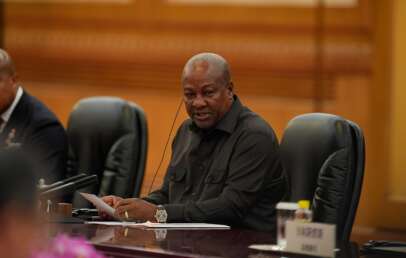
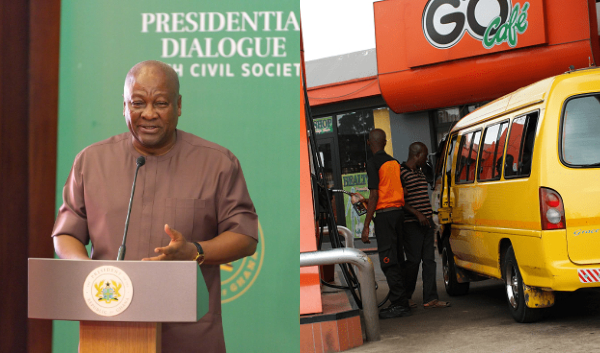
Speaking at a high-level Presidential Engagement with Civil Society Organisations (CSOs) in Accra, President Mahama acknowledged the growing burden on households and businesses, linking the rising cost of fuel directly to escalating geopolitical tensions in the Middle East.
The dialogue, part of a broader series of engagements with organised labour and the private sector, was aimed at gathering input and forging consensus on urgent national economic challenges.
Heavy tax component in fuel pricing
At the heart of the President’s remarks was a recognition that the current fuel price build-up—comprising multiple taxes, levies and margins—may no longer be sustainable under prevailing global conditions.
Among the charges embedded in fuel pricing are the Energy Sector Shortfall and Debt Repayment Levy, Road Fund Levy, Energy Fund Levy, Special Petroleum Levy, Primary Distribution Margin, BOST Margin, Fuel Marking Margin, Unified Petroleum Pricing Fund (UPPF), and various marketer and dealer margins.
In monetary terms, these taxes and levies constitute a significant portion of pump prices.
For petrol, they amount to about GH¢4.27 per litre, while diesel carries GH¢4.25.
Liquefied Petroleum Gas (LPG) attracts GH¢2.15 per kilogramme, with other products such as kerosene and marine gas oil also bearing substantial levies.
It is within this context that the President indicated that adjustments—including possible suspension of selected levies—are under active consideration to cushion consumers.
Global oil shock driving local prices
The urgency of the situation has been heightened by developments on the global oil market.
Brent crude prices have surged to $119 per barrel, nearing peak levels last seen at the onset of the US-Israel-Iran conflict.
The disruption has been exacerbated by Iran’s effective blockade of the Strait of Hormuz, a critical global oil transit route, sending shockwaves across international energy markets.
Fuel prices surge at the pumps
Domestically, the impact is already being felt. Data from the Chamber of Oil Marketing Companies (COMAC) shows that petrol prices are set to hit GH¢15.19 per litre, while diesel will rise to GH¢17.85.
LPG, widely used by households for cooking, will increase to GH¢16.59 per kilogramme.
These adjustments follow a revision of price floors by the National Petroleum Authority, which raised petrol from GH¢11.57 to GH¢13.30 and diesel from GH¢14.35 to GH¢17.10 within just two weeks.
Rising cost of living for consumers
For consumers, the implications are immediate and far-reaching. Transport operators are expected to pass on higher fuel costs to commuters, triggering increases in fares across urban and intercity routes.
Households, particularly in urban areas where LPG is the primary cooking fuel, will also face higher living costs. For many low- and middle-income families, the combined effect could significantly erode disposable income.
Inflation and economic pressures mount
Economists warn that the broader macroeconomic consequences could be severe.
Rising fuel prices typically feed into inflation, as transportation costs influence the pricing of goods and services across the supply chain.
Diesel, in particular, poses a critical concern given its central role in logistics, agriculture, manufacturing and public transport. Sustained increases could therefore ripple across key sectors, raising production costs and dampening economic activity.
Policy trade-offs and fiscal risks
From a policy standpoint, the government faces a delicate balancing act.
While reducing levies could provide immediate relief to consumers, it may also affect revenue streams used to finance energy sector obligations and infrastructure.
The current levy structure supports debt repayment, energy sector financing and fuel distribution stability—meaning any adjustments must be carefully calibrated to avoid unintended fiscal consequences.
Structural vulnerabilities in energy sector
At the same time, the price hikes reflect deeper structural vulnerabilities within Ghana’s energy framework.
Heavy reliance on imported petroleum products exposes the country to external shocks, including exchange rate fluctuations and global price volatility.
Analysts argue that without a strategic push toward domestic refining capacity or alternative energy solutions, such pressures are likely to persist.
Global energy crisis deepens
Globally, the situation is even more complex. Countries across Europe, Asia and Africa are confronting what analysts describe as a new form of crisis—an energy crunch driven not by demand, but by constrained supply and geopolitical instability. Governments are increasingly resorting to extraordinary measures, including fuel rationing, reduced travel, and energy conservation policies to stabilise their economies.
The aviation industry has already begun to feel the strain, with rising fuel costs forcing airlines to cut routes and scale down operations.
Industrial sectors are also under pressure, as energy shortages trigger partial shutdowns and disrupt production cycles.
In some regions, rolling blackouts and emergency energy protocols have become necessary to manage limited resources.
Global response and demand reduction measures
In response, the International Energy Agency has rolled out a 10-point action plan aimed at reducing global energy demand.
The measures include promoting remote work, lowering speed limits, encouraging public transport use, and shifting households toward more efficient energy consumption methods.
Industries are also being urged to adopt efficiency measures to conserve fuel without compromising output.
Ghana weighs strategic response
While Ghana has not yet introduced such measures, policymakers are closely monitoring global trends.
The possibility of adopting similar strategies—such as work-from-home policies, vehicle rationing, or industrial efficiency programmes—remains on the table should the situation worsen.
For now, the government’s focus appears to be on immediate relief through fiscal adjustments, particularly within the fuel pricing framework.
President Mahama’s indication that levies could be reviewed signals a willingness to respond proactively to public concerns, even as authorities navigate the complex interplay between economic stability and social protection.
Energy security now a national priority
Ultimately, the unfolding developments underscore a broader reality: energy has become a central determinant of economic resilience.
For Ghana, the choices made in the coming months—whether in adjusting levies, managing demand, or investing in long-term energy solutions—will play a critical role in shaping both the cost of living and the trajectory of the national economy.
As global uncertainties persist, one lesson is becoming increasingly clear—energy security is no longer a distant policy objective but an immediate necessity, with direct consequences for households, businesses and national stability