Ghana’s historic foreign reserves position has reignited discussions on whether the country should prioritise external buffers or channel more resources into domestic production to reduce reliance on imports.
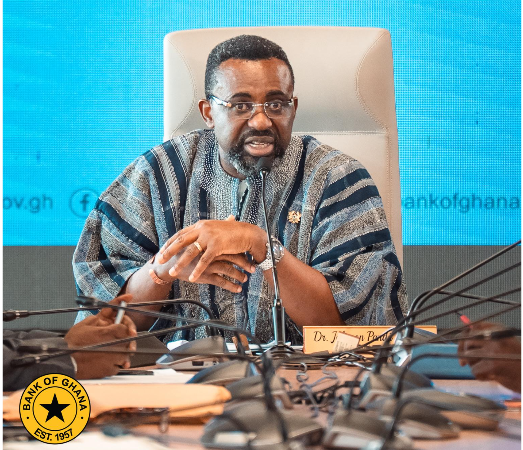
At the Ghana Exim Fireside Chat in Accra, Dr. Johnson Asiama, Governor of the Bank of Ghana (BoG), addressed the issue, offering a perspective that reframes the debate rather than positioning one goal against the other.
Policy easing and liquidity management
BoG has been pursuing a deliberate approach: gradually reducing the policy rate while intensifying efforts to withdraw excess liquidity from the financial system.
The recent decision to lower the policy rate from 15.5% to 14% underscores this ongoing cycle of easing interest rates alongside continued sterilisation.
Dr. Asiama disclosed that in 2025 alone, the Bank absorbed about GH¢17 billion in excess liquidity, highlighting the scale of these operations.
Record reserves and their drivers
Ghana ended 2025 with US$13.8 billion in gross international reserves, the highest level in its history, equivalent to about 5.7 months of import cover—up from US$8.9 billion the previous year.
The improvement was largely driven by the Domestic Gold Purchase Programme, which processed over 110 tonnes of gold, valued at approximately US$11.4 billion in foreign exchange.
This effort forms part of the Ghana Accelerated National Reserve Accumulation Policy, which aims to achieve 15 months of import cover by 2028.
Not an either-or choice
The accumulation of reserves has prompted questions about whether these funds could instead support domestic industrial growth.
Dr. Asiama argued that the issue is not a trade-off between reserves and investment but about creating the conditions that make investment possible.
“That is exactly why lending rates have to come down. Because the way you build industry is by making it affordable to invest,” he said.
He noted that when lending rates exceed 30 per cent, industrial projects become largely unviable, as the cost of borrowing outweighs expected returns.
The reduction in lending rates from above 30 per cent to below 20 per cent in 2025, he said, was therefore a critical step in enabling productive investment.
Linking reserves, investment, and economic stability
Dr. Asiama emphasised that strong reserves and industrial development are interconnected.
Robust reserves help maintain exchange rate stability, which lowers risk premiums and borrowing costs, encouraging investment and gradually reducing import dependence.
“Imports are not inherently a policy failure. The key is whether they are shifting towards capital goods and specialised inputs that strengthen long-term production capacity,” he explained.
He cautioned that weak reserves expose economies to external shocks, forcing higher interest rates and constraining investment.
“Our reserves levels are comfortable. The contingency measures are in place,” he reassured stakeholders.
Complementary goals for sustainable growth
The Governor stressed that both building reserves and reducing lending rates should be seen as complementary strategies.
In 2025, the Bank focused on these dual objectives to create favourable credit conditions that support long-term economic transformation.
“While the debate on resource allocation is valid, the real challenge lies in ensuring affordable credit to drive investment,” Dr. Asiama concluded.
Ghana’s approach, as articulated by the BoG Governor, signals a nuanced strategy: using record reserves not merely as a cushion against external shocks but as a foundational pillar to enable industrial expansion, attract investment, and gradually shift the economy towards greater self-reliance.