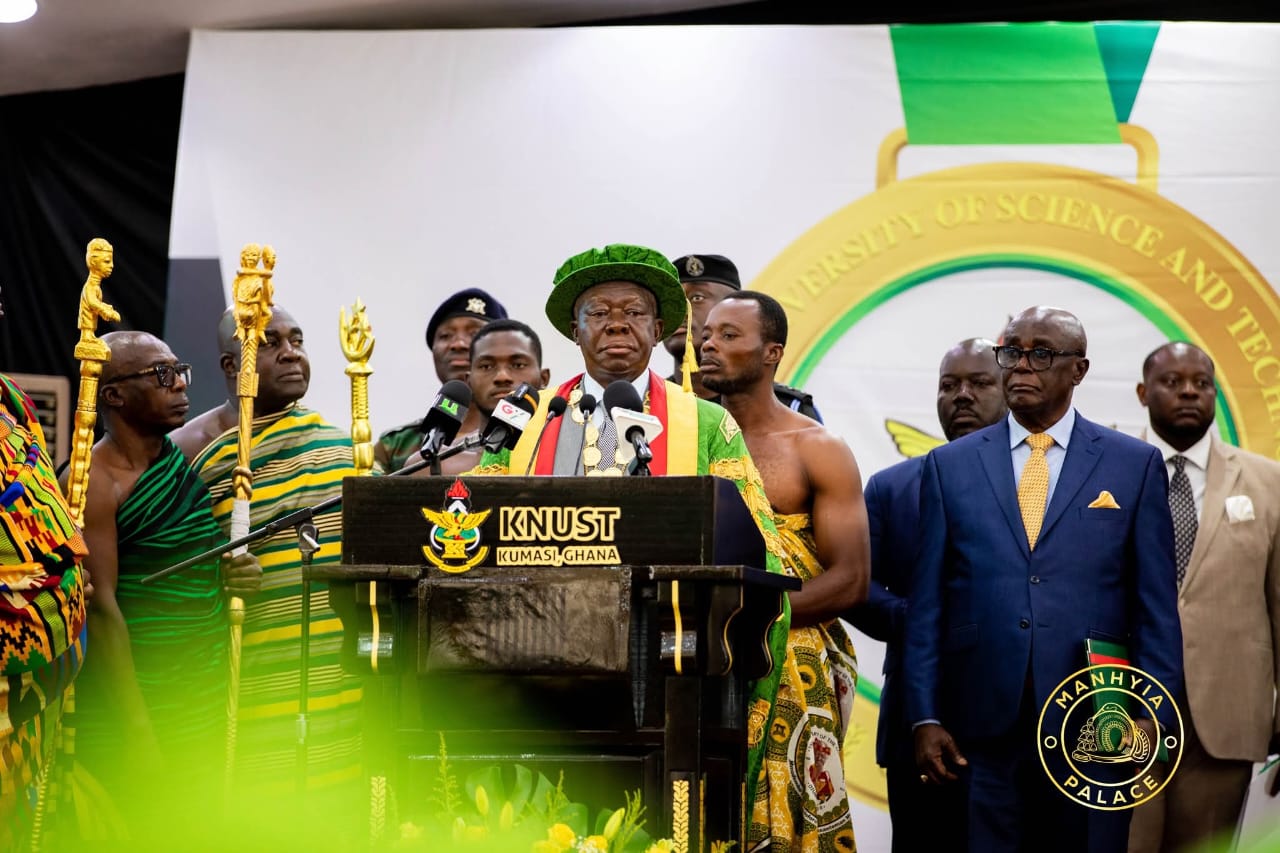
The Asantehene, Otumfuo Osei Tutu II, has called on the government to ensure that the Kwame Nkrumah University of Science and Technology (KNUST) Teaching Hospital is completed according to its scheduled timeline, emphasising the critical role the facility will play in advancing medical education and healthcare delivery in Ghana.
Speaking at the climax of the KNUST 59th Special Congregation in Kumasi, the Asantehene expressed appreciation for Parliament’s approval of the budgetary allocation for the completion of the first phase of the project.
“I want to place it on record my sincere appreciation to the government for this kind gesture,” he said.
He described the hospital as a significant national investment in education, healthcare delivery, and broader development.
The teaching hospital project, which began in July 2007 when the Asantehene cut the sod, has been under construction for 19 years.
Despite the lengthy timeline, work continues, executed by KNUST’s College of Architecture and Planning with funding from the university and the Ghana Education Trust Fund (GETFund). The project, with an estimated cost of about $125 million, covers a land area of 71 acres and will include a cardiothoracic and neurosurgical centre, diagnostic unit and laboratory, morgue, Out-Patient-Department block, wards, administration offices, security post, effluent chambers, and laundry facilities.
Highlighting the urgency of timely completion, the Asantehene noted that the facility, once operational, would serve not only as a centre for advanced medical training and research but also as a critical healthcare resource for surrounding communities and the nation at large.
“While we are grateful for the progress made thus far, we respectfully appeal that the timeline for the completion of the university teaching hospital be adhered to as originally scheduled,” he said.
He expressed hope that the first phase would be commissioned by the end of 2026.
In addition to infrastructure, the Asantehene emphasised the importance of financial clearance to enable KNUST to recruit urgently needed staff.
He noted that as student numbers continue to grow, there is increasing demand for lecturers, researchers, and administrative personnel.
“Granting financial clearance will enable the university to strengthen its human resource capacity, improve the staff-to-student ratio, and further enhance the quality of teaching and research across the academic programmes,” he stated.
He stressed that adequate staffing is essential not only to maintain KNUST’s standards but also to advance its vision as a globally competitive institution contributing meaningfully to national development.
Prof. Rita Akosua Dickson, the Vice-Chancellor, commended university staff for their community impact and encouraged graduates to translate knowledge into innovative solutions to global challenges.
Dr. Cindy Jebb, President of Ramapo College, New Jersey, USA, called for stronger partnerships to tackle global challenges in education, health, and environmental sustainability.
The 59th Special Congregation saw the graduation of 8,377 students, comprising 3,136 undergraduates and 5,241 postgraduates, including 71 PhD recipients.
The event marked a milestone in KNUST’s ongoing efforts to equip students for impactful careers while highlighting the pressing need to complete its teaching hospital as a centre of excellence in health education and service.