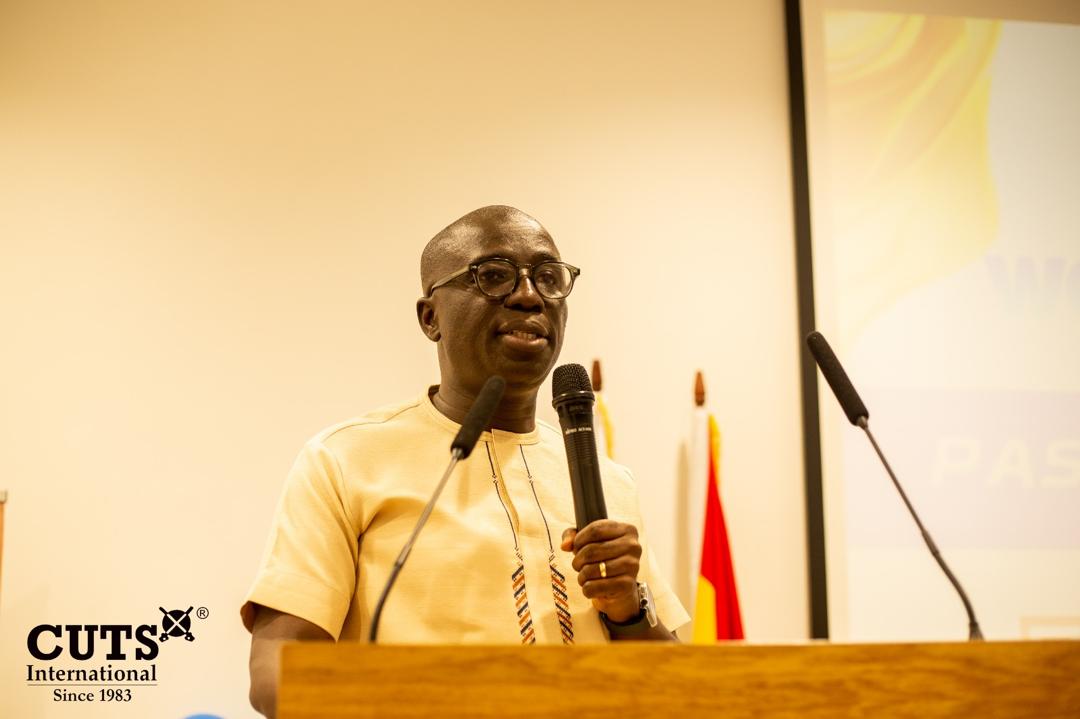
A leading research and public policy think tank, CUTS International Accra, has called on the government to urgently consider public funding support for civil society organizations (CSOs), warning that Ghana risks weakening its governance and policy systems if the funding crisis is not addressed.
The warning came in a statement by Mr. Appiah Kusi Adomako, Esq., Director of the West Africa Regional Centre of CUTS International Accra.
He noted that for more than six decades, CSOs in Ghana have largely relied on foreign donors, a situation that is now unsustainable.
“For more than sixty years, civil society organizations in Ghana have been largely sustained by foreign donors,” Mr. Adomako said.
“The result is a funding squeeze that now threatens the very survival of independent CSOs and, by extension, the quality of our public discourse and policy-making process.”
He explained that as Ghana’s democratic institutions have matured, many traditional donors have shifted their focus to countries facing instability and governance challenges.
Consequently, funding for advocacy and governance work in Ghana has steadily declined, leaving many organizations struggling to operate.
Civil society as the fifth estate
Mr. Adomako described civil society as “the fifth estate of our republic,” emphasising that CSOs play a central role in Ghana’s socio-economic development.
Through rigorous research, evidence-based advocacy, and sustained public engagement, civil society has shaped major reforms, including the Right to Information Act, the Public Financial Management Act, the Public Holidays and Commemorative Days (Amendment) Act 2025, and the Road Traffic Amendment Act 2025.
“Without a strong and independent civil society, critical voices on education, healthcare, consumer and environmental protection, and public finance would weaken,” he warned.
“This would reduce accountability and limit the quality of policy decisions.”
The director highlighted broader risks, noting that when independent CSOs cannot access reliable domestic funding, some cease to exist, others chase narrow political or foreign agendas, and a vacuum emerges that could be filled by lobby groups or foreign intelligence interests.
“He who pays the piper calls the tune,” he cautioned.
Call for local ownership
Mr. Adomako stressed that Ghana must take ownership of its research and advocacy agenda.
He argued that continued dependence on external funding allows foreign priorities to shape domestic issues, often sidelining areas critical to Ghanaian livelihoods, including consumer protection, healthcare access, and education reform.
To address this, he proposed a practical pathway for reform.
The government, he said, could fund CSOs without undermining their independence by using established, transparent mechanisms.
“The STAR Ghana Foundation provides a ready-made, proven model,” he noted.
“Selection must be transparent, competitive, and based on pre-determined criteria, with full compliance with public financial management and procurement laws.”
He recommended that the government allocate at least GH₵10 million annually through such an independent mechanism to support high-quality research and advocacy in priority sectors such as education, healthcare, road safety, governance, climate resilience, and consumer protection.
He added that strict safeguards, including public disclosure of grants and annual audits by the Auditor-General, would ensure accountability and protect against political interference.
Private sector role
Mr. Adomako also called on the private sector to play a more active role in supporting civil society, noting that corporate Ghana has shown limited interest in funding CSO work.
“We should revise our tax laws to introduce incentives that allow companies and individuals to deduct donations to accredited CSOs from taxable income,” he said, citing international examples where such policies have strengthened civic engagement.
Warning of long-term consequences
The CUTS director cautioned that failure to act could have long-term consequences for governance and development.
“If we continue to outsource the funding of our research and advocacy agenda to external actors, matters central to Ghanaian livelihoods will never remain donor priorities,” he stressed.
As the President prepares to engage civil society leaders at the Jubilee House, Mr. Adomako urged decisive commitment.
“We have come too far in building our democratic institutions to allow civil society organizations to wither for lack of local ownership,” he said.
“A clear commitment to sustainable domestic funding would constitute genuine strategic nation-building.”
CUTS International Accra is a leading research and public policy organisation dedicated to consumer protection, efficient and competitive markets, road safety, international trade, economic policy, education, and healthcare.