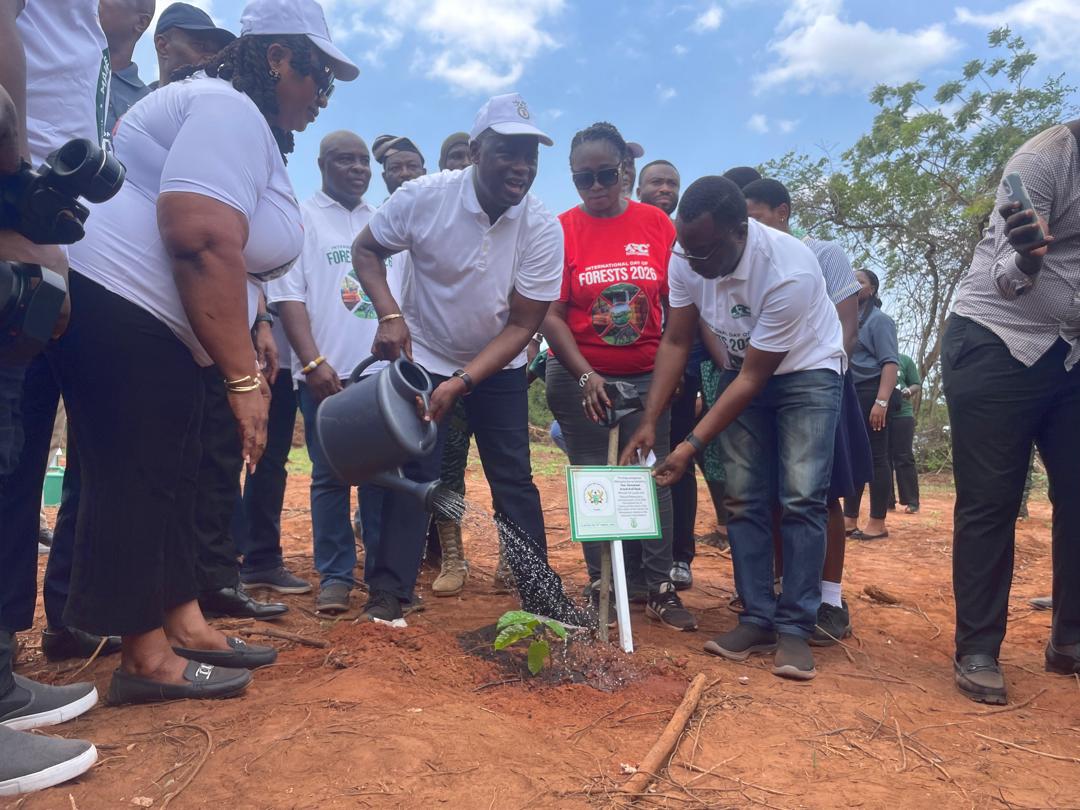
Government’s flagship Tree for Life Initiative has surpassed its 2025 planting target, with more than 30 million seedlings planted nationwide, the Minister for Lands and Natural Resources, Emmanuel Armah Kofi Buah, has announced.
Speaking at the International Day of Forests celebration at Achimota Forest on Thursday, the Minister described the achievement as a critical step in restoring degraded lands while positioning forestry as a driver of economic growth.
He said the initiative, introduced as Ghana’s response to global calls for sustainable resource management, was already delivering measurable results in job creation and environmental recovery.
“Against a target of 30 million seedlings, we successfully distributed and planted over 30 million seedlings,” he said, adding that the programme generated more than 41,000 jobs across the value chain.
The Minister attributed the success to strong public participation, particularly among the youth and farming communities.
“We salute our over 2,000 youth forest champions, more than 20,000 farmers, and thousands in nurseries and the private sector who made this possible,” he noted.
He stressed further that the initiative was not merely an environmental campaign but a deliberate economic strategy aimed at building a green asset base capable of attracting investment.
“By restoring our degraded lands, we are creating assets that can generate carbon credits, attract green investment and create high-value jobs,” he explained.
He announced that government would maintain its ambition in 2026, setting another target of 30 million seedlings, but cautioned that planting alone was not sufficient.
“We must do more than plant. We must nurture, because a seedling is a promise and a mature tree is a legacy,” he said.
Linking the programme to national development, the Minister described the Tree for Life Initiative as a transformative policy designed to convert degraded landscapes into productive economic zones.
“The health of our forests and the health of our nation are one and the same,” he stated.
He noted that the initiative aligns with the vision of President John Dramani Mahama, who launched the programme in Nkawie in the Ashanti Region, adding that the movement from rural forest zones to urban centres such as Accra shows its nationwide relevance.
The Minister further argued that forests must now be viewed beyond their ecological value.
“Forests are no longer just ecological treasures. They are powerful engines for national prosperity,” he said.
He mentioned opportunities within the emerging bioeconomy, including sustainable timber production and the development of non-timber forest products for industries such as pharmaceuticals and cosmetics.
The Minister explained that timber exports generate about €100 million annually, while domestic consumption of wildlife and forest products exceeds $250 million.
He also referenced outcomes from the recent COP30, where he led Ghana’s delegation, noting a shift towards performance-based climate action.
“The era of mere promises is over. The era of performance has begun,” he said, adding that countries protecting their forests now stand to benefit from carbon credit financing.
“We are witnessing a new economic reality where a standing, thriving tree is not just an ecological asset, but a financial one,” he added.
The Minister, however, warned of persistent threats to forest sustainability, including bushfires, illegal logging and illegal mining, and called for intensified protection measures involving forestry guards and security agencies.
For her part, the Country Representative of the Food and Agriculture Organization, Priya Gujadhur, outlined the economic and social value of forests.
“Forests are not only environmental assets, but powerful engines for economic growth, livelihoods and resilience,” she said.
She commended government’s leadership, particularly the Tree for Life Initiative, describing it as a model for restoring degraded landscapes while creating jobs.
“FAO commends the Government of Ghana for its strong leadership… which is restoring degraded landscapes while creating jobs,” she noted.
She said ongoing collaboration between FAO and national stakeholders focuses on sustainable forest management, promotion of wood value chains and support for non-timber products such as shea, honey and medicinal plants.
“Non-timber forest products offer real opportunities for communities to diversify incomes,” she said.
She further emphasised that forest restoration was both an environmental and economic imperative, calling for increased investment in sustainable production systems, green jobs and inclusive growth.
“To unlock the full economic potential of forests, we must invest in sustainable production systems, green jobs for the youth and inclusive value chains,” she added.