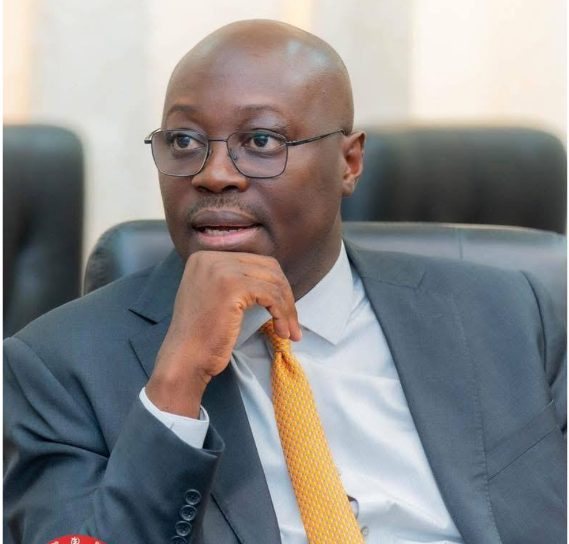
Ghana’s fiscal challenges have deepened sharply, with the Finance Minister, Cassiel Ato Forson, revealing that the government is currently borrowing about GH¢17 billion just to meet its public sector wage obligations—effectively shutting the door on new employment and severely constraining development spending.
The disclosure comes amid mounting criticism that the Ministry of Finance is delaying financial clearance for recruitment across the public sector.
However, the Minister’s defence, backed by detailed fiscal data, paints a stark picture: the government simply does not have the resources to hire more workers.
Wage bill exceeds available revenue
Presenting at the Presidency, Dr. Forson disclosed that Ghana recorded total tax revenue of GH¢183 billion in 2025.
Out of this, statutory obligations—including transfers to the District Assemblies Common Fund (DACF), Ghana Education Trust Fund (GETFund), National Health Insurance Levy (NHIL), and debt servicing—absorbed GH¢122.1 billion.
This left only GH¢61.9 billion in available funds.
However, the public sector wage bill alone stood at GH¢78.9 billion, far exceeding the remaining revenue.
The result was a financing gap of about GH¢17 billion, which the government had to borrow just to pay salaries.
In effect, 44% of all tax revenue went into wages—well above the 35% ceiling recommended by the Economic Community of West African States (ECOWAS)—highlighting the scale of fiscal imbalance.
Revenue structure shows deep imbalance
A breakdown of total government revenue further exposes the strain.
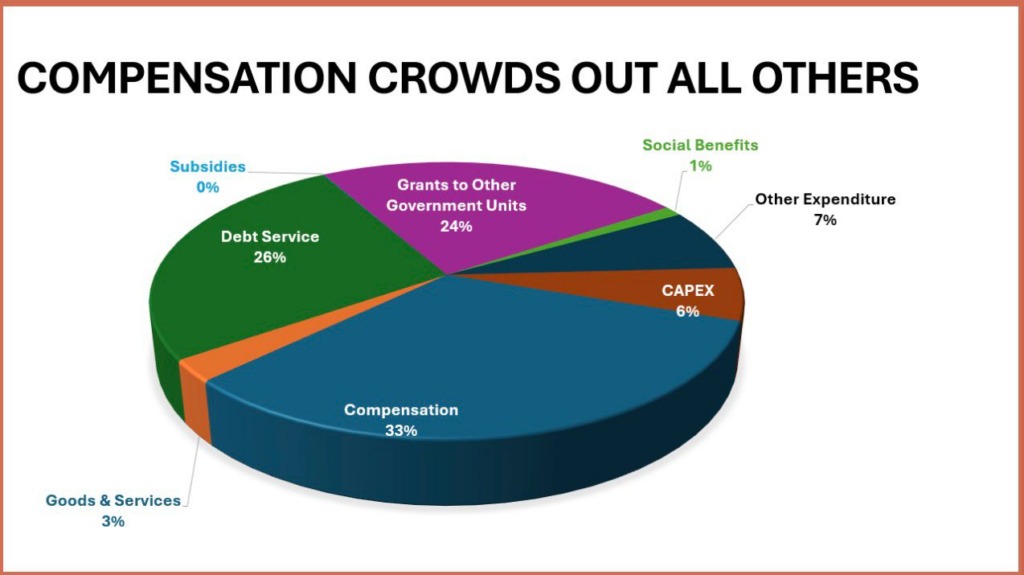
3 items consume 83% of all revenues
Compensation of employees accounts for 33% of revenue, while debt servicing takes 26% and statutory transfers to other government units absorb 24%.
Together, these three categories consume 83% of total government revenue, leaving only 17 percent to fund all other expenditures.
The remaining allocations are minimal: capital expenditure receives just 6 percent, other expenditures 7%, goods and services 3%, and social benefits only 1%.
This structure leaves government with virtually no fiscal space, forcing it to borrow not only for development but even for routine obligations.
Employment prospects dim
The implications for employment are immediate and severe.
Dr. Forson made it clear that under current conditions, the government cannot recruit additional workers.
This effectively freezes public sector hiring at a time when thousands of graduates depend on government employment for stable livelihoods.
The situation also casts doubt on plans to expand recruitment into the security services from 20,000 to 40,000 personnel over the next four years.
Analysts question how such an expansion can be financed when the government is already borrowing to pay existing staff.
Beyond immediate hiring constraints, the fiscal pressures may force tighter controls on wage growth, delayed promotions, and potential restructuring within the public sector.
Infrastructure development at risk
Equally concerning is the impact on infrastructure development.
With only 6% of total revenue allocated to capital expenditure, the government’s ability to invest in roads, schools, hospitals, and other critical infrastructure is severely limited.
This underinvestment could slow economic growth, worsen service delivery, and deepen regional inequalities.
Poor infrastructure also raises the cost of doing business, discouraging private investment and limiting job creation in the broader economy.
Borrowing for consumption, not growth
Economists warn that Ghana is increasingly borrowing to finance consumption—mainly salaries—rather than investing in productive sectors.
This trend is unsustainable. Borrowing to pay wages does not generate returns, yet it adds to the country’s debt burden, leading to higher interest payments and reduced fiscal flexibility in the future.
If this pattern persists, Ghana risks entering a cycle where rising debt crowds out development spending, further weakening economic prospects.
Long-term trend of rising wage burden
Historical data shows that the wage bill has consistently consumed a large share of tax revenue over the years.
In 2016, wages accounted for GH¢14.2 billion out of GH¢25.7 billion in tax revenue, representing 55%.
In 2017, GH¢16.8 billion out of GH¢32.2 billion—52%—was spent on wages.
In 2018, wages reached GH¢19.6 billion, representing 51.91% of GH¢37.8 billion revenue.
In 2019, GH¢22.2 billion out of GH¢42.8 billion—about 51%—went into salaries.
The trend continued in 2020, when wages consumed GH¢28.3 billion out of GH¢44.4 billion, representing about 63.60%.
In 2021, GH¢31.7 billion out of GH¢56.5 billion, or 31.7%, was spent on wages.
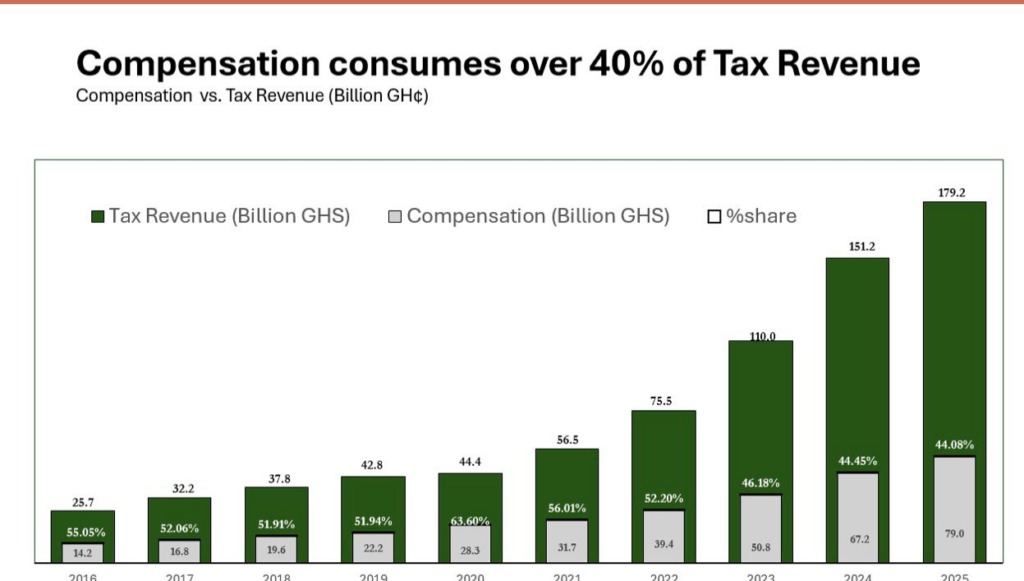
In 2022, wages rose again to GH¢39.4 billion out of GH¢75.5 billion, representing 52.20%.
In 2023, tax revenue increased significantly to GH¢110 billion, with wages at GH¢50.8 billion, representing 46.18%.
More recent figures show that in 2025, tax revenue reached GH¢151.2 billion, with GH¢67.2 billion spent on salaries, representing 44.45%.
These figures highlight a persistent structural challenge: even as revenue grows, wage expenditure continues to absorb a large share, limiting fiscal improvement.
Policy promises under pressure
The current situation also raises questions about political promises related to job creation.
Commitments to employ large numbers of unemployed youth and implement labour-intensive policies, including a 24-hour economy model, may prove difficult to achieve under current fiscal constraints.
The gap between policy ambition and fiscal reality underscores the need for a shift toward private sector-led job creation, as reliance on public sector employment becomes increasingly unsustainable.
The way forward
Dr. Forson has stressed the urgency of reforms to restore fiscal balance. Managing wage growth, improving revenue mobilisation, and rationalising expenditure will be critical to creating space for both employment and development.
Without decisive action, Ghana faces the risk of entrenching a fiscal cycle where borrowing to pay salaries becomes routine, crowding out investment, slowing growth, and limiting opportunities for future generations.
By ELVIS DARKO, Accra