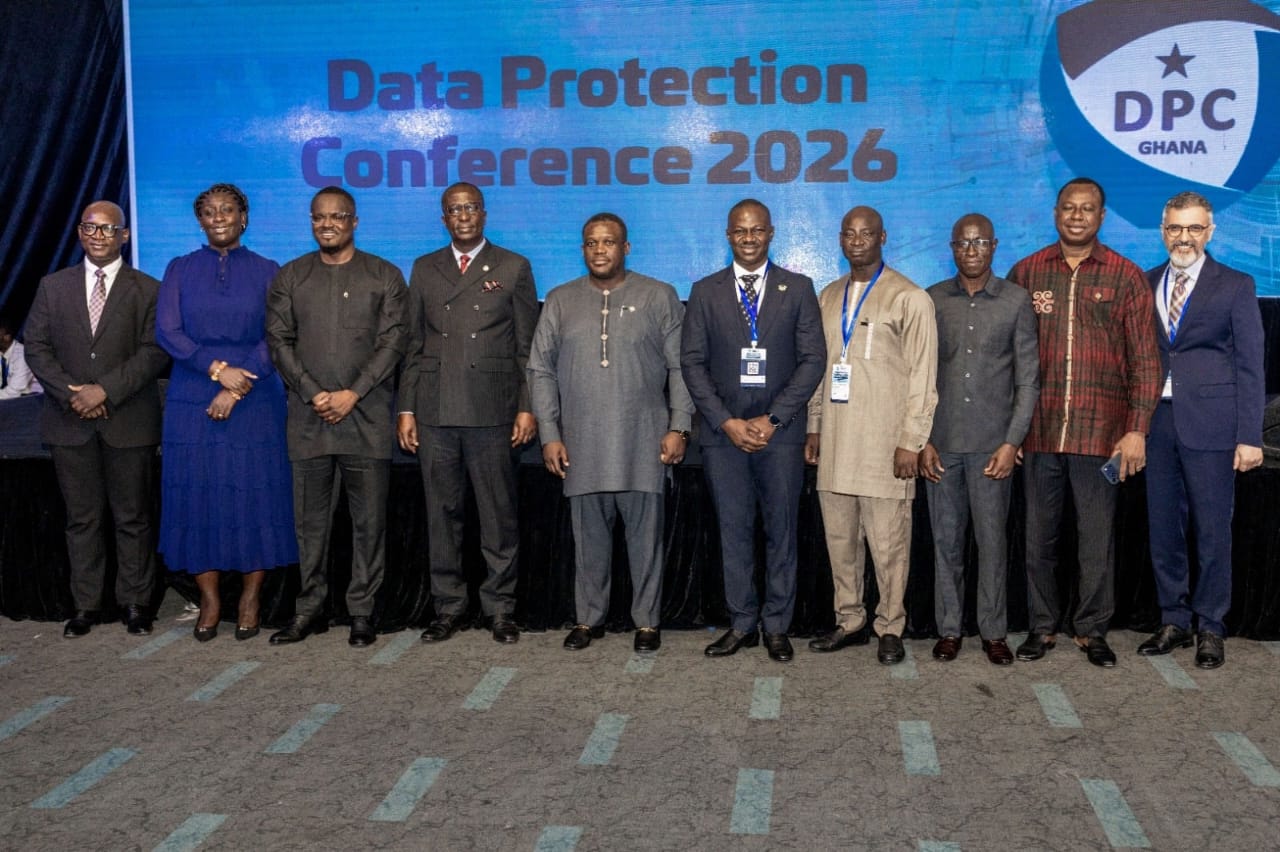
The Government is developing a new Data Protection Bill to regulate Artificial Intelligence (AI) systems, automated decision-making and cross-border data transfers as part of efforts to strengthen Ghana’s digital governance framework and safeguard citizens’ rights.
Mr Samuel Nartey George, the Minister of Communication, Digital Technology and Innovations, announced this on Thursday at the 2026 Data Protection Conference in Accra, held on the theme: “Your Data, Your Identity – Building Trust in Ghana’s Digital Future.”
He said the proposed legislation sought to modernise Ghana’s data protection regime to respond to emerging technological realities, including increasingly complex global data ecosystems and the growing deployment of AI across sectors.
Mr George explained that the objective of the new Bill was to strengthen enforcement mechanisms, clarify international data transfer rules and enhance the rights of citizens, ensuring that Ghana’s governance framework remained relevant and resilient in the years ahead.
He noted that while Ghana had made significant strides in digital transformation through mobile money expansion, interoperable payment systems, digital public infrastructure and open banking initiatives, rapid growth without strong governance could create vulnerabilities.
The Minister described trust as a form of “economic infrastructure,” stating that without trust, participation would decline, investment would hesitate, and innovation would lose momentum.
He noted that protecting personal data was central to sustaining confidence in Ghana’s digital economy, as personal information increasingly influenced access to credit, insurance, healthcare and public services.
Mr George said the Government was also advancing a Data Harmonisation initiative to reduce fragmentation and align standards across financial services, telecommunications and the public sector.
He revealed that an Emerging Technologies Bill was being developed to provide structured oversight for AI systems, advanced analytics, digital assets and new digital platforms, stressing that it aimed not to stifle innovation but to guide it responsibly.
Mr George announced that Ghana’s Artificial Intelligence Strategy was under development to build local capacity while embedding fairness, transparency and accountability in system design and deployment.
He highlighted the One Million Coders Programme, an initiative to equip young Ghanaians with skills in coding, AI and digital engineering, and that digital sovereignty required not isolation but capacity and enforceability under Ghanaian law.
Mr Andrew Asiamah Amoako, the Second Deputy Speaker of Parliament, who represented the Speaker, said digital sovereignty had become an essential dimension of national sovereignty in the 21st century.
While sovereignty historically centered on control over land, borders and political independence, it now extended to control over data, digital systems and national identity in the digital age, he said.
Mr Amoako noted that if a nation could not determine how its data was collected, stored, analysed and shared, its sovereignty would be limited in ways that were not always visible but deeply consequential.
He called for clear and enforceable laws, resilient technical systems, and leadership that understood the long-term implications of technological change.
The Second Deputy Speaker urged Ghana to shape its digital transformation deliberately rather than experience it passively, cautioning that technology was not neutral and could reshape institutions and social norms if adopted without reflection.
Dr Arnold Kavaarpuo, the Executive Director of the Data Protection Commission, in a welcome address, underscored the human consequences of weak data governance.
He recounted the story of a young teacher who, after taking a mobile loan during a family emergency, had her personal contacts accessed and her private information circulated when she defaulted on repayment, leading to public humiliation.
Dr Kavaarpuo said the incident illustrated how personal data shared in moments of vulnerability could be weaponised, adding that data protection was not merely a technical issue but one of power, responsibility and consequence.
He said data had become central to economic participation, risk assessment and access to services, and that the systems being built today would shape how future generations experienced government, finance, healthcare and education.
Dr Kavaarpuo said a trusted digital economy would not emerge by chance but through deliberate policy, strong institutions and responsible engineering, adding that alignment among legislators, regulators, financial institutions, technology firms and civil society was essential.
The Conference was attended by members of the legislature, representatives of the Bank of Ghana, the Commission on Human Rights and Administrative Justice, the National Identification Authority, heads of regulatory institutions, members of the diplomatic corps, academia, civil society leaders and industry stakeholders.
Participants were urged to translate discussions into stronger governance frameworks and safeguards to ensure that Ghana’s digital future remained innovative, secure and anchored in public trust.