Two Ghanaian prisoners of war being held in Ukraine have pleaded for forgiveness from both Ghanaians and Ukrainians for their involvement in the ongoing Russia-Ukraine conflict.
The two men, identified as Kojo and Kofi — not their real names — were captured by Ukrainian forces on the battlefield last year and are currently being held at an undisclosed location.
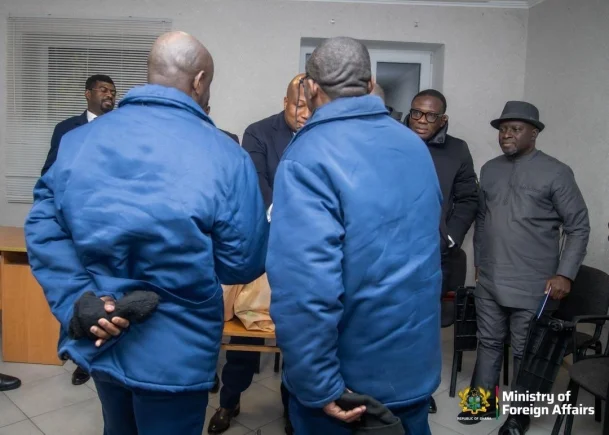
During a visit to the facility by a government delegation led by the Minister of Foreign Affairs, Samuel Okudzeto Ablakwa, at about 12:30 a.m. on Thursday, February 26, 2026, the two acknowledged that their decision to join the war effort was misguided and had dented Ghana’s reputation as a peaceful nation.
They appealed directly to President John Dramani Mahama and Ukrainian President Volodymyr Zelenskyy for clemency.
“We are very sorry for what we did. We ask President John Dramani Mahama and the people of Ukraine and their government to forgive us and spare us.
“We know people all over the world know Ghana as a peaceful country with peace loving people, but we have stained that status. We are not proud of what we did and we ask Ghanaians and Ukrainians for forgiveness.
“We know we have hurt a lot of people; but we ask for forgiveness. We’re also very sorry to our families; we know they’re very much worried about us. Let our families know that we’re alive and continue to remember us in your prayers,” Kojo, a father of one, said remorsefully.
Kofi said they were determined to turn over a new leaf if released, adding that they hoped to serve as advocates warning Ghanaian youth about the dangers of the war and what he described as the theatrics of agents who recruit unsuspecting young Africans.
Recounting the circumstances that led to his recruitment, Kojo said he was lured to join the Russian forces due to financial difficulties in paying his university fees in 2024.
With a promised signing bonus of 1.9 million Russian roubles and a monthly salary of 200,000 roubles, he said he accepted an offer to serve as a fire rescue officer, only to be deployed later to the combat frontline by his Russian superiors against his will.
He disclosed that although the money was being held in BTB Bank in Russia, it had brought him little personal benefit, explaining that he had sent 500,000 roubles home to purchase items for an orphanage in Kumasi.
Kojo said that during intense fighting, all members of his unit were killed in bomb explosions, leaving him alone on the battlefield. He claimed he expected to be killed by Ukrainian shelling but was instead captured.
Although he said he has been treated humanely at the camp, Kojo stated that he still carries fragments of metal from an explosion in parts of his body, causing him intermittent pain.
Kofi, a graphic designer, said he was lured into the Russian forces by a Russian police officer who had repeatedly cautioned him about overstaying a 14-week visa granted to him in Russia.
He explained that for the first eight months, he was not involved in combat operations, but was later deployed to the frontline following a change in command.
Kofi said he fled the battlefield after witnessing several of his compatriots killed in action and surrendered to Ukrainian soldiers, leading to his capture.
He further revealed that at the time of his training, more than 10 Ghanaians had been recruited by an agent who promised them decent jobs, only for them to realise after signing contracts that they had enlisted in the Russian army.
He said he could not confirm where those Ghanaians had been deployed or whether they were still alive.
Kojo added that recruitment into the Russian army had become a lucrative enterprise for agents, who allegedly take a 30 per cent share of each African recruit’s salary.
The two men confirmed that the camp also holds prisoners of war from other African countries, including Nigeria, Egypt, Burundi, Algeria, Morocco and Uganda, among others.
In an earlier briefing, Ukrainian officials alleged that Russia had recruited 1,785 Africans from 36 African countries, including Ghana.
Government’s assurance
Addressing the captives, the Foreign Affairs Minister conveyed the government’s forgiveness and reaffirmed efforts to secure their freedom.
“President Mahama says I should tell you that he has forgiven you. The people of Ghana have also forgiven you.
“We’re committed to working with the Ukrainian officials for your release. We have discussed that President Zelenskyy, but we still have some paperwork to do.
“We hope and pray that we can secure your release soon to commence your rehabilitation and reintegration and to also become ambassadors for peace and advocating against the criminal networks recruiting vulnerable young people to fight in this war,” he said.
Mr Ablakwa added that the government was committed to supporting efforts towards a ceasefire to allow for peaceful negotiations and bring an end to the recruitment of innocent Africans into a conflict they should not be part of.
He also urged young Ghanaians, particularly those seeking opportunities abroad, to conduct thorough checks before accepting job offers.
The Minister said the government would take decisive measures to dismantle the cartel or syndicate of agents who are endangering the lives of vulnerable Ghanaians on the battlefield, often against their will.
Source: GraphicOnline