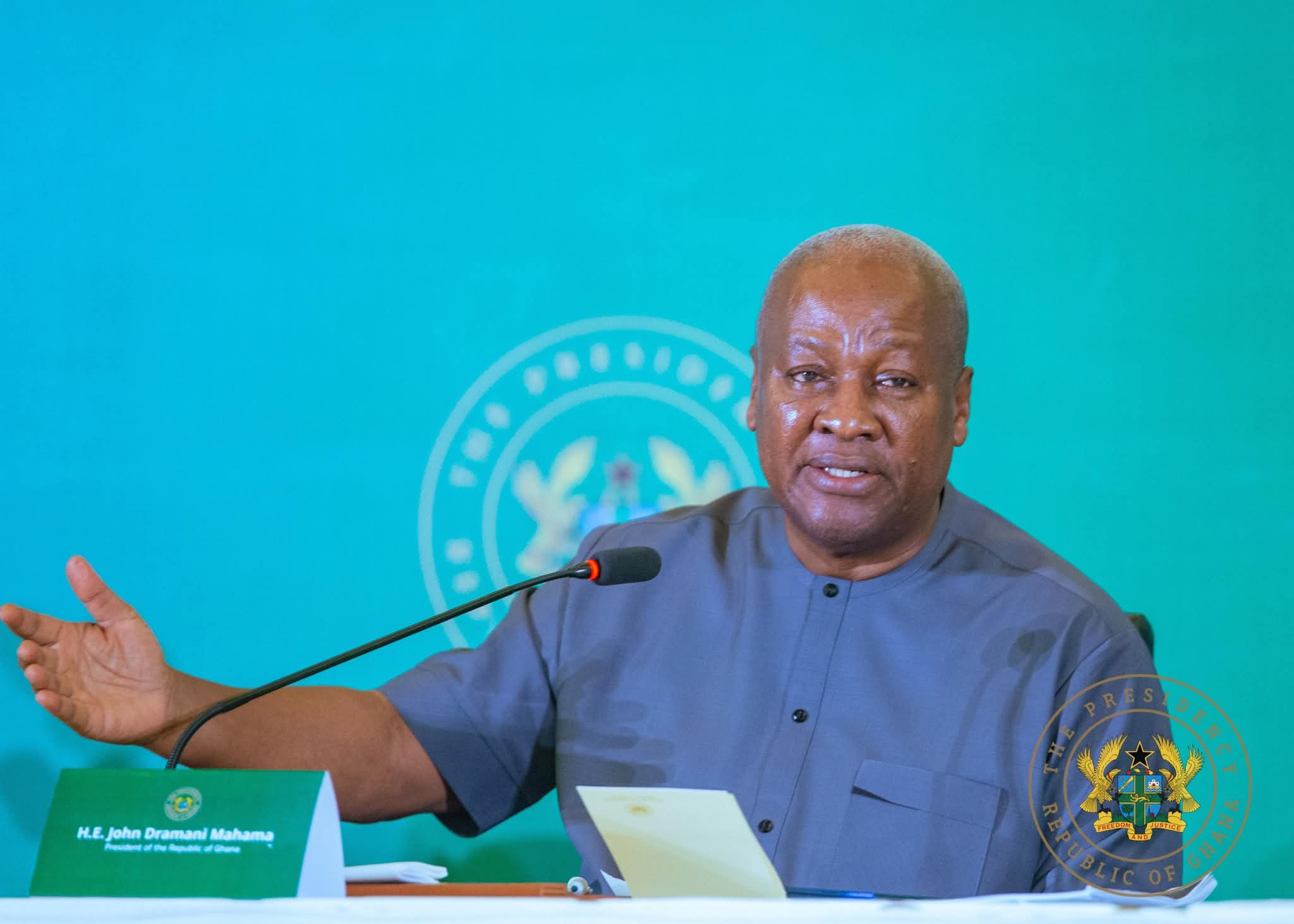
President John Dramani Mahama has set an ambitious national target of increasing manufacturing’s contribution to Gross Domestic Product (GDP) from about 10% to at least 15% by 2030, backed by the creation of 500,000 new quality industrial jobs.
The President announced the target at his maiden Presidential Dialogue with the Private Sector in Accra, where he outlined a sweeping industrial transformation agenda anchored on value addition, energy reform and the full implementation of the government’s flagship 24-Hour Economy Policy.
He disclosed that Cabinet will soon approve a comprehensive National Agribusiness Policy designed to shift Ghana decisively from raw commodity exports to value-added production.
At the centre of the reform programme is a far-reaching overhaul of the cocoa value chain, triggered by what the President described as “wild fluctuations” in global cocoa prices that have destabilised the sector.
He acknowledged that government recently took emergency measures, including what he termed a “painful” downward review of the domestic cocoa producer price, to cushion the industry and protect farmers.
However, he stressed that the crisis demands deeper structural reforms.
Among the measures announced are domestic funding for cocoa purchasing, expanded participation of local licensed buying companies, revamping of the Produce Buying Company, and a major push to expand local processing of cocoa and other tree crops.
The President further revealed plans for an automatic pricing mechanism that will guarantee farmers 70% of the international market price at prevailing exchange rates.
He also pledged drastic expenditure cuts and elimination of waste at COCOBOD, alongside the retooling of the Cocoa Processing Company.
“We must move Ghana from a raw commodity exporter to a value-added producer,” he declared, extending the same ambition to the extractive sector with a five-year target to process all mineral oils locally.
Central to this transformation is the 24-Hour Economy Policy. President Mahama explained that factories operating one shift produce only one shift output, while those running three shifts maximise capital, infrastructure and labour productivity.
He confirmed that the 24-Hour Economy Authority Bill has been assented to and is now law, establishing a statutory body to coordinate nationwide implementation.
Under the policy, manufacturers will benefit from shift-based incentives, off-peak electricity tariffs, enhanced nighttime security, structured labour dialogue and tax exemptions on equipment for factory expansion.
“This is not mere reform. It is a productivity revolution,” he said, linking the strategy to Ghana’s ambitions under the African Continental Free Trade Area (AfCFTA).
While noting signs of macroeconomic stabilisation, including relative currency stability and improved investor sentiment, the President cautioned that stabilisation alone does not equal transformation.
He identified high energy costs, unreliable power supply and expensive financing as major constraints.
To address these, government will accelerate energy sector debt restructuring, expand renewable generation, introduce differentiated off-peak tariffs, improve transmission efficiency and promote embedded generation in industrial enclaves.
Dedicated financing windows for manufacturing, expanded credit guarantee schemes and deeper long-term capital markets will also be prioritised.
“Energy reform is not optional. It is foundational,” he stressed. “We must work to make Ghana West Africa’s production hub.”