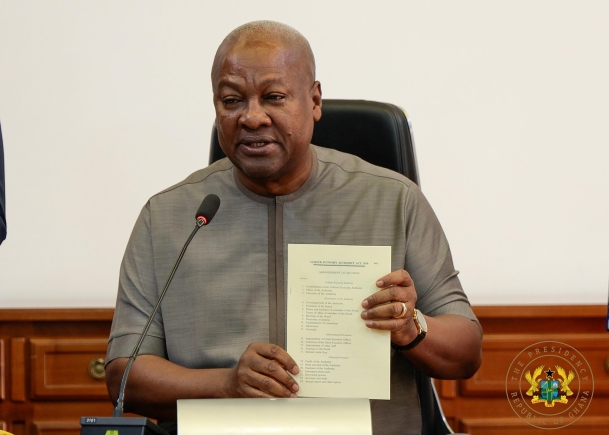
President John Dramani Mahama has signed the 24-Hour Economy Authority Bill, 2025, into law, formally giving legal backing to one of his administration’s flagship economic transformation policies.
The assent took place on Thursday in a brief ceremony held ahead of the 13th Cabinet meeting at Jubilee House.
Announcing the development, the President described the legislation as a long-awaited milestone in the government’s broader economic reform agenda.

“Cabinet colleagues, I just appended my signature to give assent to the 24-hour Authority Bill. This Bill, which Ghanaians have been waiting for, was one of our flagship strategies for economic transformation,” he said after signing the Bill.
President Mahama explained that the process leading to assent required careful scrutiny to ensure the policy framework was legally sound and implementable.
He noted that the delay in finalising the legislation was the result of due diligence aimed at giving full legal effect to the initiative.
“Now we must move from strategy to implementation. The business sector is waiting, Ghanaian investors are waiting, foreign investors are waiting,” the President added.
According to him, investors are keen to see the specific incentives and policy instruments that will underpin the 24-hour economy model.
“They want to see the package of incentives that we can afford, so that they can invest more and expand productivity and also create more employment for our young people, and so it’s my pleasure to assent to this Bill today.”

The newly enacted law establishes a 24-Hour Economy Authority as the central coordinating body responsible for implementing the policy. The Authority is expected to align public and private sector efforts, address regulatory bottlenecks and support the infrastructure required to sustain round-the-clock economic activity.
The 24-hour economy policy is designed to encourage businesses to operate in multiple shifts, increase industrial output, stimulate investment and expand job opportunities, particularly for the youth.
With the legal framework now in place, attention is expected to shift to operational details, including incentive packages, sectoral prioritisation and institutional coordination mechanisms to translate the policy into measurable economic outcomes.
GraphicOnline