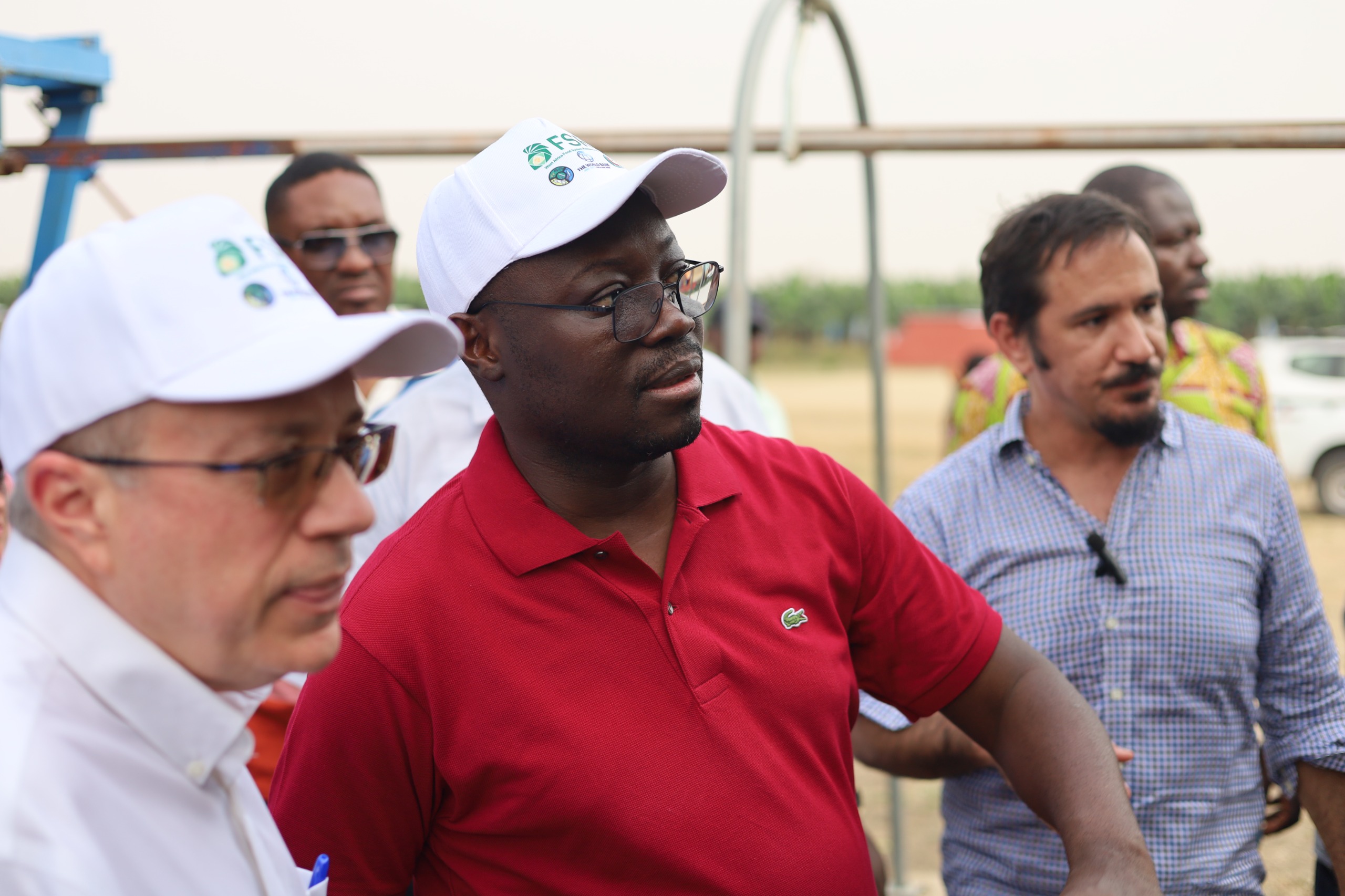
The Minister of Finance, Dr Cassiel Ato Forson, paid a working visit to the Kpong Irrigation Scheme (KIS) to assess the progress of ongoing rehabilitation and modernisation works.
The scheme, which serves farming communities around Akuse and Asutsuare in the Eastern and Greater Accra regions respectively, is currently being upgraded under the West Africa Food System Resilience Project (FSRP).
Dr Forson was accompanied by the World Bank Division Director for Ghana, Liberia and Sierra Leone, Mr Robert Taliercio O’Brien, underscoring the strong partnership between the Government of Ghana and the World Bank in advancing agricultural transformation.
Rehabilitation works and infrastructure upgrades
During the site tour, officials of the FSRP briefed the Finance Minister on the progress of works on both the Kpong Irrigation Scheme and the Kpong Left Bank Irrigation Scheme (KLBIS).
The rehabilitation programme includes the upgrading of irrigation and drainage infrastructure, the installation of automation equipment to improve water delivery, the establishment of enhanced management systems, as well as improvements to access roads within the enclave.
Boost to rice production and smallholder farmers
Dr Forson was also briefed on the expected impact of the completed expansion works on rice production and the livelihoods of smallholder farmers in the catchment area.
According to officials, about 2,000 farmers are expected to directly benefit from the project, which is designed to significantly improve productivity and reduce production costs.
The project is also expected to have positive spillover effects on aquaculture companies operating in the area, particularly those involved in the production of tilapia and catfish.
Private off-takers and path to rice self-sufficiency
FSRP officials disclosed that there are concrete plans to secure private off-takers for rice produced within the irrigation enclave to ensure ready markets and price stability for farmers.
They expressed confidence that once this model is fully developed and scaled, Ghana could attain rice self-sufficiency in the medium term.
Data-driven planning using geospatial mapping
According to Dr Ashwini Rekha Sebastian, Ghana and Regional Task Team Leader at the FSRP, efforts are underway to deploy geospatial mapping technology to accurately estimate and map rice production areas across the country.
Mr. Philip Daniel Laryea, FSRP Operations Manager further explained that if Ghana improves productivity on just 100,000 hectares of its estimated 400,000 hectares of rice-producing land, the country would achieve self-sufficiency in rice production.
Govt’s broader food self-sufficiency strategy
Dr Forson outlined government’s broader plans to ensure Ghana becomes fully self-sufficient in rice production, with the aim of ending the country’s heavy reliance on rice imports.
“If we begin the implementation of the compact, it won’t be too long; Ghana will become self-sufficient in the production of rice. We are equally targeting the production of maize and soy,” he stated.
He noted that maize and soy (2 of FSRP’s focus produce) are major staples in the country, making them critical targets for increased domestic production.
Soy production and poultry industry linkages
Beyond food security, the Finance Minister stressed that expanding soy production would help consolidate Ghana’s poultry industry, which relies heavily on soy-based feed.
Referencing the food shortages that accompanied the outbreak of the Russia-Ukraine conflict, Dr Forson observed that Ghana, with its vast arable land, abundant water resources and favourable climate, should not be unable to feed itself.
Agriculture as business, not just subsistence
Dr Forson emphasised that agriculture must be treated as business, noting that government’s focus is not only on feeding the population but also on building a sustainable economic solution.
He assured farmers, who had earlier raised concerns about lack of markets, that government has taken a policy decision to prioritise “made-in-Ghana” food for the School Feeding Programme (SFP) and to encourage other public institutions to procure locally produced food.
World Bank reaffirms support for agriculture infrastructure
On his part, Mr Robert Taliercio O’Brien noted that agriculture contributes about one-fifth of Ghana’s GDP and provides employment for over 30% of the population.
He said infrastructure—particularly irrigation and rural roads—remains a major constraint in the sector, adding that the World Bank is committed to supporting the Government of Ghana to address these challenges.
He disclosed that discussions are ongoing on how the Bank can further support economic crop production, irrigation schemes and rural road networks to accelerate Ghana’s agricultural transformation.
Tour of golden exotic and push for private investment
The Finance Minister later toured Golden Exotic Limited, a major beneficiary of the irrigation project, to familiarise himself with the company’s operations.
Speaking on the importance of such investments, Dr Forson stated that government alone cannot provide all the jobs needed, making it imperative to create an enabling environment to attract large-scale investors capable of generating employment and foreign exchange.
“Commercial farming holds the key to dealing with the unemployment situation we have, so whatever we have to do to facilitate that, we will do that,” he said.
He further stressed that government has a responsibility to support businesses of this nature to grow, expressing satisfaction with the positive impact of the irrigation project on Golden Exotic’s operations.
From SELORM GBORBIDZI, Asutsuare-ER