
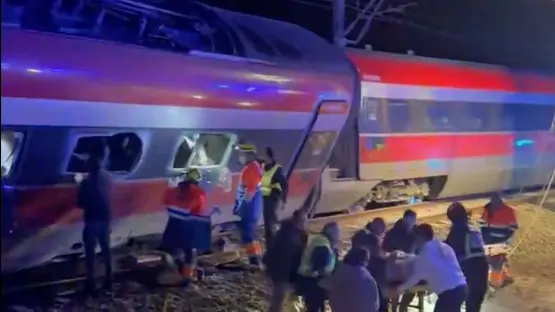
At least 39 people have died in a train collision in southern Spain and dozens more have been injured in the country’s worst rail crash in more than a decade, according to Spain’s Civil Guard.
Carriages on a Madrid-bound train derailed and crossed over to the opposite tracks, colliding with an oncoming train in Adamuz, near the city of Córdoba.
Four hundred passengers and staff were onboard both trains, the rail networks said. At least 73 people were taken to hospital – 24 of them seriously injured, including four children – according to Andalusia’s emergency services.
Spanish Transport Minister Óscar Puente described the incident as “extremely strange” as officials launched an investigation
All the railway experts consulted by the government “are extremely baffled by the accident”, Puente told reporters in Madrid.
Rail network operator Adif said the collision happened at 19:45 local time (18:45 GMT), about an hour after the train left Málaga heading to Madrid, when it derailed on a straight stretch of track.
The force of the crash pushed the carriages of the second train into an embankment, Puente said. He added that most of those killed and injured were in the front carriages of the second train, which was travelling from Madrid to Huelva.
The type of train involved in the crash was a Freccia 1000, which can reach top speeds of 400 km/h (250 mph), a spokesperson for the Italian rail company Ferrovie dello Stato told the Reuters news agency.
Rescue teams said the twisted wreckage of the trains made it difficult to recover people trapped inside the carriages.
Córdoba fire chief Francisco Carmona told Spanish public broadcaster RTVE: “We have even had to remove a dead person to be able to reach someone alive. It is hard, tricky work.”

Salvador Jimenez, a journalist with RTVE who was on one of the trains, said the impact felt like an “earthquake”.
“I was in the first carriage. There was a moment when it felt like an earthquake and the train had indeed derailed,” Jimenez said.
Footage from the scene appears to show some train carriages had tipped over on their sides. Rescue workers can be seen scaling the train to pull people out of the lopsided train doors and windows.
A Madrid-bound passenger, José, told public broadcaster Canal Sur: “There were people and screaming, calling for doctors.”

All rail services between Madrid and Andalusia were suspended following the accident and are expected to remain closed all day on Monday.
Iryo, a private rail company that operated the journey from Málaga, said around 300 passengers were on board the train that first derailed, while the other train – operated by the state-funded firm Renfe – had around 100 passengers.
The official cause is not yet known. An investigation is not expected to determine what happened for at least a month, according to the transport minister.
Spain’s Prime Minister, Pedro Sánchez, said the country will endure a “night of deep pain”.
The mayor of Adamuz, Rafael Moreno, was one of the first people on the scene of the accident, describing it as “a nightmare”.
King Felipe VI and Queen Letizia said they were following news of the disaster “with great concern”.
“We extend our most heartfelt condolences to the relatives and loved ones of the dead, as well as our love and wishes for a swift recovery to the injured,” the royal palace said on X.
The emergency agency in the region of Andalusia urged any crash survivors to contact their families or post on social media that they are alive.

Advanced medical posts were set up for impacted passengers to be treated for injuries and transferred to hospital. Adif said it set up spaces for relatives of the victims at Atocha, Seville, Córdoba, Málaga and Huelva stations.
The Spanish Red Cross has deployed emergency support services to the scene, while also offering counselling to families nearby.
Miguel Ángel Rodríguez from the Red Cross told RNE radio: “The families are going through a situation of great anxiety due to the lack of information. These are very distressing moments.”

French President Emmanuel Macron, Italian Prime Minister Giorgia Meloni and European Commission chief Ursula von der Leyen have published statements offering condolences.
“My thoughts are with the victims, their families and the entire Spanish people. France stands by your side,” Macron wrote on social media.
In 2013, Spain suffered its worst high-speed train derailment in Galicia, north-west Spain, which left 80 people dead and 140 others injured.
Spain’s high-speed rail network is the second largest in the world, behind China, connecting more than 50 cities across the country. Adif data shows the Spanish rail is more than 4,000km long (2,485 miles).
SOURCE: BBC NEWS

